Fertilizers, Chemicals, Agriculture, Energy Transition, Grains, Renewables
July 21, 2026
COMMODITY TRACKER: 4 charts to watch this week

By Staff
Editor:
Wheat prices in the Black Sea climbed amid conflict-related shipping concerns, while weaker economics pressured French LNG terminal utilization. Alumina markets eye tighter balances ahead, and Brazilian soybean exports climbed to their highest point since late 2023.
1. Black Sea wheat prices climb on escalating conflict
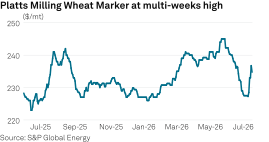
What's happening? Black Sea wheat prices increased over the week of July 13 following intensified Russia-Ukraine attacks since July 10, which targeted vessels loading at ports and export infrastructure. Platts wheat benchmark the Milling Wheat Marker rose 3% since July 10, reaching a three-week high as of July 20. Prices in Romania and Bulgaria jumped over 14% to their highest levels since June 2024. The price spread between the Constanta-Varna-Burgas market and Russian and Ukrainian wheat widened to $31-33/mt. Russian 12.5% and Ukrainian 11.5% wheat prices increased by 4% and 2.5%, respectively, reaching three- or four-week highs. Platts assessed the CIF East Mediterranean 12.5% price at $265/mt on July 20, up 7.7% from July 10 amid higher freight rates. Platts is part of S&P Global Energy.
What's next? Demand remains weak as buyers hold back, awaiting greater market clarity amid ongoing uncertainty. Some short-covering activity emerged, particularly in Romanian-Bulgarian wheat, to cover August tender positions. However, firm FOB bids are scarce, with Russian wheat FOB buyers bidding at $235/mt. In Egypt, one of the largest Black Sea wheat importers, buyers paused before entering the market, with CIF offers for 12.5% wheat quoted at $270/mt for August shipment. Market participants noted that Ukraine's military was planning to establish a special convoy to escort ships. Russia's Ministry of Agriculture stated the situation in the Sea of Azov would not affect food exports, with supply logistics to be reoriented if needed.
2. France's LNG terminal use drops on weak economics
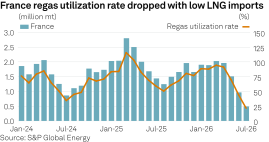
What's happening? France's LNG regasification terminal utilization fell sharply in July as weakening economics prompted slot cancellations. The combined regasification rate for all terminals reached 490,000 metric tons so far in July, or 23% of France's total regasification capacity, down from 970,000 mt, or 46% in June, and 1.51 million mt, or 71% in May, according to S&P Global Energy CERA data released July 16. Regasification at French terminals is currently out of the money, an Atlantic-based trader said. Platts assessed the delivered ex-ship Northwest Europe marker for September at $18.189/MMBtu July 16, at a discount of 22 cents/MMBtu to the September Title Transfer Facility hub futures price.
What's next? The unprofitable regasification in France suggests that most other European terminals are likely out of the money as well, except for Gate and Dunkirk, which are the most competitive facilities in Northwest Europe, the trader said. Imports were also pressured by a stronger eastward pull for LNG cargoes, as higher Japan-Korea Marker prices, driven by concerns over halted Qatari LNG exports, boosted the attractiveness of deliveries into Asia. As Asian buyers moved to backfill potential losses of Qatari supply, fewer spot cargoes were available for Europe. France has imported around 490,000 mt of LNG so far in July.
3. Pacific alumina market eyes tighter Q3 balance
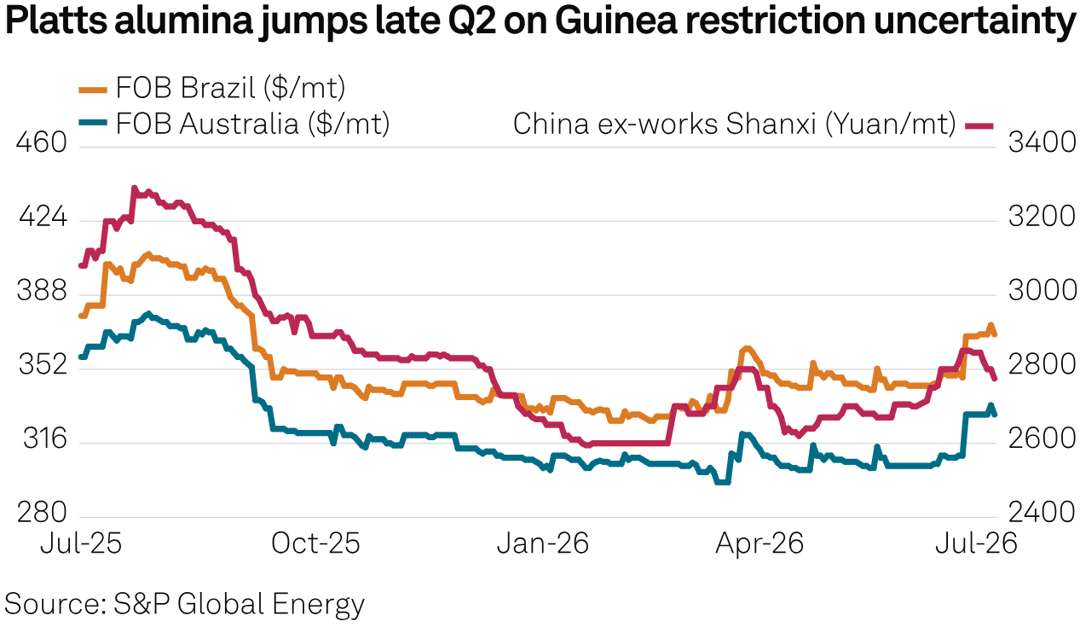
What's happening? The Pacific alumina market could see stronger support in the third quarter of 2026, as uncertainty over Guinea's export controls, rising Indonesian aluminum demand, and the gradual recovery of Middle Eastern smelting capacity begin to offset the second-quarter surplus. Platts assessed FOB Australia alumina at $330/mt on June 26, up 8.19% from $305/mt in early June. The assessment averaged $307.42/mt in the second quarter, up marginally from $306.91/mt in the first quarter. CIF China alumina averaged $340.74/mt in the second quarter, up 2.83% quarter over quarter.
What's next? CERA analysts forecast the global alumina market will remain in a 1.79 million mt surplus in 2026. Potential Guinea export restrictions or quota measures could raise feedstock costs for Chinese refiners, supporting alumina prices in the third quarter. However, China's elevated bauxite inventories are likely to cushion the initial impact, suggesting that any supply shock may take time to reach physical markets. Indonesian aluminum expansions remain the clearest source of incremental alumina demand, with CERA forecasting Indonesia's aluminum output could approach 1.2 million mt in 2026, about double 2025 levels. Recovery in Gulf Cooperation Council alumina demand is expected to be gradual. Third-quarter prices are likely to be driven more by policy developments and expectations for future demand growth than by immediate changes in supply-demand fundamentals.
Related content: METALS MONITOR: Critical mineral shortages persist despite new projects; US anthracite coal industry welcomes Section 232 probe
4. Brazilian soybean export prices reach higher level since late 2023
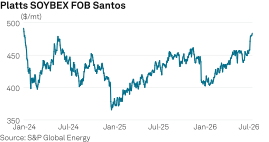
What's happening? Brazilian soybean export prices hit an over two-and-a-half-year high July 15, supported by gains in Chicago Board of Trade futures and firm overseas demand, which has kept port differentials firm despite a record domestic crop. Platts assessed SOYBEX FOB Santos for August loading at $483.66/mt July 15, the highest level for a spot shipment since Dec. 29, 2023. The Brazilian soybean assessment has risen nearly 20% so far in 2026. The gains have been partly driven by stronger CBOT soybean futures amid renewed optimism over Chinese purchases of US soybeans. US farmers are preparing to harvest the upcoming crop in the coming months, while adverse weather in early July -- including hot and dry conditions across parts of the US Midwest -- also supported Chicago benchmarks.
What's next? Brazilian soybean export premiums are expected to remain resilient despite the country harvesting a record 182 million mt of soybeans in the 2025-26 season, up more than 10 million mt from the previous cycle, according to CERA estimates. For July, Brazil is expected to export 13.76 million mt of soybeans, also a record for the month, according to the Brazilian Grain Exporters Association. The projected July volume would be up 15.2% year over year but largely unchanged month over month.
Reporting and analysis by Vivian Iroanya, Angeles Rodriguez, Clio Ho, Nick Tan, Louissa Liau and Jose Roberto Gomes.
