Natural Gas, LNG
July 17, 2026
French LNG imports, terminal utilization slide amid eastbound cargo pull
By Angeles Rodriguez and Clio Ho
Editor:
HIGHLIGHTS
French LNG terminal use drops to 23% in July
Regasification becomes unprofitable for buyers
Asian demand pulls cargoes away from Europe
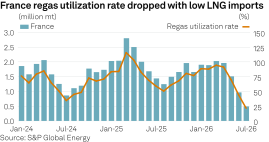
France's LNG regasification terminal utilization and imports fell sharply in July as weakening regasification economics prompted slot cancellations, while market participants said the current Northwest Europe LNG and gas spread was not in the money.
Utilization at France's four existing LNG regasification terminals has significantly reduced so far in July, data from S&P Global Energy CERA showed July 16.
The combined regasification rate for all terminals so far in July amounted to 490,000 metric tons, or 23% of France's total regasification capacity, down from 970,000 mt, or 46% in June, and 1.51 million mt, or 71% in May, according to CERA data.
Monthly utilization at the Dunkirk terminal in northern France stood at 37% as of July 16, down from 55% in June and 119% in May. The Fos Tonkin terminal recorded utilization of 34% so far this month, down from 68% in June and 66% in May. The neighboring Fos Cavaou saw its utilization rate fall to 16% this month, down from 18% in June and 71% in May.
Meanwhile, utilization at the Montoir-de-Bretagne facility on the Atlantic Coast dropped to 12% in July, down from 59% in June, but unchanged from May. France's total regasification capacity amounts to 2.11 million mt.
"The drop in utilization was due to LNG slot cancellations, which in turn reduced storage injections at the French terminals," an Atlantic-based trader said late July 16.
French terminals fall out of the money
"Regasification at those terminals is currently out of the money," the trader said.
This comes amid narrowing spreads between DES LNG and domestic gas hub prices in Europe.
Platts, part of S&P Global Energy, assessed the DES Northwest Europe marker for September at $18.189/MMBtu July 16, at a discount of 22 cents/MMBtu to the September TTF hub futures price.
The NWE-TTF spread averaged minus 22.5 cents/MMBtu so far in July, slightly wider than the average of minus 18 cents/MMBtu in June. However, the spread averaged around minus 91 cents/MMBtu from January to February, prior to the start of the war in the Middle East.
On the other hand, breakeven cost for most French regasification terminals are around 30-40 cents/MMBtu, except for Dunkirk, which is about 15 cents/MMBtu, the trader said.
That would result in a loss of over 10 cents/MMBtu for bringing LNG cargoes to French regasification terminals, making it unprofitable for LNG buyers.
The unprofitable regasification in France suggests that most other European terminals are likely out of the money as well, except for Gate and Dunkirk.
"Gate and Dunkirk are the most competitive facilities in Northwest Europe," the trader added.
Arbitrage opened to the East
Imports were also pressured by a stronger eastward pull for LNG cargoes.
Higher JKM prices, driven by concerns over halted Qatari LNG exports, boosted the attractiveness of deliveries into Asia. As Asian buyers moved to backfill potential losses of Qatari supply, fewer spot cargoes were available for Europe.
LNG imports to France averaged nearly 1.95 million mt from January to April this year. Imports then fell to 1.51 million mt in May, and to 970,000 mt in June. France has imported around 490,000 mt of LNG so far in July, CERA data showed July 16.
