Natural Gas, Crude Oil
July 02, 2026
Nigeria joins International Energy Agency as association country

Editor:
HIGHLIGHTS
First OPEC member to partner with IEA
Nigeria joins 13 other association countries
Focus on expanding African partnerships
The International Energy Agency has admitted Nigeria as its newest associate country, it said July 2, calling the move a step toward deepening its African ties and global energy governance.
"As Nigeria works to strengthen energy security, support economic growth and expand energy access, deeper cooperation with the IEA will bring important benefits for both sides," said a statement from the organization's executive Director, Fatih Birol.
Nigeria will be the IEA's 14th association country and the first OPEC member to partner with the organization. The oil producer's alliance has often clashed with the Paris-based IEA over its long-term oil outlook, which projects demand peaking by 2030 based on stated energy policies.
It will also be the IEA's sixth African association member alongside Egypt, Kenya, Morocco, South Africa and Senegal, and is the fastest ever accession process for any IEA applicant.
Initially founded as an organization of OECD countries in 1974, the IEA launched its Association country program in 2015 as a second-tier partnership to boost its global reach. The agency has 32 fully-fledged member countries, including the US, Australia, Japan, and most of the EU, which are expected to hold 90 days' worth of oil reserves and be able to contribute to stock releases.
By contrast, association countries, like India, typically have reserves well below the 90-day threshold. Association countries are not obliged to hold strategic reserves but have collaborated with the IEA on previous stock releases, subject to their specific circumstances, an IEA spokesperson told Platts, part of S&P Global.
Recent collective actions include a 400-million-barrel stock release in response to the Middle East conflict, as well as two in the aftermath of the Russia-Ukraine war.
Instead, association countries are expected to cooperate on data sharing and analysis, and work with the IEA on building emergency reserves and energy security strategy. In practice, however, the agency has still expressed challenges in accurately capturing energy data from certain association countries like China, which joined the program in 2015.
Nigerian energy role
The IEA statement highlighted Nigeria's growing role in global energy markets, which has recently transformed it from an upstream oil and gas producer into a major global refiner.
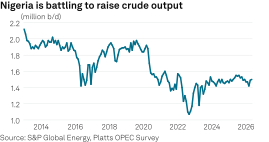
As Africa's largest oil producer, Nigeria has recently pumped 1.7 million barrels/day of crude, and currently produces roughly 7.5 billion cubic feet/day of natural gas, according to government estimates. Before the Middle East conflict erupted in late February, Nigeria was the seventh-largest producer in the OPEC+ alliance, according to the Platts OPEC+ Survey. It has since targeted 2 million b/d of oil output in 2026.
In the downstream oil market, the country's privately-owned Dangote refinery, launched in 2024, has the capacity to process some 700,000 b/d of crude. In April, the refinery emerged as the world's largest jet fuel exporter, and it has set a 2028 target to double its capacity.
"It is an honour for Nigeria to join this leading energy agency and I will take this opportunity to encourage the African continent to embrace the IEA, as we all work together to achieve key development goals," Ekperikpe Ekpo, the country's gas minister, said.
A recent IEA roundtable in Abuja on reducing methane emissions hinted at closer ties in the West African country, which first shared ambitions to join the organization back in May. The agency also noted progress in the country's rollout of decentralized solar solutions and focus on promoting clean cooking access.
According to the IEA, its expanding association program has seen its partners grow their share of global energy demand from 40% in 2015 to over 80% today. In early June, officials said that an historic 400 million barrel stock release was almost halfway complete, while EU officials have hinted that further stock releases could still be possible.
