Refined Products, Crude Oil, Diesel-Gasoil, Jet Fuel, Gasoline
May 28, 2026
INTERVIEW: Dangote CEO eyes heavier crude options, new era of trade maturity

Editor:
HIGHLIGHTS
Gasoline blending boosts capacity to 200%
Refinery was world’s largest jet fuel exporter in April
Focus on heavier crude and residue blends
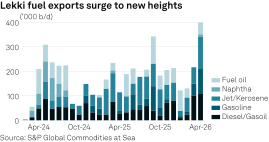
Nigeria's Dangote refinery hit full capacity at a critical moment. Within weeks of reaching 650,000 barrels/day in February, the African producer was shipping record quantities of diesel and jet fuel to countries cut off from Middle Eastern supply.
Sustaining current run rates demands another order of trading sophistication, testing the limits of Dangote's logistics, said David Bird, who left OQ8, owner of Oman's Duqm refinery, in 2025 to become the company's first CEO.
Bird has a three-year deadline to expand the Nigerian refinery to become the largest in the world. But first, cementing its role as a global heavyweight depends on feedstock diversification, securing offtake commitments and fixing supply chain bottlenecks, he told Platts in an interview at the refinery. Platts is part of S&P Global Energy.
"This is not a traditional refinery in an oil-producing country that just sits on the end of a crude pipeline and processes one crude," Bird said. "This is a fully merchant refining model that you could see in Europe or Asia."
Dangote transformed Nigeria's fuel sector when it launched in 2024, but its output was capped at around 450,000 b/d during a gradual ramp-up punctuated by repeated outages on its main gasoline-producing unit. Since reaching 650,000 b/d in February, the refinery has remained at close to full capacity.
After the Middle East war began, Dangote shifted to "max jet mode," and in April it became the world's single largest exporter of aviation fuel, according to S&P Global Commodities at Sea data. The refinery is also producing 200% of its gasoline potential by importing blending components like GTL naphtha and Bonny condensate, Bird said. As such, it can "comfortably" make 75 million liters/day (about 650,000 b/d), and could do 100 million l/d with better storage infrastructure, he added.
Other projects will further diversify the feedstock coming into Dangote. In addition to a new linear alkylbenzene plant and diesel hydrotreater, the company is planning to build a new 750,000 metric ton/year propane dehydrogenation plant, which will process imported LPG and convert it into polypropylene.
Diversification drive
The Dangote model was designed to process the light sweet crude native to OPEC member Nigeria, but has been challenged by what the refinery says is a lack of local supply and poor terminal reliability.
Dangote can now refine 40 different types of crude, but Bird would like to see the number get closer to the 130 used at Singapore's Pulau Bukom refinery, which he ran between 2012 and 2015, he said.
Dangote's $10 billion expansion project will make the refinery capable of processing 1.4 million b/d, equivalent to 90% of Nigeria's oil output, forcing it to seek new crude streams. It has so far relied on US WTI Midland crude to supplement local supply, but as it scales up, it can incorporate heavier grades and residues, Bird said.
"We will be in the crude blending game," he said. "So you can easily imagine at 1.4 million b/d we could process 30% Middle Eastern grades on each train."
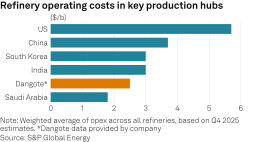
In an interview before the Middle East war began, founder Aliko Dangote said his business was eyeing crudes from countries like the UAE, and would consider Russian oil should sanctions be lifted. The refinery already has competitive operating costs of under $2.50/b, but the number could drop to $1.50/b post-expansion, he said. South American residues are also being considered, according to Bird.
In time, the company hopes to stimulate regional demand with low-cost fuel. It is finalizing approvals for a Namibian tank farm, which it plans to connect to Zambia by pipeline, and is also discussing a Djibouti oil link and storage in Cameroon, according to Bird and Devakumar Edwin, Dangote's vice president for oil and gas.
Push for term contracts
The refinery currently ships half of its production overseas and plans to export all additional product from its expansion to international markets, Edwin said in a separate interview at the site.
By design, the refinery lacks storage capacity.
"We normally try to avoid stocks in all of the businesses," Edwin said, explaining a wider Dangote Group ethos of forcing salespersons to move product.
However, limited tankage space leaves little margin for error for operators facing "a tsunami of product coming down the pipe every day" and unpredictable truck demand, Bird said.
Consequently, the business is deviating from its existing spot model, managed mostly by international trading companies, to pursue more long-term purchasing commitments from governments, distributors and national oil companies.
"We'll be making sure that we're not the supplier of last resort," Bird said. "We want to start building some of those direct offtake relationships."
Dangote has had an influx of requests from African countries and a recent deal with Ethiopian Airlines, Bird said. In contrast to its early years, the refinery is better positioned to offer competitive credit and payment terms, he added.
The company is also tailoring its port infrastructure to support smaller cargoes and reduce dependence on truck-outs. After hitting constraints with its single-point mooring system, it is developing a four-berth marine jetty to accommodate LR2-size ships and below, Bird said.
Design tweaks
The refinery expansion will involve "ruthless replication of the existing plant," Bird said, partly to cut engineering time. Nevertheless, the second train will likely involve different catalyst choices to meet winter fuel-grade specifications in the Northern Hemisphere, which incur a heavy yield penalty with the current configuration, he said.
The project is being supported by an IPO later this year, which Dangote hopes will value the business at $40 billion, Edwin said. The company will list 5%-10% of its shares on the Nigerian stock exchange and is considering others, including London and Dubai.
According to Bird, the refinery is on the cusp of transforming the Lekki free zone, where it is located, into an industrial hub that could resemble some of the largest in the Middle East. "It will be a very brave person that underestimates Alhaji Aliko Dangote," Bird said. "You come here in 10, 15 years, and this will look like Jebel Ali."
