Refined Products, Crude Oil, LPG, Gasoline
June 02, 2026
Oil demand shows first sign of contraction as emergency buffers fade: analysts

Editor:
HIGHLIGHTS
IEA hints at further demand revisions due to protracted conflict
Early resilience led by government support, stock releases
Chinese run cuts signal possible demand adjustment
The global oil market is showing its first signs of demand destruction due to the Middle East war, as the effects of panic-buying and stock releases have started to fade, analysts said at the S&P Global Middle East Petroleum & Gas Conference June 2.
The war has sent shockwaves through the oil market since February by shutting off some 14 million barrels/day of oil that once transited the Strait of Hormuz. Nevertheless, the Dated Brent crude benchmark has retreated 30% from its record high in April, and most major economies have so far avoided mass fuel shortages that would force demand lower.
More than three months into the war, however, new data is beginning to show "significant drop-offs" in demand across key consuming economies, which will only accelerate as the conflict persists, said Toril Bosoni, head of oil research at the International Energy Agency.
In May, the IEA slashed its global oil consumption forecasts to predict a 420,000 barrels/day annual contraction in global oil demand this year. Yet as the conflict has outlasted initial assumptions, the agency may be forced to further downgrade its outlook.
"Our scenario forecast assumes there will be some sort of normalization from June. That's looking unlikely," Bosoni said.
Early consumption losses have been led by falling jet fuel demand in the Middle East, coupled with declining petrochemical use and price-sensitive LPG consumption in India. In contrast, record inventory draws and government support have protected demand for products like gasoil and gasoline, which actually increased in Q1 relative to 2025 levels.
"We see demand come in waves," said Scott Nelson, head of trading at Indian refiner Reliance International, who warned that importers could come in "extremely prompt and urgently," despite an initial quiet period that has tempered price spikes.
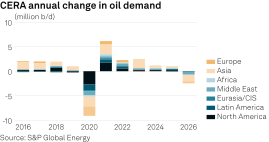
The longer prices stay elevated, the more governments will struggle to sustain costly support mechanisms, the panelists argued. Already, countries like Bangladesh, India and Malaysia have turned to demand-side levers to manage markets, implementing measures such as work-from-home policies and cooling restrictions.
"Pressure on budgets in places where governments directly or indirectly support product sales may mean prices are already at levels that have a negative impact on demand," said analysts from S&P Global Energy CERA in a May 28 report. CERA analysts now see a 2.4 million barrels/day annual demand contraction in 2026, more than five times the scale last projected by the IEA.
Also at the MPGC event, Bassam Fattouh, director of the Oxford Institute for Energy Studies, said that current demand adjustments remain well below the level needed to offset material supply losses from the Middle East. Yet optimism over a swift resolution to the conflict has muted necessary price signals to encourage steeper curbs on fuel use, he said.
"If you want to have a much stronger demand response, you need a higher oil price," he said, adding that speculation on an imminent peace deal was "not allowing the price to play its role".
Consumer heavyweights
The US, the largest oil-consuming country, is approaching record lows in its Strategic Petroleum Reserve, which is historically the world's largest inventory.
The country has emerged as a major supplier to regions such as Southeast Asia and Europe to replace lost Middle Eastern barrels, but faces growing strain on its domestic market as its peak summer driving season nears. As shortages become more apparent, it remains to be seen whether Washington implements some form of an export ban, Fattouh said.
China, the world's second-largest oil consumer, recently cut its crude imports by some 6 million b/d, the IEA estimates, leaving analysts perplexed over actual demand figures.
"To think that end-user demand is falling at these rates, it's very hard to believe," Bosoni said, adding that the agency had struggled to "make heads or tails" of the sudden drop-off in imports.
China was estimated to have stockpiled some 1.3 billion barrels of crude oil before the conflict began, but satellite data suggests limited draws, Bosoni said. Last year, the IEA estimated the country consumed some 17 million barrels/day, equating to about 16% of global oil demand.
S&P Global Energy CERA estimates that Chinese export bans have accounted for about 3 million barrels/day of crude import losses, with lower refinery runs mostly driven by tactical decision-making from state-owned refiners. Increasingly, however, lower crude intake is being driven by independent refiners responding to demand signals, with repercussions for the global market.
"This shift from preventive production cuts to loss-making production cuts directly impacts the demand for crude feedstock," CERA analysts Minmin Hu and Jing Ren said.
Platts, part of S&P Global Energy, assessed Dated Brent at $100.3/barrel on June 1, down from a record threshold of $144.4/barrel on April 7 and $71/barrel before the conflict.
