Refined Products, Crude Oil, Gasoline, Jet Fuel, Diesel-Gasoil
May 13, 2026
World oil market ‘severely undersupplied,’ to stay in deficit until Q4: IEA

Editor:
HIGHLIGHTS
IEA sees 420,000 b/d annual demand contraction
Oil supply on track to fall by 3.9 million b/d in 2026
Americas supply forecast increased by 600,000 b/d
The world is facing a massive 6 million b/d oil supply shortage that could keep markets tight well beyond 2026 even if the war in Iran is resolved swiftly, the International Energy Agency said May 13.
The Paris-based agency has overhauled its market outlook in light of the conflict, which it said has already created a cumulative supply loss of more than 1 billion barrels and could reduce global production by 3.9 million b/d across 2026.
On the demand side, the IEA now expects global oil demand to fall by 420,000 b/d to 104 million b/d over the full year, a decline more than five times the scale it projected last month. Before the conflict, it expected that annual demand would grow by 850,000 b/d.
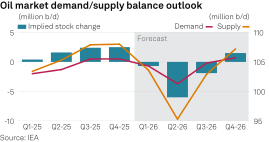
From a starting point projecting a major oil supply glut in the first half of the year, the IEA now sees a 1.8 million b/d production shortfall through 2026, and expects the market to remain in deficit until the final quarter of the year.
"The market will remain severely undersupplied through the end of Q3 2026, even assuming the conflict ends by early June," the IEA said in its closely watched monthly oil outlook. Should the disruption last longer, however, the cumulative supply deficit could feasibly double in some scenarios, the IEA said.
Analysts at S&P Global Energy CERA see the crude market in a 1.2 million b/d deficit through 2026, but expect a deeper demand loss of nearly 2 million b/d. The OPEC secretariat, which has maintained a more bullish consumption view, said in its latest forecast May 13 that global oil demand would grow a "healthy" 1.2 million b/d in 2026 and another 1.5 million b/d in 2027, citing the resilience of the world economy.
Demand toll
Early demand destruction has been partly offset by stock releases, panic-buying and government subsidies in many of the developing countries particularly exposed to price shocks.
However, as governments run out of options to cushion the impact of the crisis, global demand is now taking a bigger hit, the IEA said. In the second quarter, demand is now on track to fall by 2.45 million b/d from 2025 levels, with OECD countries accounting for 38% of the consumption loss, according to the agency.
Petrochemical feedstocks have so far seen the steepest contraction, accounting for roughly half of the 2026 demand downgrade. Consumption of jet fuel/kerosene has also been badly hit, and the full-year forecast was cut by 210,000 b/d from the prewar outlook, the IEA said.
In contrast, there has been a "relatively modest" impact on road fuels, although that could still deteriorate. In February and March, global gasoil and gasoline deliveries were 300,000 b/d higher than in 2025, the IEA reported, noting potential precautionary buying in markets such as the US and China.
However, such behavioral patterns can only provide short-term uplift. In the US, drivers now face gasoline prices roughly 40% higher than they were pre-war, while global oil inventories were depleted by 250 million barrels over March and April.
In the refining sector, crude processing is forecast to fall by 4.5 million b/d in Q2, transferring further tightness from the crude markets to fuel. Crude imports have been markedly lower in China, Japan, South Korea and India, signaling run cuts.
On a macroeconomic scale, slower growth risks dragging on consumer and industrial consumption, and potentially straining economies subsidizing imports. The IEA outlook now assumes global GDP growth of 2.9% in 2026, down from a previous forecast of 3.4%.
Supply levers
On the supply side, output fell by a further 1.8 million b/d in April, led by a 14.4 million b/d production loss from the Middle East Gulf. As a result, global output in Q2 is on track to fall below 100 million b/d for the first time in four years, the IEA said.
Using its East-West pipeline, Saudi Arabia increased its Red Sea loadings by 900,000 b/d to 5.3 million b/d in April, while higher pipeline deliveries boosted exports from the UAE's port of Fujairah by 430,000 b/d. To restore Gulf production more significantly, however, trade exports will need to first normalize for at least two to three months, the agency suggested.
Outside the Middle East, the US, Brazil, Canada, Kazakhstan, and Venezuela have all increased production, adding 3.5 million b/d to Atlantic Basin crude exports from February. The IEA duly upgraded its Americas supply forecast by 600,000 b/d from its pre-war estimate, and now sees some 1.5 million b/d of regional supply growth in 2026.
Russia also increased its crude exports in April by 250,000 b/d from the previous month, but the shift was partly driven by Ukrainian attacks on its refineries. Products exports were down by 340,000 b/d, falling to the lowest on IEA records.
In the longer run, rebuilding depleted oil inventories could require an extra 1 million b/d of supply growth for the next three years, the agency said. As of May 8, its member countries had released 164 million barrels of a planned 400 million barrel stock release, while the organization has said it could sanction more releases if needed.
Forecast uncertainty
With little clarity over the trajectory of the Middle East conflict, forecasters have struggled to make definitive projections on the state of the market.
Should a peace deal materialize, global demand could still swing back to growth towards the end of the year, while the level of infrastructure damage contributes to "significant uncertainty" around the new forecast, the IEA warned.
The IEA and OPEC, have diverged in their recent assessments of the market, with the oil exporting organization maintaining a more bullish view on demand.
OPEC announced a rare meeting between its Secretary General Haitham al-Ghais and IEA Executive Director Fatih Birol on May 12, which it said involved discussions on the global energy outlook and commitments to a stronger dialogue.
The IEA announced it will defer its annual long-term oil report, Oil 2026, which was due to cover the period out to 2031, from its scheduled release in June. It has yet to specify a new publication date.
