May 18, 2026
Rare earth trade detente could undermine Western investments: experts

Editor:
HIGHLIGHTS
China eases rare earth export restrictions
Non-Chinese material up to 10 times higher: association
The White House's claims of reaching an understanding with China to ease rare-earth export restrictions should be seen as political positioning rather than concrete trade commitments, industry experts told Platts, part of S&P Global Energy.
The White House said China would "address" US interest in importing rare earth minerals following a summit in Beijing between US President Donald Trump and Chinese President Xi Jinping on May 15, though China did not mention rare earths in its own summary.
However, should Beijing follow through on easing export controls after Xi and Trump meet in October, the move could threaten billions of dollars in US government funds invested in rare earth projects outside China, experts said. The potential easing of trade tensions with China could alleviate supply concerns, push down prices, and undermine billions of dollars invested in developing rare earth supply chains outside China, as Western projects struggle to compete with lower Chinese production costs.
"I think it is noise until we see concrete steps to a more secure supply chain," Ashley Zumwalt-Forbes, nonresident fellow at the Rice Center for Energy Studies, told Platts. "Realistically, I do not think the Western world or Western supply chains can ever go back to the 'status quo' as we know China can turn off the tap again at any juncture."
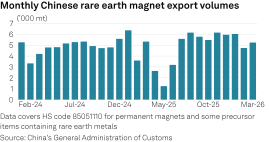
China's shipments of rare earth magnets fell 73.4% year over year in May 2025 to 1,239 metric tons, according to China's General Administration of Customs, after Beijing imposed export restrictions in retaliation for US tariffs on China. Exports have since rebounded to 5,238 mt as of March 2026; however, the risk of a new market disruption persists.
Market impact
China currently accounts for about 60% of global mine production of rare earth elements -- required to produce permanent magnets found in everything from consumer electronics and electric vehicles to airplanes and military defense systems -- and as much as 91% of global refining and processing capability, according to the International Energy Agency.
"A relaxation of export restrictions runs the risk of pushing prices down, which brings into question the economic viability of ex-China deposits and downstream supply chains," Chris Berry, founder and president at House Mountain Partners.
The US and allied nations have committed substantial resources to building alternative supply chains spanning mining to recycling operations. The US government has provided $1.4 billion to USA Rare Earth to develop the Round Top rare earthsdeposit in Texas and has taken a $400 million equity stake in MP Materials, which is constructing a heavy rare-earth separation unit at its Mountain Pass mining operations in California and a magnet production facility in Texas.
"Any resolution on export bans or an acceleration of export authorizations would undermine the economics of US projects," Nick Tricket, head of short-term analytics at CERA, told Platts. "However, it would not derail them, assuming price floors persist and compensation from the US government is provided to manage the higher costs of production or purchases."
Whether that support proves long-lasting to maintain the build-up of alternative supply chains in the face of potential easing of Chinese rare-earth exports remains uncertain.
Current market prices reflect ongoing supply disruptions, and buyersappear willing to pay morefor non-Chinese material, at least with the risk of export controls.Platts, part of S&P Global Energy, assessed dysprosium oxide price at $2,000/kg CIF North America in April, 10 times the average price in China in the same month, according to China's Rare Earth Industry Association, while the Platts-assessed terbium oxide price was at an average of $4,700/kg CIF North America in April, more than five times the China price of $896/kg.
"If China lifts REE export restrictions, the short-term implications would be a potential fall in the prices of REEs, a reduction in supply uncertainty, and the possibility that certain projects may become uneconomic," Greeshma Gadikota, professor of Climate Change at Lenfest Earth Institute in Columbia University, told Platts. "Investment in REE projects may slow down. However, if there is continued impetus from the US government to advance domestic supply chain resilience, then long-term investment in domestic REE mining projects will continue. Defense-linked supply chains will likely continue receiving support in the near term and the long term."
Industry experts warned that abandoning supply chain diversification efforts based on preliminary statements from the Trump-Xi meeting would be shortsighted.
"Taking this statement at face value without continuing to deploy capital into a separate, secure supply chain would be akin to sticking our head in the sand," Zumwalt-Forbes said.
