Metals & Mining, Non-Ferrous
April 01, 2026
RARE EARTHS SERIES: Govt policy, economic resilience drive growth of new mine-to-magnet supply chains

By Euan Sadden
Editor:
HIGHLIGHTS
China controls 90% of magnet output, prompting policy shift
DOD backs MP Materials, Lynas in US supply chain push
Rare earth elements have come under increasing focus owing to their criticality to defense equipment manufacturing and clean technology. China has monopolized this supply chain for over two decades and has not shied away from using it for geopolitical leverage, forcing others to think of a diversification strategy. This is Part 1 of a 5-part series in which Platts News explores the strategies under play and the challenges they face.
Rare earth elements, or REEs, are now indispensable to modern technology, driving advancements across the energy transition, electrification, automation and defense sectors. As global demand for these critical metals surges, their strategic importance—and the risks of supply concentration—have come into sharp focus. This overview explores the pivotal role of REEs in manufacturing, their diverse applications, and the evolving landscape of supply chain resilience shaped by government policy and private investment.
REEs comprise 17 metals, including the 15 lanthanides, plus scandium and yttrium. They are foundational to the world's most advanced and rapidly growing technologies, spanning energy, digitization, and aerospace. In manufacturing, REEs—particularly neodymium, praseodymium, dysprosium, and terbium—are essential for high-strength permanent magnets, enabling compact, energy-efficient electric motors and generators. These components are critical to electric vehicles, industrial robotics, and wind turbines.
Beyond manufacturing, REEs play a vital role in consumer electronics, such as smartphone vibration motors and display color phosphors. They are also integral to energy and environmental technologies, including catalysts, refining processes, and emerging clean-tech supply chains. Defense and aerospace systems rely on REE-based components for precision guidance, sensors, radar, and high-temperature alloys—making supply chain resilience a matter of national security.
Demand growth drivers
According to McKinsey, magnetic rare earths—neodymium, praseodymium, dysprosium, and terbium—account for roughly 30% of total rare earth volumes but over 80% of market value.
In a July 2025 report, McKinsey forecast that global demand for magnetic rare earths will triple from 59,000 metric tons in 2022 to 186,000 metric tons by 2035. This growth is driven primarily by automotive applications, projected to expand at a compound annual rate of about 10% between 2025 and 2035. Wind and machinery segments are expected to grow by 5%–6%, while appliances will see more modest growth of around 3% over the decade.
McKinsey senior partner Michel Van Hoey told Platts, part of S&P Global Energy, that most of this demand centers on dysprosium and terbium, which enable magnets to operate at higher temperatures—a key requirement for hybrid and electric vehicles. Accordingly, McKinsey projects demand for dysprosium and terbium, or DyTb, to grow at a CAGR of about 8.8%, outpacing the 6.1% CAGR forecast for neodymium and praseodymium, or NdPr, which remains the dominant magnet material.
Supply disruptions have prompted some automotive original equipment manufacturers, or OEMs, to explore alternative motor designs that use fewer or no rare earths. However, these alternatives often result in lower power density and increased reliance on other critical minerals such as copper.
Mine-to-magnet supply chain initiatives
McKinsey's findings reflect broader industry trends, with governments and OEMs actively seeking rare earth supply chains independent of China. China currently accounts for nearly 60% of global mining, over 85% of processing capacity, and more than 90% of permanent magnet production, according to the US Department of Commerce. This makes rare earths a strategic vulnerability for governments and industry alike.
In the US, policy has focused on permanent magnets and developing a secure "mine-to-magnet" supply chain, encompassing sourcing, separation, processing, metallization, alloying, and magnet manufacturing. The US Department of Defense, has been especially proactive, investing in established rare earth and magnet projects through its Manufacturing Capability Expansion and Investment Program.
In July 2025, MP Materials announced a multibillion-dollar public-private partnership with the DOD, including a $400 million preferred stock investment and a 10-year agreement granting the DOD rights to 100% of the permanent magnet output from MP's planned 10X facility.
Expected to begin commissioning in 2028, the plant will boost MP Materials' magnet capacity to around 10,000 metric tons per year, supplying defense applications such as drones, robotics, and advanced semiconductor fabrication.
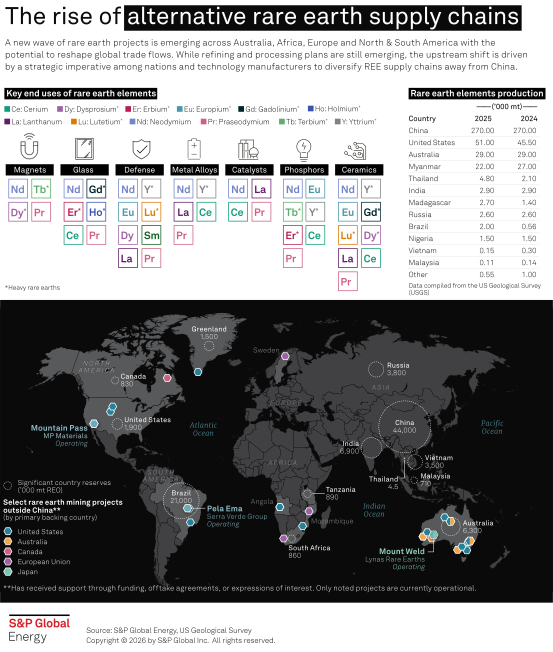
Australia's Lynas Rare Earths has strengthened its US presence through a binding letter of intent with the DOD, covering about $96 million in light and heavy rare earth oxide purchases over four years. Lynas also remains a key supplier to Japanese permanent magnet producers and recently extended its long-term offtake agreement with Japan Australia Rare Earth, or JARE, citing new Chinese restrictions on exports of "dual-use items," including REEs, to Japan.
Under the extension, Lynas will supply up to 7,200 mt/year of NdPr to Japan through 2038, and make 75% of its heavy rare earth oxide output available to Japanese customers.
In Brazil, Serra Verde secured $565 million in financing from the US International Development Finance Corp. to support operations at its Pela Ema deposit in Goiás, where commercial production began in early 2024.
With a product mix rich in dysprosium, terbium, and other heavy rare earths, Serra Verde aims to expand output from 5,000 to 6,500 mt/year of total rare earth oxide by end-2027.
New rare earth and permanent magnet projects are also attracting strong interest from US government agencies. In October, project developer Pensana received a letter of interest from the US Export-Import Bank for up to $160 million in debt funding to support the development of its Longonjo rare earth mine in Angola.
Production at Longonjo is scheduled to commence in early 2027, with an initial output of 20,000 mt/year of clean mixed rare earth carbonate. A planned second phase could double production to 40,000 mt, representing about 5% of current global rare earth material production.
"OEMs are looking for supply chain resilience—today that means non-China. They want certainty about supply chain provenance at all links, and once they have realigned from China, they want to be able to scale," Paul Atherley, Pensana chairman, told Platts.
Atherley's observations are echoed by REalloys CEO Lipi Sternheim, who told Platts that demand for rare earths and permanent magnets sourced outside China is accelerating, driven by government policies and supply-side constraints.
REalloys has received a letter of interest from the US EXIM Bank for a loan of up to $200 million to support the development of its integrated mine-to-magnet North American supply chain, comprising its Hoidas Lake rare earth asset in Saskatchewan and downstream magnet manufacturing operations in Euclid, Ohio.
"Over the next decade, we expect sustained growth in offtake interest from OEMs, Tier 1 suppliers, and government-linked buyers seeking secure, traceable, and geopolitically aligned supply chains," Sternheim said. "From our perspective, this demand is not cyclical—it is policy-driven and supply-constrained."
Platts launched four first-of-their-kind price assessments for rare earth elements, focusing on mine-to-industry alternative supply chains on March 31.
