Metals & Mining Theme, Non-Ferrous
January 27, 2026
Rare earth supply bottlenecks set to persist in 2026
By Kip Keen and Liubov Georges
HIGHLIGHTS
China's export curbs disrupt rare earth supply chains
Heavy rare earths face bottlenecks, high prices
Calls grow for non-Chinese rare earth pricing benchmarks
China's rare-earth export restrictions are set to drive supply chain disruptions and higher prices in 2026, especially for rare-earth materials used in high-performance technologies, according to industry participants and experts.
Rare earths became a linchpin in global trade in 2025 after China, a heavyweight in the sector, launched a strict licensing regime in April aimed at limiting exports for sectors that feed defense and other high-tech industries.
Beijing eased off some of the restrictions in July 2025 after US pushback. But in early 2026, China imposed tough new export controls targeting dual-use items — or products that the defense sector can also use — heading to Japan. The latest controls have put rare earths back in the spotlight and highlighted the metals' supply chains, which depend heavily on China for production, refining and manufacturing.
Industry participants flagged the trade measures targeting Japan as bound to have ripple effects on buyers that want to diversify supply chains away from China. Japan is one of the few countries outside China that produces rare-earth permanent magnets, experts said.
"If Japan is unable to import the necessary rare earth elements for magnet production, it will eventually affect all companies downstream in the global supply chain," a government official at Japan's embassy in Washington, DC, told Platts, part of S&P Global Energy. The official, who requested anonymity to speak on the matter, estimated Japan's global share of manufacturing advanced rare earth permanent magnets and alloys at about 15%, second only to China.
This could mean more supply bottlenecks emerge this year and next, industry participants told Platts.
"The real pinch point is processing, refining and qualification," Charles Altshuler, interim CEO and CFO of Globe Metals & Mining Ltd., an ASX-listed niobium-tantalum developer, told Platts. "For rare earths, that shows up most clearly in magnet materials and heavies used to maintain performance at high temperatures."
"Heavies" is an industry term that refers to heavy rare earth elements (HREE) such as terbium and dysprosium, which are key to high-performance permanent magnets. Less powerful permanent magnets, such as the ones used in refrigerators, do not depend on the materials. The light rare earth elements include neodymium and lanthanum.
China dominates production and processing of rare earths, accounting for 61% of global mined supply and 91% of global refining and processing capacity of key rare earths in 2024, according to the International Energy Agency.
Dual-use restrictions
At face value, China's export data suggests that rare earth supply chains have been operating as normal in recent months.
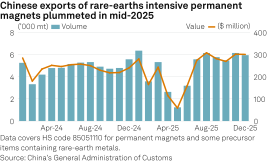
China's global exports of rare earth magnets rebounded to 5,952 metric tons in December 2025, according to Chinese customs data. Exports plunged 74.3% year over year to 1,239 mt in May 2025 in the immediate aftermath of US President Donald Trump's country-specific tariffs.
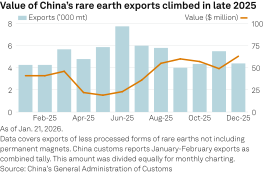
However, exports of smaller volumes of certain rare earth compounds and metals, particularly heavy rare earths used for magnets and other manufacturing, have slowed down.
China's global exports of less processed rare earths fell to 4,392 mt in December 2025, 15.8% below the 2025 monthly average of 5,215 mt. Meanwhile, experts flagged crucial, but small volumes of rare earth materials made from heavy rare earths like dysprosium as having dried up because of China's dual-use restrictions. These exports are not captured by the bigger volumes of less sensitive rare earth materials.
"The supply of certain export-controlled compounds and metals remains a concern as we enter 2026, as recent export data show volumes remain below historical levels and that exports are going to a more limited number of countries than before the April export controls," said Andrew David, senior vice president of research and analysis at the Silverado Policy Accelerator think tank.
Meanwhile, China's April 2025 restrictions on seven rare earth elements remain in place, alongside a dual-use licensing system that continues to constrain exports to the US and allied military end-users, experts said.
"The ex-China market will continue to face bottlenecks in the supply of HREE products over 2026 and 2027 as alternative suppliers of HREEs are constructed and commissioned," said David Merriman, a research director at the Project Blue metals consultancy.
"Key elements facing disruption are [yttrium, lutetium, terbium and dysprosium], flowing into the supply chains of magnet manufacturers, aerospace components, and electronics," Merriman said.
Experts said they expect the dual-use restriction to weigh on some rare earth supply chains for the foreseeable future.
"As long as China continues its saber-rattling regarding dual use and export restrictions, this will serve to impede trade flows and elevate prices," Chris Berry, an independent battery metals analyst and president of House Mountain Partners, told Platts.
China's dominance
China's control of rare earths will be difficult to break.
"China holds almost 100% competitive edge in medium and [HREE] refining due to cost factors," the government official at Japan's embassy in Washington, DC, told Platts.
The country's mined supply includes large ore deposits such as Bayan Obo, Huishan and Maoniuping. These types of assets help give China an edge.
Chinese refined rare earth compounds are five to six times cheaper than those currently produced in the West, according to Kazuto Suzuki, professor of science and technology policy at the University of Tokyo's Graduate School of Public Policy.
"Unless we find alternatives which are comparatively cheaper than the Chinese products, it will be very difficult to penetrate this market," Suzuki told Platts.
Premiums, benchmarks
China's export controls have driven up prices for relatively scarce supplies of some rare earths over the past year, and industry participants said they expect global premiums outside China to flourish in 2026.
"Pricing premiums are most evident where performance, qualification and continuity matter [for] magnet materials like [neodymium-praseodymium] and certain heavy rare earths, because buyers aren't just purchasing a chemical — they're buying assured supply over long time frames," Altshuler said. "I would expect those premiums to persist through 2026, and likely beyond, particularly while non-Chinese processing capacity remains constrained."
The high prices come against a backdrop of growing demand for some rare earths, which are crucial to magnets in things including robots, an area where many experts see growth on the horizon.
"As European nations rebuild their defense capabilities, the AI/data center thematic continues its enormous [capital expenditure] binge, and traditional demand drivers such as magnets and robotics continue their ascent, I can't see lower rare-earth pricing in 2026 or 2027," Berry said.
Experts highlighted HREEs such as yttrium, terbium and dysprosium as having the biggest premiums, reflecting demand outside China from defense and other sectors using high-performance rare earth materials.
"With limited alternative sources of HREEs in operation currently, and notable new capacity not scheduled to enter the supply chain until 2027, price premiums are expected to persist in the short term," Merriman told Platts.
The market split between Chinese producers and other global suppliers is driving support for more pricing benchmarks in Europe and North America. Experts told Platts that the benchmarks could reflect much different cost curves for materials made in China and outside China, as well as higher incentive prices needed to boost development of new rare earth projects, from mines to manufacturing facilities.
A new benchmark could be used as a reference price in contracts, risk management in a fragmented market, and as a policy mechanism for things such as price floors and strategic stockpiles, according to Cristiano Veloso, president, CEO and chairman of Verde AgriTech Ltd., a fertilizer producer that has targeted rare earth assets.
"They're critical," Veloso said.

Editor: