Metals & Mining, Ferrous, Non-Ferrous
April 17, 2026
TRADE REVIEW: Iran supply gap, freight woes to support Asian steel prices in Q2
Editor:
HIGHLIGHTS
Uncertainty lingers over Middle East war
China fills Iran's semi-finished supply gap
High electricity costs threaten scrap demand: market sources
This report is part of the S&P Global Energy's Metals Trade Review series, where we dig through datasets and digest some of the key trends in iron ore, metallurgical coal, copper, alumina, cobalt, lithium, nickel and steel and scrap. We also explore what the next few months could bring, from supply and demand shifts to new arbitrages, and to quality spread fluctuations.
Asian semi-finished steel prices are likely to remain elevated in the second quarter of 2026, as market participants expect the absence of Iranian supply to persist, while scrap prices could remain firm despite potential downward pressure from rising electricity rates.
Following the outbreak of the war in the Middle East, freight rates rose amid logistical disruptions, which supported steel prices. Moreover, freight volatility discouraged suppliers from offering aggressively, as they feared that freight increases could eat into their margins.
Iran exported 2.84 million metric tons of semi-finished steel products in 2025, with 70% of the volumes entering the Southeast Asian market, according to S&P Global Market Intelligence's Global Trade Analytics Suite.
The war, however, has halted Iran's export trade flows, with the disruption expected to last longer due to military strikes on Iran's two significant steel plants in March.
Market participants said steelmakers in Asia, especially those from China, could fill the supply gap left by Iran, while steel purchases from the Middle East have been put on hold due to uncertainties over disruptions in the Strait of Hormuz.
China actively exports slab; India focuses domestically
Chinese slab exports are expected to remain active in Q2, with firm demand and strong margins likely to continue.
Since the Middle East war broke out, Iranian slab offers have been absent from the market, leaving buyers in Southeast Asia to seek supply from alternative origins, such as China.
The number of deals, offers, bids and indications for Chinese slab heard in the Southeast Asian market rose to 28 in Q1 2026 from eight in the previous quarter, according to spot market data compiled by Platts, part of S&P Global Energy.
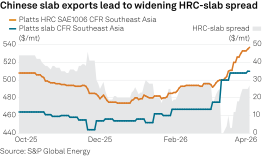
The spread between hot-rolled coil and slab on a CFR Southeast Asia basis also started to widen, with China becoming more active in offering slab and displacing Indonesia- and Vietnam-origin as the most price-competitive supplier, while Chinese-origin HRC was less favored due to antidumping duties.
Platts assessed HRC SAE1006 CFR Southeast Asia at $576/mt April 16, up $80/mt since the war broke out.
Demand for Chinese HRC was slow, with shipments to its two main destinations, the UAE and Saudi Arabia, at a halt, even though market participants believed they would resume once disruptions over the Strait of Hormuz ended.
Moreover, overseas buyers were unfazed by rising export prices and would find it hard to keep up with higher offers, which also accounted for higher freight costs, according to several China-based traders.
Indian mills, however, stepped back from the export market in late Q1 amid tight supply and competitive domestic prices. Elevated production costs, driven by rising fuel prices and gas-related production disruptions, kept the market tilted in favor of sellers.
Indian domestic HRC prices have risen 16.3% from the previous quarter to Rupees 58,500/metric ton ($622.08/mt) on March 31, according to Platts data.
Looking ahead, Indian trader sources expect supply tightness to persist into Q2, which would hold prices firm, along with import constraints due to safeguard measures. Hence, Indian cargoes might remain absent from the seaborne market, but this would depend on geopolitical developments in the Middle East.
China to take over Southeast Asian billet market
Asian billet prices are expected to remain firm in Q2 with limited alternatives to Chinese supply.
Countries that previously relied on Iranian billets, such as Thailand and Indonesia, had to turn to China for purchases.
Deals to Thailand on a CFR basis for 3sp 150 millimeters billets rose from $455/mt in mid-February to $485/mt in late March, according to Platts spot data.
Meanwhile, Indonesia and Vietnam, the other two major suppliers in Southeast Asia, have withdrawn from the export market amid robust domestic demand.
Domestically, Indonesian billet sales were made at $30/mt higher than China's export price, while Vietnamese prices were even higher on the back of strong infrastructure demand, according to regional market sources.
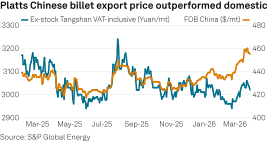
The increase in Chinese billet export prices outpaced that of domestic prices. Since the war, domestic billet prices rose 2% from Feb. 27 to Yuan 3,030/mt ($443.90/mt) March 31, while export prices over the same period increased 4.3% to $458/mt, according to Platts data.
Beyond geopolitical uncertainty, China's domestic market will be another key factor to monitor in Q2.
"We think that weak fundamentals will cap the ability of prices to rise much higher," said Paul Bartholomew, associate director of metals and mining analytics at S&P Global Energy CERA. "Soft domestic steel consumption, low domestic prices and robust crude steel production mean the export market will remain a vital outlet for Chinese steel."
Asian scrap outlook hinges on Middle East
Asian scrap prices are expected to remain strong in Q2, though market participants noted that an energy crisis and rising energy costs resulting from an escalation of the war could eat into scrap demand.
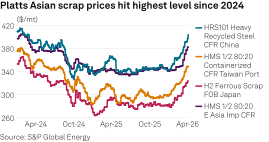
Rising freight rates, coupled with difficulties securing ships, have contributed to higher scrap prices and limited supply. The easing of the situation may depend on the end of the war in the Middle East, market participants in Asia said.
However, market participants noted that if the war in the Middle East continued to drive up energy prices, higher electricity costs would weigh on scrap demand for electric-arc-furnace-based mills.
A Taiwan-based trader said, "Higher electricity rates and natural gas shortages would force Taiwanese mills to switch over to purchase more billet instead of scrap."
