Metals & Mining, Non-Ferrous
April 15, 2026
Drones emerge as the fastest-growing REE demand segment

Editor:
HIGHLIGHTS
Drones drive fastest REE demand growth
Sector consumes 3,000-8,000 tons in 2025
Supply chains face magnet shortage stress
Drone manufacturing is the fastest-growing demand segment for certain rare earths as conflicts in Ukraine and the Middle East drive an unprecedented need for military-grade high-performance permanent magnets, according to industry CEOs recently interviewed by Platts.
However, drones use specialized magnets made from rare earths caught in supply chain bottlenecks strained by China's export controls and surging demand from competing industries, including electric vehicles and advanced manufacturing.
"Even though drones are not the largest end market by tonnage, they are one of the fastest-growing and most strategically important because they rely on compact, high-power-density systems where rare earth magnets are essential," Lipi Sternheim, CEO of Realloys, a manufacturer of rare-earth metals and magnets, told Platts, part of S&P Global Energy.
The drone sector consumed between 3,000 and 8,000 metric tons of rare-earth permanent magnets in 2025, about 3% of total rare-earth demand,according to data from Rare Earth Exchanges, a market intelligence platform.
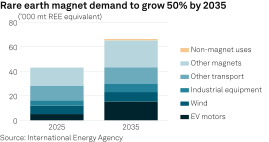
Rare-earth elements, including neodymium, dysprosium, and terbium, are essential for creating the high-performance, lightweight, and heat-resistant permanent magnets used in drone motors, enabling extended flight times and operation in extreme conditions.
"The key thing about the drone magnets is that they rely on high-grade, high-performance magnets, and that market is very supply sensitive," Robert Garbett, founderand chief executive of Drone Major,aconsultant specializing in drones, told Platts.
Supply chain stress
China overwhelmingly dominates the rare-earth supply chain, controlling approximately 60% of mining, 91% of refining, and 94% of permanent magnet production, according to the International Energy Agency.
On Oct. 9, 2025, China expanded its stringent export controls on rare earths and rare earth permanent magnets, causing exports to plummet, but later on Oct. 26, announced a one-year pause in a trade standoff with the US. Chinese permanent magnet shipments rebounded sharply to 5,952 mt in December 2025 from a low of 1,239 mt in May of that year, according to Chinese government trade data.
However, exports of certain upstream heavy rare-earth oxides and metal alloys used in magnet manufacturing have not recovered at the same pace, creating bottlenecks for Western manufacturers seeking to establish independent supply chains. China's global exports of less processed rare earths fell to 4,392 mt in December 2025, 15.8% below the 2025 monthly average of 5,215 mt, China's export data showed.
While the US and other countries invest to expand rare earth production outside China, they will need years to bring projects to fruition. In the meantime, downstream magnet makers are looking to secure rare-earth supplies for future drone production, rare-earth industry players told Platts.
Supply chain stress is expected to intensify as several major drone manufacturers scale up operations in early 2026. Anduril Industries opened its "Arsenal-1" plant in Ohio in March for drone production, while drone-maker Swarm Aero started operations at a new 80,000-square-foot facility in Arkansas on Feb. 18.
The US Army's "SkyFoundry" program plans to acquire and field at least 1 million drones over the next 2-3 years, according to a Military Times Nov. 7, 2025 report citing US Army Secretary Dan Driscoll.
The program aims to manufacture more than 10,000 small unmanned aerial systems per month by late 2026.
"In the next 6 to 12 months, the biggest challenge we are going to have is to secure the supply chains for the permanent magnets to scale up the drone industry in the West," Garbett told Platts.
The procurement surge reflects broader defense spending increases as military strategists recognize drones' battlefield importance.
"Defense spending is a major catalyst. As governments scale procurement of drones and autonomous systems, demand for magnet rare earths increases in parallel," Sternheim said.
