Metals & Mining Theme, Non-Ferrous
February 19, 2026
Robot rise could be slowed by metals shortage: analysts

HIGHLIGHTS
Massive demand spike expected for copper, lithium, rare earths
Industry seeks solutions like substitutes, new technologies
The rapid commercialization of humanoid robots will require unprecedented growth in the production of battery metals and rare earth magnets, with industry analysts warning that supply constraints could delay mass deployment beyond manufacturers' timelines.
AI-powered robots capable of mimicking human behavior and interactions are rapidly advancing from pilot programs to full-scale commercial production.
Tesla Inc. CEO Elon Musk has said the Texas-based company plans to start selling humanoid robots to the public in 2027, eventually targeting annual production of 1 million units. China-based manufacturers, including Hangzhou Yushu Technology Co. Ltd. -- also known as Unitree Robotics -- and Fourier Intelligence International Pte. Ltd. are also advancing commercial robot offerings.
However, this rapid scaling faces a critical bottleneck in securing adequate supplies of battery metals and neodymium-iron-boron, or NdFeB, magnets essential for robot functionality, industry participants told Platts, part of S&P Global Energy.
"Producing and deploying 10 billion robots by 2040, as Musk has famously projected, would require global production of critical inputs like copper, lithium, and rare earth magnets to increase by multiples — just for robots alone," Ryan Castilloux, managing director of Adamas Intelligence, told Platts.
Adamas Intelligence is a market research and advisory firm covering rare earths and battery metals.
"For NdFeB magnets, it would necessitate more than 100 times current global production; for lithium, that figure is more than 10 times," Castilloux said. "In the case of copper, 10 billion humanoid robots could consume the equivalent of four times current global production."
Even less ambitious forecasts expect a substantial ramp-up in robots. Citi Global Perspectives and Solutions has projected that 1.3 billion AI robots will be operational by 2035, increasing to 4 billion by 2050. Other financial institutions have also been more conservative, including Morgan Stanley, which estimated that more than 1 billion units will be deployed by mid-century.
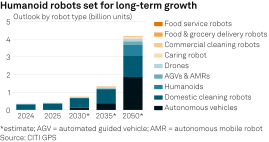
Permanent magnets provide the magnetic strength and temperature stability required for precise robotic movement and control systems. The same materials face competing demand from sectors, including electric vehicles, wind turbines, consumer electronics and defense contractors, creating supply chain interdependencies.
Worldwide production of copper, lithium, nickel, and cobalt -- all critical materials used in humanoid robots -- amounted to less than 30 million metric tons in 2024, according to S&P Global Market Intelligence data.
Supply bottlenecks for robot rollout
The commercial deployment of humanoid robots could face significant delays in the 2030s as mining capacity for critical raw materials does not keep pace with projected demand.
Current output levels for rare earths, copper, nickel and lithium are insufficient to meet expected demand for robotics, particularly when competing uses in batteries and technology infrastructure are factored in, according to Chris Berry, founder and president of the House Mountain Partners advisory firm.
The supply chain pressures mirror challenges facing the electric vehicle sector, where automakers have sought to diversify sourcing of battery metals such as lithium, cobalt and nickel. Robots must also compete for metals with global electrification efforts. Supplies of lithium and nickel have become abundant, and prices have fallen, but copper is expected to be in short supply.
Without a meaningful supply expansion, the copper market is estimated to fall into a 10 million mt shortfall by 2040, potentially creating a "systematic risk" for global industries, according to a recent study by S&P Global Energy and S&P Global Market Intelligence. The same study found that having 10 billion humanoid robots in operation by 2040 would require another 16.5 million mt of copper, further widening the projected supply gap.
Humanoid robots will place particular strain on rare earth supply chains. The robots require multiple motors per unit -- potentially 30 or more, depending on the design -- each using rare earth magnets that offer higher power density than alternative motor technologies.
A price surge for neodymium-praseodymium, or NdPr, oxides indicates end users are likely starting to prepare for production ramp-ups.
"The fact that NdPr oxide currently trades for over $120,000 per kg when it was at roughly $60,000 per kg last July is a sign that end users are aggressively looking for this feedstock," Berry said.
Industry seeks solutions
Governments are pushing miners to fill the projected supply gaps.
US President Donald Trump enacted several policies to boost the production of rare earths and critical minerals, and some companies have started to respond with new projects. That includes MP Materials Corp.'s expansion of the Mountain Pass operations in California and a magnet manufacturing facility built by Vulcan Elements Inc. in North Carolina.
Some companies are looking for rare earths in old coal mines, such as Ramaco Resources Inc. The Kentucky-based company is developing the Brook mine in Wyoming with a pilot plant to process rare earth oxides, alongside coal output.
"Supply is a structural concern in the 2030s, but the amount of capital now available and the expansion of state interventions to procure these inputs are ultimately favorable for a stronger supply response," Nick Trickett, an associate research director at S&P Global Sustainable1, said.
Although there is enough certainty in the material reserves to handle strong forecast demand from robotics, it would take years before new sources of minerals come online.
Globally, mines that came into operation between 2020 and 2024 had an average lead time of 17.9 years, according to a 2024 research report by S&P Global Energy.
The anticipated supply constraints are pushing the industry toward two potential solutions: substitute materials that may be more readily available, or developing new batteries, magnets and actuators that either eliminate certain raw materials or reduce usage, Berry said.
Japan-based magnet manufacturers, including Proterial Ltd. and Aichi Steel Corp., are developing and commercializing permanent magnets free of rare earths.
"I would think that Tesla, their Chinese competitors, and the rest of the supply chain are well aware of raw material constraints and are either stockpiling magnets or looking to build and invest in supply chains that minimize the use of rare earths," Berry said.

Editor: