Crude Oil
June 08, 2026
Hormuz disruption drives Americas crude exports to all-time high in May

By Binish Azhar
Editor:
HIGHLIGHTS
US crude exports hit record 5.6 mil b/d in May
Medium, heavy crude exports surge
Freight rates level off as fewer vessels stuck at Hormuz
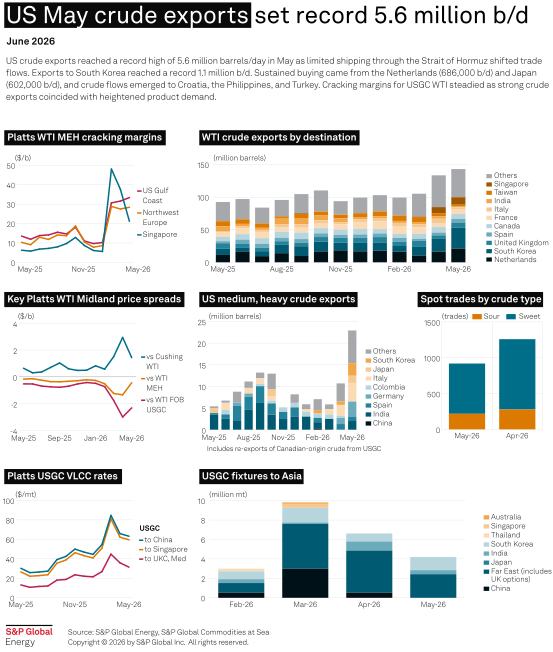
US crude oil exports surged to a record 5.6 million b/d in May, as Strait of Hormuz disruptions forced global buyers to seek alternative supply sources, S&P Global Commodities at Sea data showed.
The sharp decline in Middle Eastern crude availability pushed buyers toward US Gulf Coast suppliers, with South Korea emerging as the largest single destination at a record 1.1 million b/d in May.
European buyers also stepped up purchases, with the Netherlands taking 686,000 b/d and new flows emerging to several markets, including Croatia, the Philippines and Turkey.
US exports to Japan were steady at 602,000 b/d in May.
The bulk of US crude exports -- 4.9 million b/d -- was light, sweet crude.
Medium and heavy crude exports from the US climbed to a record high in May, with 3.5 million barrels sent to Germany and 4.3 million barrels to Italy. The US exported 3 million barrels of medium and heavy crude to South Korea and 1.7 million barrels to Japan.
Americas crude replaces Persian Gulf barrels
The surge in US exports was part of a larger regional trend. Dirty tanker shipments from the Americas hit an all-time high of 14.5 million b/d in May, up from 13.8 million b/d in April, a 40% increase from May 2025, according to shipping association BIMCO.
The surge came as transits through the Strait of Hormuz plummeted 89% from February to May, with total ship movements dropping from over 3,700 to around 400, according to CAS data.
"With a 32% year-on-year increase and a 30% rise compared to January-February, US exports have been the main driver of the boost from the Americas during March-May," said Niels Rasmussen, chief shipping analyst at BIMCO, in a report.
Asia accounted for nearly 50% of the year-over-year volume increase during March-May, with flows to Asia growing from 4.1 million b/d in the same period in 2025 to 5.4 million b/d in 2026, BIMCO said.
Latest Platts fixtures data shows a decline in May shipments to Asia after a surge in March and April. May fixtures from the US to Asia fell to 4.1 million mt, compared to 6.6 million mt in April and a record 9.8 million mt in March.
The Americas region accounted for 91% of the global increase in dirty tanker exports from countries outside the Persian Gulf during the March-May period, with exports rising 23% year over year during the three months since the Iran War began, according to BIMCO.
Increased US shale oil production, the relaxation of sanctions on Venezuelan crude, production from new floating production storage and offloading vessels in Brazil, and the startup of Guyana's Yellowtail field in August 2025, all contributed to the historic export levels, the analysts said.
Freight rates stabilize
Freight rates have stabilized across vessel classes since reaching all-time highs at the start of the US-Israel conflict with Iran, when vessels became stuck attempting to pass through the strait, constraining tonnage availability.
With fewer ships now caught up at Hormuz, tonnage availability has improved at key loading points, including the US Gulf Coast, allowing freight rates to level off despite record export volumes.
VLCC transits through the strait collapsed from 384 in February to just 22 in May, while product tanker movements fell from around 760 to 39 over the same period, CAS data shows.
"A continuation of strong Americas export volumes can help soften the global oil supply shortfall as long as the Strait of Hormuz remains effectively closed," Rasmussen said. "Once Persian Gulf exports can return to normal, the strong Americas volumes may be enough to accommodate both an increase in global oil demand and the needed rebuilding of global oil inventories."
Cracking margins for USGC WTI strengthened to $33.38/b in May from $31.54/b in April and $30.64/b in March, as strong crude exports coincided with heightened product demand.
However, cracking margins for WTI into Singapore averaged $21.18/b in May, down from $37.57/b in April and a record $48/b in March.
