Crude Oil
May 28, 2026
South Korea eases refiners’ crude stockpiling mandate under IEA plan
HIGHLIGHTS
Seoul directs private sector to cut reserves to 20 days
Move releases 12 million barrels under IEA plan
State oil stockpiles remain untouched
South Korea has decided to ease crude oil stockpiling requirements for local refiners, a move that will effectively release 12 million barrels into the market as Seoul carries out its oil release pledge under a joint emergency plan adopted by members of the International Energy Agency, the trade ministry said May 28.
Starting May 29, South Korean refiners will be required to maintain mandatory oil reserves equivalent to 20 days of average domestic sales, down from the current 40 days, Yang Ghi-wuk, deputy minister for trade, industry and resources security, said at a press briefing.
The measure is intended to ensure the "faithful" implementation of South Korea's pledge to release a record 22.46 million barrels of oil from its strategic reserves, in line with an IEA member-country agreement for an emergency release of 400 million barrels, according to Yang.
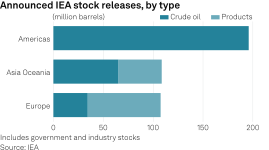
Yang said the IEA recognizes the easing of private oil stockpiling requirements — which allows refining companies to release supplies into the market — as part of a strategic oil stock release. Under that interpretation, the government plans to report to the IEA a strategic oil release of around 12 million barrels through the reduction in private stockholding obligations alone.
"Lowering the private stockpiling obligation allows for oil refiners to manage their inventory in a smooth manner, and there will be no major impact as private refiners already hold sufficient inventory levels," Yang said.
He added that South Korea's four major refiners are currently holding 90 million barrels in commercial stockpiles, suggesting the change will not materially undermine supply security.
State reserves untouched
Despite the formal release commitment, the government signaled it does not intend to rush additional barrels out of state-controlled reserves.
"The government would release the state-run strategic oil reserves in possibly unavoidable circumstances," Yang said.
Among IEA members, South Korea -- Asia''s third-biggest crude buyer -- holds the fifth-largest oil reserves, according to the latest IEA data published on May. 13.

That stance reflects Seoul's preference to first use flexibility within its broader stockpiling system, which combines state-run strategic inventories with mandatory private holdings by refiners. For a country that depends heavily on imported crude, particularly Middle Eastern grades, that dual structure has long been a key part of its energy security framework.
Crude swap scheme
Yang said there is currently a limited immediate need to draw further on state reserves because refiners are already receiving supplies through a separate crude oil swap arrangement introduced earlier this year.
South Korea has operated a "crude oil swap system" since March 31, under which the government lends heavy sour crude from state-run strategic reserves to local refiners in exchange for future deliveries of alternative supplies. The program was designed to help ease supply disruptions from the Middle East.
So far, a total of 15 million barrels has been delivered to refiners under the swap scheme, Yang said.
Under the formula, refiners are allowed to borrow part of the country's strategic crude reserves — mostly Middle Eastern grades — for immediate processing, and then return the same volume once cargoes secured abroad arrive, Platts reported previously.
"A total of 15 million barrels have been so far delivered to refiners under the crude oil swap scheme, so there is no major demand for the state-run oil reserves at the moment," Yang said.
Supply outlook remains stable
Yang also pushed back against concerns over an imminent crude supply shortage, saying South Korea has secured about 85% of pre-Iran war oil supplies for use throughout July.
The comment underscores the government's view that, despite ongoing geopolitical disruption, the country's near-term import position remains manageable. It also helps explain why Seoul is counting first on lower private stockpiling requirements and the crude swap program, rather than a broader immediate release of state-held barrels, feedstock managers at two major refiners based in Ulsan and Yeosu told Platts May 29.
In recent weeks, coordination between South Korea's government and private refiners has helped stabilize Middle Eastern crude inflows at a time of elevated regional risk, limiting pressure on refinery feedstock planning and domestic inventory management, feedstock managers at two major refiners based in Ulsan and Seosan told Platts, part of S&P Global Energy, over May 28-29.
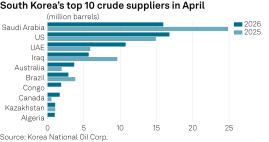
The recent arrival of multiple VLCC cargoes of Saudi Arab Light via the Red Sea has been particularly important for the market, as the grade remains a key part of the feedstock slate for South Korea's refining system.
