Crude Oil, Refined Products, Gasoline, Jet Fuel, Naphtha
April 08, 2026
South Korean govt secures 110 mil barrels of crude for April, May amid Hormuz disruptions
HIGHLIGHTS
Seoul secures 50 mil barrels for April, 60 mil for May
Alternative crude covers 60%-70% of monthly imports
Refiners meet Asia fuel supply commitments
The South Korean government has secured 110 million barrels of alternative crude oil supplies for the next two months, sourced from 17 countries, to offset losses from the Middle East and help major local refiners maintain steady fuel production for both domestic and international consumers, the Ministry of Trade, Industry and Resources said April 7.
The government secured spot purchase deals for 50 million barrels of crude for April and 60 million barrels for May, to be shipped via alternative routes avoiding the Strait of Hormuz, MOTIR's Deputy Minister Yang Ghi-wuk said during a press briefing attended by Platts, part of S&P Global Energy.
The shipments are sourced from 17 countries worldwide, spanning Africa to the Americas, Yang said during his press briefing. "These include Congo, Gabon, Canada, Australia, Brazil and the US, as well as Saudi Arabia's Yanbu terminal and the UAE's Fujairah port," Yang added.
MOTIR did not specify which crude grades the government purchased. However, local refiners are already familiar with Brazil's Tupi and Buzios, Canada's Cold Lake, Congo's Djeno, Australia's North West Shelf and Ichthys condensate and US WTI Midland and Mars Blend, traders at two South Korean refiners' Singapore trading offices and a feedstock manager at a Seosan-based refiner told Platts on April 8.
"The volume of 110 million barrels [arriving] over the next two months accounts for 60%-70% of South Korea's monthly crude imports, which average about 80 million barrels/month," Yang said.
South Korea -- Asia's third-largest crude buyer and the world's fourth-largest crude importer -- has not received any cargoes from the Middle East since March 20, according to MOTIR's briefing report.
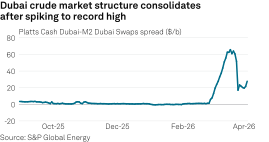
Disruptions in tanker arrivals from the Persian Gulf have continued to keep the Middle Eastern crude benchmark Dubai price structure elevated, with Platts assessing the spread between cash Dubai and the same-month Dubai swap at a record-high monthly average of $37.66/b in March. The spread was last assessed at $27.68/b on April 6.
However, some light and medium sour crude cargoes loaded from Fujairah and Yanbu terminals are expected to arrive during the week of April 19, feedstock managers at two major local refiners, including S-Oil, told Platts during market discussions over April 6-8.
South Korea received 124.28 million barrels from the Middle East over January-February, accounting for 70% of its total crude imports of 177.31 million barrels during the period, the latest data from Korea National Oil Corp. released March 27 showed.
Refinery operation, fuel output
Major South Korean private-sector refiners said the government's rigorous efforts to secure crucial crude feedstock are extremely helpful, especially as the country's refining industry not only supplies fuel for domestic consumers but also serves customers across Asia, Oceania and the US West Coast, who rely heavily on South Korea's term supplies of gasoil/diesel, gasoline and jet fuel, product marketing managers at three refiners based in Ulsan and Yeosu told Platts.
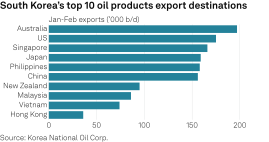
South Korea is Asia's largest supplier of clean oil products, and its refining industry plays a significant role in the regional market, the product managers said.
"The government's April and May feedstock procurement support will help refiners meet second-quarter term middle distillates supply obligations for Asia-Pacific customers," a product sales manager at a major refiner in Ulsan said.
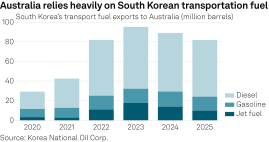
South Korea exported a combined 72.47 million barrels of gasoline, diesel and jet fuel over January-February, up 14.9% from 63.08 million barrels during the same period a year earlier, KNOC data showed.
Govt's trading support
To further secure alternative crude oil supplies, President Lee Jae-myung dispatched his chief of staff as a special presidential envoy for strategic economic cooperation, tasked with negotiating oil supplies from Kazakhstan, Oman and Saudi Arabia, the government said in its official policy briefing report April 8.
Just before his departure on April 7, Presidential Chief of Staff Kang Hoon-sik said in a briefing that the government is making every effort to secure alternative sources, such as crude oil and naphtha, until the Middle East conflict is fully resolved.
Kang pledged to work closely with local oil refiners and petrochemical companies to ensure that high-level consultations with oil suppliers produce tangible results.
On March 18, Kang, returning from a visit to Abu Dhabi as a special presidential envoy, announced that South Korea had secured an emergency supply of 24 million barrels of crude oil from the UAE, with shipments already en route to the country.
Kang also highlighted that the government is taking measures to ensure the safe passage of 26 South Korean-related ships currently stranded in the Strait of Hormuz, including seven oil tankers.
