Agriculture, Refined Products, Energy Transition, Biofuels, Jet Fuel, Vegetable Oils, Renewables, Carbon
September 30, 2026
India SAF premium needs shared-cost market architecture: SAF Association

Editor:
HIGHLIGHTS
India needs multipathway SAF strategy
Cost premium requires shared market structure
Process feedstocks domestically before export
India should develop multiple sustainable aviation fuel pathways and prioritize domestic processing of feedstocks before exporting surplus fuel, while creating price-support and financing mechanisms to distribute SAF's green premium across the value chain, according to industry platform SAF Association.
The country should not select between hydroprocessed esters and fatty acids-based SAF and alcohol-to-jet production because neither waste lipids nor ethanol can alone support long-term aviation demand, Rohit Kumar, secretary general of the SAF Association, said in written responses to Platts, part of S&P Global Energy.
"I would not frame this as an either-or question," Kumar said. "India will need a multipathway SAF strategy, because no single feedstock can realistically support the scale of aviation fuel demand over the long term."
HEFA produced from used cooking oil and other eligible waste fats has the strongest immediate commercial proposition because the technology is comparatively mature and recognized under international SAF frameworks. ATJ provides a strategic medium- and longer-term opportunity by using India's established ethanol production and supply infrastructure, he said.
India's indicative roadmap targets SAF blending on international flights of 1% in 2027, 2% in 2028 and 5% in 2030. The roadmap remains a proposal or policy target rather than a fully enforced mandate, Kumar said.
Feedstock potential to certified supply
India has developed significant ethanol capacity concentrated in major production states, giving ATJ a foundation that few other emerging SAF markets possess, Rohit Kumar said. However, the relevant test is not total nameplate ethanol capacity, but whether the feedstock can deliver competitive lifecycle emissions, reliable availability and certification for aviation use.
HEFA and refinery co-processing could establish near-term supply, while ATJ would help India move beyond the physical limits of waste-lipid availability. Fischer-Tropsch routes based on agricultural residues and municipal waste, alongside power-to-liquid or e-SAF, could progressively broaden the feedstock portfolio as technology and commercial conditions mature.
The industry must evaluate each route against sustainable feedstock availability, lifecycle carbon performance, certification, technology maturity, cost and international market access, rather than headline theoretical output, Kumar said.
IndianOil's Panipat refinery has already obtained India's first ISCC CORSIA certification for SAF production. The certification covers lifecycle emissions and traceability and creates a pathway for Indian airlines to integrate certified SAF into their operations.
The facility is expected to support initial SAF availability through UCO co-processing, while IndianOil is also developing a commercial ATJ plant with initial co-processing volumes to support India's first 1% target.
Green premium requires shared solution
The cost difference between SAF and conventional jet fuel cannot be sustainably borne by airlines alone, particularly in a price-sensitive aviation market, according to Kumar.
"The SAF price gap is fundamentally a market-creation problem as much as a technology problem," he said.
India would need a combination of long-term offtake agreements, production incentives, concessional and blended finance, contracts for difference or similar revenue-support mechanisms, carbon-value recognition and SAF certificates or book-and-claim systems, he added.
Those mechanisms would need clear rules governing ownership of lifecycle-emissions benefits and other environmental attributes to prevent the same reduction from being claimed more than once.
The objective should be to shift the policy discussion from identifying a single party to pay the premium toward creating a market structure that progressively reduces it through scale, improved technology, mature supply chains and lower financing costs, Kumar said.
The recommendation supports conclusions in the joint S&P Global Energy-SAF Association report, which said blending requirements should be complemented by supply-side measures such as grants, tax credits, or revenue certainty, and by offtaker support, including levies or cost-sharing mechanisms.
Export fuel, retain domestic value and feedstocks
India could participate across the Asia-Pacific SAF chain through feedstock aggregation, technology, certified production, logistics and environmental-attribute management, but should avoid building an export model centered primarily on shipping unprocessed feedstocks, Kumar said. "We should not build an export industry that simply ships away our best feedstocks while domestic aviation remains dependent on imported energy."
India should instead collect and process waste domestically, manufacture certified SAF, develop local technology and skills, meet domestic requirements and export surplus volumes and related capabilities, he added.
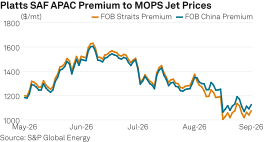
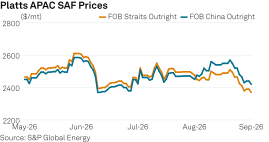
Platts, part of S&P Global Energy, assessed Sustainable Aviation Fuel HEFA-SPK FOB Straits, reflecting CORSIA-certified cargoes, at $2,420/metric ton on Sept. 29, down $20/mt from Sept. 28.
