Agriculture, Crude Oil, Refined Products, Biofuels, Sugar, Fuel Oil, Diesel-Gasoil
April 14, 2026
FEATURE: Middle East conflict drives multi-faceted ethanol push in India

Editor:
HIGHLIGHTS
Ministerial panel to expedite increased ethanol use
Middle East war disrupts LPG, crude oil supplies
Panel to evaluate E25, E30 blending by November
Disruptions to both crude oil and LPG supply chains in the Middle East are prompting India to rethink use cases for its surplusethanol supplies, in a push that marks a structural shift in how New Delhi views its domestic biofuel capacity: less as a climate tool and more as a strategic energy reserve that can no longer afford to sit idle.
India is focusing on four fronts: raising blending mandates beyond E20, deploying ethanol-based cookstoves as an alternative to LPG, accelerating flex-fuel vehicle adoption, and, in a world first, testing isobutanol as a diesel blending component, according to industry executives and government representatives.
The country achieved its E20 target ahead of schedule, saving an estimated $19.8 billion in forex, Food Secretary Sanjeev Chopra said at the ISMA SugarNXT 2026 conference on April 8.
Rapid expansion in sugarcane- and grain-based distilleries has lifted ethanol capacity to 20 billion liters/year, while oil marketing companies procure only 11-12 billion liters annually for the E20 mandate.
The resulting surplus capacity of 8-9 billion liters has become a financial strain for distillers, ISMA DG Deepak Ballani said at the same event on April 8.
Inter-ministerial panel
Against this backdrop, the Indian government has constituted an inter-ministerial panel comprising officials from the ministries of petroleum, heavy industries and food to evaluate how to activate the surplus ethanol capacity.
Chopra confirmed the panel's formation at ISMA SugarNXT, saying it was set up in direct response to industry demands and disruptions caused by the Middle East conflict.
The panel is weighing a roadmap beyond E20 (including E25 and E30), flex-fuel vehicle uptake, easing ethanol export curbs, alternative domestic uses such as cookstoves and generator blending and sweet sorghum to diversify feedstocks beyond sugarcane, rice and corn.
The panel could deliver recommendations before the next ethanol supply year commences in November, Chopra said.
LPG disruption
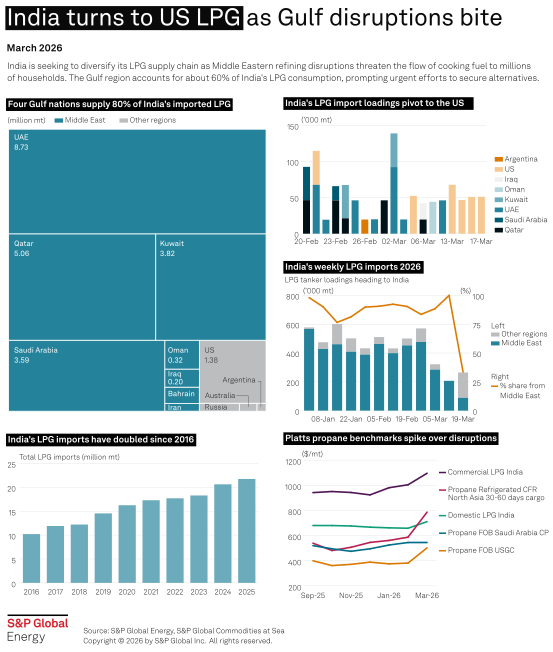
Meanwhile, India, which imports nearly 90% of its LPG from the Middle East, is facing one of its worst supply disruptions.
The government has curtailed industrial LPG supplies to protect household allocation, but the shortage has cascaded through the economy, pulling down both sugar and edible oil consumption.
India's sugar consumption fell 400,000 metric tons to 27.7 million metric tons in 2025-26, reversing earlier gains after March's Middle East conflict escalation, ISMA's Ballani said. Edible oil imports dropped 9% month over month in March to 1.2 million metric tons as weaker food service demand hit palm and soft oils, SEA's BV Mehta said.
For the ethanol sector, the LPG crisis has opened a door.
The Indian Federation of Green Energy has urged ethanol-based cookstoves as an LPG substitute, citing KOKO Networks' model, already deployed in Kenya and arguing that the technology could simultaneously reduce import dependence, utilize surplus ethanol production and support rural farmers' incomes.
Other industry bodies, including GEMA, AIDA and ISMA, have also separately written to the government recommending the adoption of ethanol-based cookstoves across households, commercial establishments, street vendors and institutional kitchens, especially in semi-urban and rural areas.
Flex-fuel vehicles
Industry and automakers have seen flex-fuel vehicles as the structural long-term answer to the surplus problem, but the path to scale is obstructed by cost and policy friction.
Leading auto manufacturers have developed prototype FFV models across the two-wheeler and passenger car segments, but mass production awaits a clearer policy framework.
The central barrier is taxation. While electric vehicles attract a GST rate of 5%, flex-fuel vehicles face rates of 18% to 40%, depending on configuration. This disparity, industry groups argue, penalizes the most commercially scalable low-carbon fuel pathway available to India today.
IFGE has called for flex-fuel vehicles to be brought under lower GST slabs, and for the rate on ethanol at fuel stations to be reduced to 5% from the current 18%.
Isobutanol pivot
The search for new ethanol applications has also taken an unexpected turn at the heavy transport end.
Road Transport and Highways Minister Nitin Gadkari confirmed on April 11 that India is now testing isobutanol-diesel blends, making it the first country in the world to conduct real-world pilots of this combination.
The pivot away from ethanol-diesel blending is significant.
Earlier ethanol-diesel blending trials failed due to low cetane, instability, phase separation and safety concerns from a low flash point, limiting blends to about 5%.
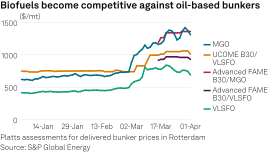
Isobutanol, a fermentation-based biofuel like ethanol, is more diesel-compatible, offering greater stability, no phase separation, higher energy density and improved mileage and torque.
If viable, isobutanol-diesel blending could unlock a much larger demand pool given India's diesel-heavy consumption while indirectly absorbing surplus ethanol capacity through a parallel biofuel market using similar feedstocks.
Supply, demand and crosscurrents
The India ethanol story now has multiple simultaneous moving parts across the feedstock, sugar, vegetable oil and biofuel markets.
The potential uplift in ethanol offtake from E20 to E25 or E30 would require an additional 2-5 billion liters of annual procurement by OMCs, partially absorbing the surplus but not eliminating it, according to market estimates.
If ethanol cookstoves gain policy support, the additional demand could be significant -- India has about 300 million household cooking units,according to AIDA.
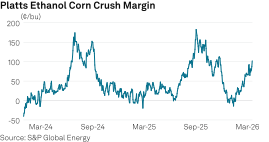
However, grain prices, particularly maize and broken rice, remain critical inputs: with 72% of allocations now grain-based, any tightening in domestic grain availability compounded by export demand or a poor kharif harvest could quickly flip the surplus narrative, according to industry estimates.
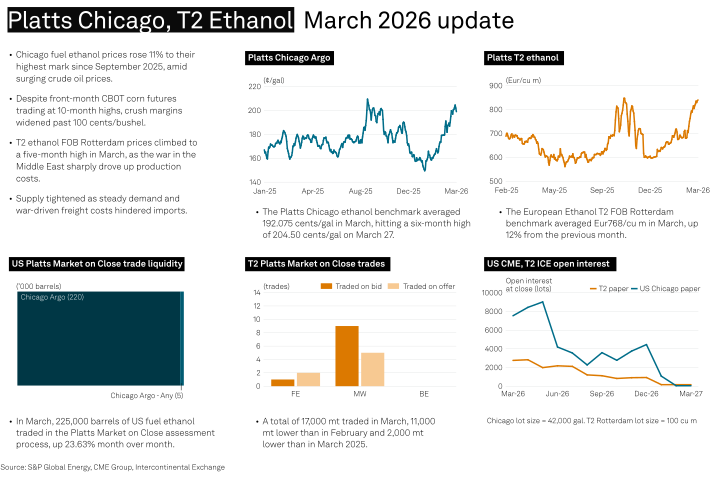
The Asian fuel ethanol marker rose $4.33/cubic meter day over day at $671/cubic meter on April 13.
Platts, part of S&P Global Energy, assessed industrial-grade B ethanol unchanged day over day at $635/cubic meter CFR Ulsan on April 13.
