Agriculture, Energy Transition, Refined Products, Biofuels, Renewables, Jet Fuel
July 09, 2026
IOC traces India SAF journey with blending mandate; flags feedstock sustainability as core challenge

Editor:
HIGHLIGHTS
India sets SAF blending mandate at 1% by 2027
Feedstock consistency emerges as key challenge
Co-processing offers fastest near-term scaling
India's sustainable aviation fuel program has progressed from an initial 2018 government policy committee to a codified regulatory pathway, with domestic blending mandates now set at 1% from 2027 and 2% from 2028, a representative with Indian Oil Corp. Ltd., told an industry conference, while cautioning that feedstock consistency remains the sector's most fundamental constraint.
Yajuvendra Singh Jhala, the deputy General Manager (Policy Cell) at IOCL, said July 6 at the International Sustainability and Carbon Certification's sustainability conference in India that aviation's urgency about decarbonization stems from its status as one of the fastest-growing and most profitable segments of the global mobility sector, even though it contributes a comparatively modest 2%-3% of global fuel emissions.
He argued that SAF is uniquely suited to the sector precisely because there is no viable near-term alternative propulsion pathway available at scale.
"There's no parking space available, you have to be 100% sure of the technology and the fuel, because SAF offers an efficient decarbonization route to existing aircraft and infrastructure without requiring any changes to those systems," he said.
India's SAF policy timeline
Jhala laid out a detailed chronology of India's SAF development. The country's SAF policy discussions began in 2018, when a demonstration flight requirement tied to an Airbus A320 test flight prompted the formation of a government committee, of which Jhala said he was a part.
The Bureau of Indian Standards subsequently cleared an initial fuel standard, and in 2019, the CSIR-Indian Institute of Petroleum (CSIR-IIP), Dehradun, developed its own indigenous SAF production pathway.
India's first commercial SAF-blended flight followed in 2023, with adoption expanding to additional routes through 2024.
In 2025, the Indian Standards framework formally adopted co-processing as an accepted SAF production pathway, a route Jhala described as a "low-hanging fruit" that much of the world is now pursuing, after which major technology licensors began actively engaging with Indian refiners.
That same year, IOCL became the country's first refiner to receive ISCC certification for SAF production.
In 2026, the government amended aviation turbine fuel control regulations, formally permitting SAF to be handled and distributed as a standard transport fuel where produced through approved pathways.
Co-processing is the fastest near-term scaling route
Jhala said co-processing blending approved feedstocks directly into existing refinery streams at low percentages, typically about 5%, without new dedicated plant investment, offers the fastest route to meeting India's 2027 mandate using existing refinery infrastructure.
Beyond that, he said refiners would need to invest in dedicated hydroprocessed esters and fatty acids (HEFA) capacity to scale blending toward 3% and eventually to 5%. He, however, noted that experts have flagged that HEFA facilities carry their own sustainability and feedstock-availability requirements that need to be resolved in parallel.
He stressed that any SAF pathway adopted must remain a "drop-in" fuel fully compatible with existing aircraft, engines, and fuelling infrastructure, meaning no new aircraft parts can be approved without full performance testing and certification, since the fuel must chemically match conventional refinery-derived jet fuel molecules.
Feedstock consistency as a central bottleneck
Jhala identified feedstock sustainability and supply consistency as the industry's most significant operational challenge, distinguishing it from certification-based sustainability criteria.
"My feedstock has to be consistent for my production, and my production has to be consistent for my emissions performance and equipment—production cannot be turned on and off at will," he said, noting this operational reality constrains how quickly SAF output can scale even where certified feedstock is technically available.
He also referenced IOCL's broader decarbonization efforts across fuel categories, noting the company's compliance with IMO MARPOL marine fuel sulfur limits since 2020, when it began supplying 0.5%sulfur marine fuel, alongside its road transport fuel transition.
Call for stronger domestic ISCC support infrastructure
Closing his remarks, Jhala said India needs to build deeper in-country expertise about ISCC certification processes rather than relying primarily on external support, arguing that government policy encompassing mandates, subsidies, incentives, and penalties, similar to frameworks seen in the UK, needs to be matched with practical logistics and storage infrastructure investment.
"The biggest challenge is sustainability, because I have to build my own sustainability model that requires policy support specific to feedstock availability in this country," he said, requesting greater collaboration between government, industry, and certification bodies to accelerate the build-out.
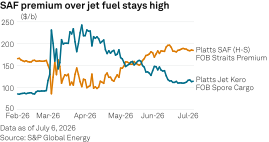
Platts, part of S&P Global Energy, assessed the SAF FOB FARAG barge price at $2,768.25/mt, up $122.50, or 4.6%, week over week, while the premium to jet barges rose marginally to $1,650.75/mt.
