Agriculture, Energy Transition, Refined Products, Chemicals, Biofuels, Renewables, Jet Fuel, Gasoline, LPG, Naphtha, Solvents & Intermediates
June 15, 2026
India caps jet fuel price with $1.06 billion fund, pivots surplus ethanol for 2030 SAF target

Editor:
HIGHLIGHTS
India caps aviation fuel at Rupee 115/liter
Government allocates $1.06 bil for ethanol SAF
Policy mandates 5% SAF blending in jet fuel
India has capped domestic aviation fuel prices at Rupee 115/liter under a newly approved Rupee 100 billion ($1.06 billion) ATF Price Stabilization Fund designed to insulate commercial airlines from global crude market shocks, a government minister said.
In tandem with stabilizing current aviation costs, the move is meant to use the country's surplus biofuel capacity to reduce fossil fuel imports.
The mechanism is designed to insulate commercial airlines from global crude market shocks, particularly amid rising costs linked to geopolitical tensions, as jet-fuel prices account for up to 40% of airlines' operating costs.
The policy framework for SAF production in the country is nearing completion, with the petroleum ministry working toward a phased roadmap that will mandate a 5% SAF blending target by 2030, Union Road Transport and Highways Minister Nitin Gadkari said at the Sugar, Ethanol and Bioenergy conference in Mumbai June 12-13.
"If we make aviation fuel from ethanol, I believe it will certainly be economically viable," Gadkari said. "And by doing so, our country will no longer run on aviation fuel. Now the world market is open to us. We'll export all that aviation fuel to the world."
The SAF initiative comes as India grapples with 8 billion-9 billion liters of surplus ethanol production capacity, with domestic output reaching 20 billion liters/year ,while oil marketing companies procure only 11 billion-12 billion liters annually for the E20 gasoline blending mandate.
India imports fossil fuel worth Rupee 22-23 trillion ($233.5-$244 billion) annually, accounting for 87% of the country's oil requirements, making it the world's second-largest fossil fuel importer, Gadkari said.
Global SAF momentum
The SAF policy aligns with global aviation decarbonization efforts, with Europe already mandating 2% SAF blending. SAF can be blended up to 50% with conventional jet fuel and delivers 80% greenhouse gas emissions savings compared to petroleum-based jet fuel, Gadkari said.
"In Europe, 2% use of this sustainable aviation fuel has come to the pipe, mandatory," Gadkari said. "There is also 80% saving on greenhouse gas emissions in this, and it can blend up to 50%."
The Indian Air Force has successfully tested SAF in fighter jets, demonstrating the fuel's technical viability for military and commercial aviation applications, the minister said.
The SAF push is part of a broader biofuel strategy that includes the recent launch of flex-fuel vehicles and E85 retail infrastructure.
Hero MotoCorp launched flex-fuel motorcycle variants on June 3, followed by Maruti Suzuki's flex-fuel Wagon R. Indian Oil, Bharat Petroleum and Hindustan Petroleum began selling E85 fuel at about 50 retail outlets on June 5.
Twelve automobile manufacturers, including Tata, Mahindra, Hyundai and Toyota, are developing 100% ethanol flex-engine vehicles, the minister said.
2G projects
Gadkari highlighted a flagship project in Panipat operated by Indian Oil that converts rice straw — typically burned by farmers in Punjab and Haryana — into biofuels. The facility processes 250,000 mt of rice straw to produce 100,000 liters/d of ethanol, 150 mt/d of bio-CNG, with 88,000 mt/year of sustainable aviation fuel.
"In Panipat, we have an Indian Oil project, which is my dream project, which is a matter of great pride," Gadkari said. "The rice which Punjab and Haryana burn is being properly utilized and value is also created in it."
In Assam's Numaligarh, the government is producing ethanol from bamboo, while experiments are underway to produce isobutanol from ethanol as a diesel alternative, the minister said.
Gadkari acknowledged feedstock challenges, noting that India generates 750 million tons of agricultural waste annually that could be converted to biofuels. The country is building 4,000 compressed biogas plants, with 150-200 currently operational.
"India generates 750 million tons of agricultural waste annually," Gadkari said. "We will be able to produce bio-CNG from these plants."
Gadkari positioned biofuels as complementary to EV rather than competing technologies. "We have to explore all the alternatives for the country," he said. "Converting these to biofuels as an alternative is in the interest of society and the country."
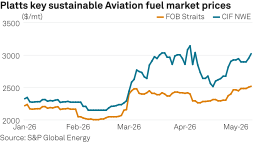
Platt, part of S&P Global Energy, assessed sustainable aviation fuel HEFA-SPK FOB Straits at $2,555/mt on June 15, down $30/mt from June 12.
The SAF FOB Straits premium was assessed at $1,627.50/mt over Platts Jet Kero FOB Singapore forward curve (MOPs), up $32.25/mt from June 12.
