Agriculture, Coal, Energy Transition, Grains, Thermal Coal, Food, Meat, Vegetable Oils, Oilseeds, Renewables, Biofuels
June 08, 2026
WEF warns El Nino poses systemic risk as shipping flags food and coal risk

Editor:
HIGHLIGHTS
Asian coal demand surges amid power shortages
Shipping faces trade flow shifts through 2027
The World Economic Forum has warned that an emerging El Nino weather pattern poses a systemic shock to global markets, with shipping industry analysts flagging potential disruptions to Asian coal demand and agricultural trade flows as the climate event develops through mid-2026.
The WEF said in a June 5 report that El Nino should be seen as more than a weather story, warning that the 2026-27 event could strike a planet already facing brittle food systems, fragile public finances, stressed energy markets and growing geopolitical instability.
The organization said the phenomenon will likely test the resilience of institutions already operating close to their limits, with far-reaching consequences for commodity markets and supply chains.
The warning comes as the World Meteorological Organization confirmed on June 2 an 80% likelihood of an El Nino event between June and August 2026, while the US National Oceanic and Atmospheric Administration's Climate Prediction Center estimates a 96% probability the pattern will persist into early 2027.
Shipping market analysts said the timing of the weather event coincides with peak Asian power demand, Indian monsoon risk and grain-crop formation across major producing regions, creating potential volatility for freight rates.
For dry bulk markets, the greatest impact is expected through coal movements to Asia.
India's peak power demand has already reached 270.73 gigawatts, above the government's summer expectation of 270 GW, after four consecutive days of record demand, according to shipping industry data.
Coal still accounts for more than 70% of Indian power generation, and a hotter, drier summer is expected to extend the call on coal-fired generation and slow the rebuilding of domestic stocks.
Freight implications
Asian thermal coal imports are forecast at 76.26 million metric tons in May, up 23% from April and above last year's May level. China's seaborne arrivals are projected at 22.63 million mt, while India's are expected at 13.78 million mt,according to Intermodal data.
The increased coal movements are expected to support incremental imports into India, mainly from Indonesia, Australia and South Africa, helping absorb Panamax and Kamsarmax ships supply in the Indian and Pacific Oceans.
"El Nino is again becoming a factor for 2026, and its freight impact is likely to be felt mainly through Asian power demand, crop risk and trade-flow shifts," shipping analysts at Intermodal said in a May 26 market report. "The important point for shipping is timing; this is developing into the Northern Hemisphere summer, when Asian power demand, Indian monsoon risk, Pacific weather disruption and grain-crop formation all start to matter at the same time."
The impact on agricultural commodities presents a more complex picture for shipping markets.
El Nino leads to reduced rainfall in Australia, Indonesia and parts of South Asia, while improving moisture conditions in parts of southern South America.
Current projections point to a 19% fall in Australian wheat output to 29 million mt in 2026-27, with exports falling 2.5 million mt to 23.5 million mt, according to industry forecasts cited by Intermodal.
The WEF said El Nino threatens to further disrupt commodity markets already showing the impact of economic risks, warning that the world must be prepared for a climate shock layered on top of a cost-of-living shock.
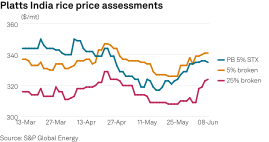
Rice is an important bellwether because it is both a traded commodity and a daily necessity for billions of people, the organization said. Asian farmers have already reduced rice planting amid soaring energy and fertilizer costs due to the war in the Middle East, and El Nino threatens supplies of the world's most consumed staple.
Platts, part of S&P Global Energy, assessed Vietnam 5% WR at $405/mt FOB on June 8, up $1/mt day over day. Platts assessed Fragrant 5% rice at $489/mt FOB, down $1/mt day over day.
Global supply chains also face disruption as drought lowers river levels and impedes inland transport, floods damage roads, ports, warehouses and processing plants, and heat reduces labor productivity across sectors, the WEF said. Agriculture is especially exposed because input costs are rising just as climate risks intensify.
The World Health Organization has warned that El Nino events are associated with heat stress, exposure to wildfire smoke, vector-borne diseases, drought-related health impacts, and nutrition shocks. In already hot regions, the phenomenon can push temperatures beyond safe thresholds for outdoor workers, older people, children and those with chronic illnesses.
Trade flow shifts
For agricultural freight, support may come less from higher volumes and more from trade-flow shifts, shipping analysts said. A weaker Indian monsoon could lift imports of vegetable oils, pulses, feed grains and fertilizers, while Indonesia and Malaysia's palm oil supply may redirect the vegetable oil trade.
Platts assessed CPO CFR WC India at $1,232.50/mt June 8 for June loading, up $2.50/mt from June 5.
South America could gain a relative export share in soybeans and meal if the weather improves there while Asian crops suffer, creating more Atlantic-to-Asia demand and ship repositioning, especially in the Supramax and Panamax segments.
Platts last assessed the SOYBEX FOB Santos soybean contract for July loading at $443.33/mt on June 5, down $7.17/mt from the previously assessed June 3.
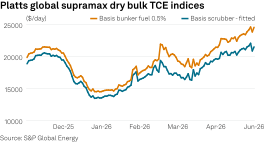
"The freight conclusion is therefore selective," Intermodal said. "El Nino is more constructive for coal freight than for grain freight in the near term. It supports Pacific dry bulk utilization through Asian power demand, while creating downside risk to Australian grain exports and upside risk to Atlantic grain and oilseed tonne-miles."
The strongest freight response will come if heat, weak monsoon rainfall and Indonesian supply disruption occur together, the analysts said. Without that combination, El Nino is expected to act as a volatility driver rather than a blanket bullish event for freight rates.
