Fertilizers, Chemicals, Energy Transition, Renewables
May 06, 2026
Hormuz closure past end-May risks Southern Hemisphere farm-to-fork supply chain: economist

Editor:
HIGHLIGHTS
Limited Hormuz traffic threatens fertilizer supply
Australia faces 25% wheat yield cut risk
Mid-May reopening critical for crop output
The closure of the Strait of Hormuz is rapidly evolving from an energy market disruption into a direct threat to global agricultural output, tightening fertilizer availability just as key planting windows open in the Southern Hemisphere, according to Dennis Voznesenski, sustainable agriculture economist at Commonwealth Bank of Australia.
As sowing begins, producers in Australia and Argentina face heightened risks of lower yields and protein dilution due to constrained access to nitrogen-based inputs, a supply shock now rippling through grains and livestock markets in both countries.
"This 'war premium' is now gradually transmitting through the global food supply chain," Voznesenski said in a May 5 interview with Platts, part of S&P Global Energy.
Australia, Argentina crops first in line
The Northern Hemisphere winter wheat crops were largely planted, and fertilizer was at least partially secured before the war disrupted shipping through the Strait of Hormuz. However, Southern Hemisphere producers are entering the growing season with minimal buffers.
"The first crops to be impacted straight from planting would be Australian and Argentina's winter crops," Voznesenski said.
"There could be a notable reduction in wheat area, reducing availability for Asia, especially of high-protein wheat," a defining quality for Asian milling markets.
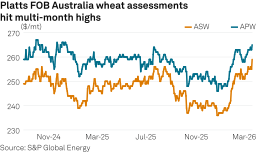
For Australia, the exposure is acute. The country has been fully dependent on urea imports since 2023, with 64% sourced from the Middle East in 2025.
Some farmers had secured fertilizer for initial planting in April, but a prolonged disruption in June threatens the availability of critical midseason applications during the crop growth phase.
According to North Dakota State University estimates March 13, reported by the Commonwealth Bank of Australia, the Strait of Hormuz is a primary passage for the global fertilizer trade, accounting for 43% of all seaborne urea exports, over 27% of global ammonia exports, 44% of the world's sulfur exports, critical for phosphate production and 16% of global phosphate fertilizer exports.
Australian wheat, barley and canola producers face output cuts of up to 25%, 32% and 31%, respectively, in the 2026-27 season if the Strait of Hormuz disruption forces a 45% reduction in nitrogen fertilizer application, according to the bank.
First full-season urea risk
Australia stopped producing urea domestically in 2023 when the Gibson Island fertilizer plant in Brisbane, the country's last urea facility, closed due to an inability to secure an affordable long-term gas supply. The country is now 100% import-dependent for nitrogen-based fertilizer. In 2025, 64% of those imports came from the Middle East, according to the report.
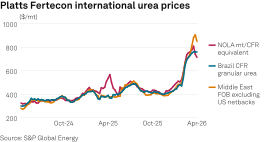
Australian urea prices have already risen 69% against prewar levels as of late March, while domestic diesel, of which it imports roughly 80%, is up 93%. Both are inputs with limited substitutability in broadacre cropping.
Farmer responses take shape
Voznesenski said Australian farmers he has spoken with are responding in three main ways to the fertilizer price spike and the uncertainty about availability.
"First, they have plans to reduce nitrogen application rates during the growing season, which would reduce yields and protein content," he said. "Second, they are switching from fertilizer-hungry crops like wheat to feed barley and pulses. Third, there is anecdotal evidence of farmers reducing overall area, but so far this is minimal."
It typically takes two to three consecutive years of disruption before farmers choose not to plant at all, he said, adding that the ongoing season represents the first full test.
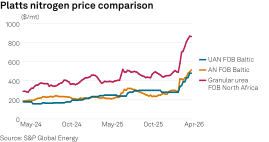
For wheat, urea is needed not only at the proper time of flowering in September to maximize yield but also post-flowering to build protein content. This characteristic makes Australian wheat's quality premium specifically vulnerable if midseason nitrogen application is rationed. Canola similarly requires urea at planting and ahead of September flowering.
"Since we are so early in the Australian growing season, it is difficult to say how much less nitrogen farmers will apply to their winter crops this year," Voznesenski said.
"We have modeled scenarios of 15%, 30% and 45% reduction in nitrogen application for 2026-27," he added.
Production impact of reduced nitrogen application versus 2025
| Crop | 15% urea reduction | 30% urea reduction | 45% urea reduction |
| Wheat | -3 million mt (9% decline) | -6 million mt (17% decline) | -9 million mt (25% decline) |
| Barley | -2.8 million mt (17% decline) | -4 million mt (24% decline) | -5.2 million mt (32% decline) |
| Canola | -780,000 mt (10% decline) | -1.5 million mt (19% decline) | -2.4 million mt (31% decline) |
Source: Commonwealth Bank of Australia
Australia's broadacre cropping typically accounts for 30%-35% of total farm gross domestic product. A 20%-30% output cut in this segment alone could shave up to 0.2 percentage point from Australian national GDP growth, according to Commonwealth Bank of Australia estimates.
The binary trigger
Market participants are closely tracking a narrow logistical window.
"If the Strait of Hormuz reopens by the end of May, the impact on Australian crop yields will be notably reduced," Voznesenski said.
With shipping times of 20-30 days, supplies would arrive by late June, in time for key nitrogen applications.
Each week of disruption beyond mid-May raises the probability of significant reductions in fertilizer use during critical growth stages, he added.
Argentina's winter crops, planted from mid-May, represent the next major exposure point, Voznesenski said.
Together, Australia and Argentina supply significant volumes of wheat, barley and canola to Asian markets, particularly high-protein wheat for Indonesia, the Philippines, Japan and South Korea.
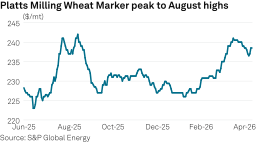
A reduction in both output and quality could tighten supply across the region, especially for premium milling grades.
Northern Hemisphere producers, meanwhile, remain relatively insulated in the near term.
Crops in Europe, Russia and the Black Sea were planted earlier, with fertilizer largely secured. Russia has also introduced export restrictions on certain fertilizers to protect the domestic supply.
Protein squeeze
The fertilizer shock is already feeding into broader agricultural markets.
"We have started to see global grain prices move higher," Voznesenski said, citing both weather disruptions and fertilizer constraints.
Rising grain and oilseed prices are increasing feed costs, squeezing feedlot margins and potentially dampening demand for feedlot animals. At the same time, higher fuel costs are eroding consumer purchasing power, particularly for higher-value feed and proteins.

"Higher fuel costs could reduce consumers' ability to spend on higher-quality products like meat," Voznesenski said, noting a decline in consumer confidence since the conflict began.
The result is dual pressure on protein markets: rising input costs from feed and softer demand due to macroeconomic strain.
Platts assessed Australian Premium White wheat up $1/mt day over day at $276/mt FOB Kwinana on May 6 for cargoes loading between July 5 and Aug. 4.
