Agriculture, Chemicals, Sugar, Biofuels
June 05, 2026
Biofuel mandates risk worsening food crisis: Transport & Environment

Editor:
HIGHLIGHTS
Biofuel mandates consume 5% global fertilizer
Global biofuel demand could surge 70% by 2030
Mandates correspond to 40% of staple stocks
Escalating global biofuel mandates risk deepening food insecurity and fertilizer shortages triggered by the Middle East crisis, as countries divert agricultural commodities and nutrients from food production to meet transport fuel targets, according to a study published June 4 by Transport & Environment.
The analysis warns that if proposed blending mandates are fully implemented, global biofuel demand could surge 70% by 2030, intensifying competition for crops, fertilizer and farmland at a time when supply chains remain disrupted by the closure of the Strait of Hormuz.
The study estimates that current biofuel mandates consume about 6.6 million metric tons of nitrogen, phosphate and potash nutrients combined, equivalent to roughly 5% of total global fertilizer use and half of the Middle East's fertilizer exports.
The strain is particularly acute in mandate-heavy nations, with Indonesia and the US directing 17% and 11% of their respective fertilizer supplies solely to meet biofuel requirements, according to the report.
Transport & Environment said the findings underscore a structural conflict between energy policy and food security, as rigid biofuel targets create inflexible demand for feedstocks even during severe crop shortages and fertilizer supply disruptions.
"While promoted as a path to energy independence, the global rush toward crop-based biofuels is ultimately deepening import reliance, fueling food inaccessibility, and accelerating environmental breakdown," the study said.
The report noted that high oil prices resulting from the Middle East crisis are accelerating the global biofuels push, yet ever-higher biofuel targets risk putting further strain on already tight global food and fertilizer markets.
Feedstock competition intensifies
The study found that biofuel mandates correspond to roughly 40% of ending stocks for main staple commodities, threatening to prevent global reserves from fully replenishing.
Major exporters of agricultural feedstocks like Brazil and Indonesia are limiting exports as they divert feedstock volumes to meet increased domestic demand for biofuels, creating artificial scarcity in global markets, according to the analysis.
The threat to feedstock reserves is particularly evident for vegetable oils and sugar, whose global demand for biodiesel and ethanol was already outpacing global rolling stocks before the crisis, the report said.
Transport & Environment said countries including the US, Brazil, India and Indonesia are ramping up biofuel targets in response to the crisis.
The US Environmental Protection Agency recently enforced strong renewable fuel requirements for 2026 and 2027 and is considering raising its ethanol blend limit to 15%, potentially increasing total biofuel demand by 40% in a short timeframe, the study noted.
India and Brazil are accelerating blending mandate plans, while ASEAN countries including Indonesia, Malaysia and Thailand are sharply raising biofuel targets to decrease fossil fuel import dependency, according to the report.
The study warned that if biofuel mandates globally reached 20% of diesel and petrol demand, current volumes would need to grow fivefold, requiring an additional 130 million hectares of agricultural land, equivalent to the size of South Africa.
Such an increase risks resulting in encroachment of natural ecosystems, leading to further deforestation and emissions as well as ecological implications such as soil impoverishment, water depletion and biodiversity loss, the report said.
Fertilizer dependency exposed
Based on 2024 UN Comtrade trade data, the study found that top biofuel producers source around half of their fertilizer imports from Russia, China and the Middle East.
India, Europe and Brazil source close to two-thirds of their fertilizer nutrients from these regions, creating a paradox where nations increase biofuel mandates to achieve energy independence while their ability to grow that fuel remains reliant on foreign chemical inputs, according to the analysis.
The report noted that about one-third of global nitrogen fertilizer exports and 20% of liquefied natural gas, the primary feedstock for nitrogen production, transit through the Strait of Hormuz, which is currently restricted due to regional conflict.
Transport & Environment said the current shock in fertilizer prices has not yet fully translated into biofuel costs, as today's biofuel crops were grown using fertilizer and fuel inputs secured before the 2026 energy surge.
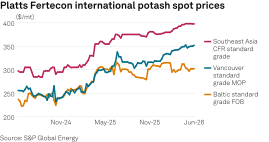
However, should fertilizer prices remain at record highs through the end of the year, this price pass-through will become inevitable, the study warned. Coupled with the projected El Niño event, which threatens to disrupt crop yields in key biofuel hubs like Brazil and Southeast Asia, the overlap of input scarcity and climate volatility is creating a perfect storm, the report said.
The study recommended that policymakers prioritize food production over biofuels, equip biofuel policies with emergency brake mechanisms that cancel first-generation biofuels' contribution to mandates during food price shocks, and transition away from crop-based biofuels by accelerating electrification and increasing investments in renewable e-fuels.
Platts, part of S&P Global Energy, assessed the Brazilian soybean oil FOB Paranaguá price for July loading at $1,195.13/mt June 3, up $11.03/mt from June 2.
