Agriculture, Refined Products, Coal, Electric Power, Biofuels, Diesel-Gasoil, Grains, Thermal Coal, Meat
September 08, 2026
COMMODITY TRACKER: 6 charts to watch this week

By Staff
Editor:
European diesel margins hit record highs as US East Coast inventories reach record lows, while Asian ethanol prices climb to two-month peaks on Brazilian supply concerns. India's power plants struggle with coal import substitution. In the US, solar contracts dominate clean energy deals.
1. European diesel cracks reach $98/b on US East Coast shortage
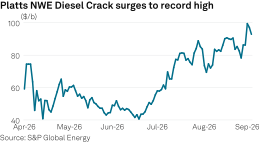
What's happening? European diesel refining margins reached record levels in early September, with the Amsterdam-Rotterdam-Antwerp diesel crack hitting $98/b on Sept. 1 before easing to $95.30/b on Sept. 2, according to Platts, part of S&P Global Energy, assessments. This is higher than the August average of $80.50/b. The rally was driven primarily by a supply crunch on the US East Coast, where diesel inventories hit a record low, with New England stocks at an all-time low of 2.3 million barrels, according to the latest US Energy Information Administration weekly report. Irving Oil's Saint John refinery is shutting down for two months of maintenance.
What's next? The US East Coast is likely to struggle building diesel stocks ahead of the winter heating oil season, raising competition for Gulf Coast barrels and feeding through to European cracks, according to William O'Neil, principal analyst at S&P Global Energy CERA. Water levels on the Rhine River are forecast to fall below 25 cm during Sept. 8-13, according to German water authority WSV, threatening further disruption to fuel supply chains. Freight costs from the ARA hub to Basel stood at €145/metric tons on Sept. 2, up from €135/mt on Sept. 1, according to Spotbarge data.
2. US diesel prices hit record high on supply constraints
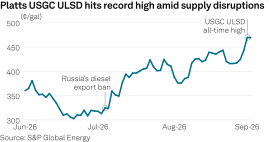
What's happening? US Gulf Coast Colonial Pipeline ultra low sulfur diesel prices reached $4.6973/gal on Sept. 1, marking the highest value since assessments began in May 2006, according to Platts assessments. US diesel and gasoil exports soared to a record 54.2 million barrels in August, according to S&P Global Commodities at Sea data. Russia extended its diesel export ban until Sept. 30.
What's next? ULSD stocks fell for the fourth straight week to 93.590 million barrels in the week ended Aug. 21, according to EIA data. Seasonal demand factors, including the domestic harvest season and winter preparations, are coming into focus. US military strikes on Islamic Revolutionary Guard Corps targets in Iran on Sept. 1 added a geopolitical risk premium to the diesel market.
3. Asian ethanol prices reach two-month high
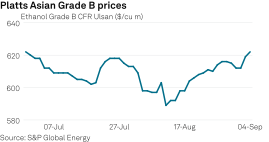
What's happening? Platts Asian Grade B ethanol prices rose to $622/cubic meter CFR Ulsan on Sept. 4, up $6/cubic meter week over week, reaching the same level last seen on June 29. The increase was driven by strengthening origin prices from Brazil, where domestic prices climbed to $551.22/cubic meter FOB Santos Sept. 3, up $16/cubic meter week over week and the highest since May 22. Brazilian prices increased amid rising domestic costs and production concerns related to rainfall risks. Chicago ethanol futures also rose, supported by higher corn futures, reinforcing upward sentiment across Asia.
What's next? Despite the price rally, demand remains subdued as buyers struggle to match elevated offer levels. Asian-based traders noted that many buyers appear to have sufficient inventories through year-end, limiting prompt inquiries. Import activity is expected to remain muted in the near term, with most buyers adopting a wait-and-see approach while monitoring volatile freight rates and evolving origin prices before committing to fresh procurement.
4. India's thermal coal imports fall on domestic supply shift
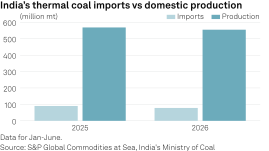
What's happening? India's thermal coal imports fell to about 45.4 million mt in fiscal year 2025-26 (April-March), down about 27% from the previous year, as end users turned to lower-cost domestic supplies, according to government data. Domestic production stood at 1.04 billion mt, 0.6% lower than FY 2024-25. India-delivered 4,200 kcal/kg GAR coal on the west coast averaged $71.35/mt in the January-June period, up from $56.65/mt in the same period the previous year, according to Platts assessments. The grade was assessed at $83.45/mt on Sept. 1.
What's next? India is moving from easy import substitution to more difficult engineering challenges. Roughly 18 gigawatts of generating capacity was originally designed around imported coal specifications. Power plants designed for imported coal have been blending 10%-30% domestic coal since early this year, leading to boiler efficiency challenges and high ash-handling costs, an operator of an imported-coal-based plant told Platts. Certain power plants will remain structurally dependent on imported fuel because of design limitations.
5. Solar power leads US clean energy deals in H1 2026
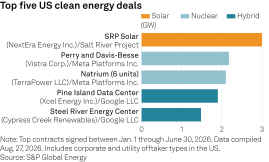
What's happening? Offtakers signed 96 clean power contracts totaling 28.1 gigawatts in the first half of 2026, up from about 22.4 GW in the same period of 2025, according to S&P Global Energy Horizons data. Solar projects dominated, with 46 solar-only deals totaling over 10 GW. The largest deal was Salt River Project's 3-GW agreement with NextEra Energy Resources to develop 500 megawatts of solar capacity annually in Arizona between 2029 and 2034. Hyperscalers Meta and Google were the largest offtakers, with 9,830 MW and 6,469 MW respectively, representing over half of total deal volume. Seven nuclear offtake agreements totaling about 7.5 GW were signed in the first half of 2026, including deals for small modular reactors.
What's next? Despite the 10- to 15-year lead time, hyperscalers are well positioned to take a long-term view, accepting the extended lead time in exchange for securing future capacity at a given site, according to Luke Edney, partner at Norton Rose Fulbright, told Platts.
6. Drought threatens US beef production in 2026
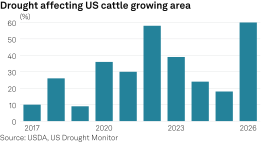
What's happening? Drought conditions affecting the US cattle inventory area worsened in the week ended Sept. 1, with 60% of the area impacted compared with 58% in the previous week and 18% in the same period last year, according to the US Drought Monitor report released Sept. 3. Texas, which accounts for 15% of US cattle production, saw 61% of its cattle area face intense drought conditions. In Kansas, 50% of the cattle area experienced severe drought. Nebraska saw conditions improve slightly, though drought still affected significant portions of the state.
What's next? US beef production is estimated at 25.04 billion pounds in marketing year 2026 (January-December), down 4% year over year, according to the US Department of Agriculture, which released Aug. 12. For MY 2027, US beef output is projected at 25.05 billion pounds, largely stable year over year, the USDA report said.
Reporting and analysis by Alexandra Vladimirova, David Neef, Carlos Castillo, Franklin Zhang, Muskan Agarwal, Pritish Raj, Nushin Haq and Sampad Nandy.
