Electric Power, Energy Transition, Natural Gas, Renewables
September 01, 2026
Solar power purchase contracts dominate first half of 2026

By Nushin Huq
Editor:
HIGHLIGHTS
Solar deals reach 10 GW in first half of year
Hyperscalers Meta, Google lead offtake volume
While the year began with several notable nuclear agreements, solar power remained the clean energy source of choice in the US during the first half of 2026.
In the first half of 2026, offtakers signed 96 deals totaling 28.1 gigawatts of clean power contracts, compared with about 22.4 GW in the first half of 2025, according to S&P Global Energy Horizons data. While nuclear deals dominated the first quarter of 2026 by volume, offtakers favored solar projects in the second quarter of 2026, including both solar-only and solar-plus-battery deals.
Offtakers, including utilities and corporations, signed 46 solar-only deals totaling a little over 10 GW in the first half of 2026.
The largest deal in the first half of the year was Salt River Project's (SRP's) 3-GW agreement with NextEra Energy Resources LLC to develop 500 megawatts of solar capacity per year in Arizona between 2029 and 2034. The Phoenix-area utility said its agreement with NextEra would help it more than double its power system by 2035 to meet reliability, affordability and sustainability goals.
"This approach will allow us to collaborate early in the project development process to minimize project risk and ensure the best outcomes for our customers and the communities where we operate," said Bobby Olsen, associate general manager and chief power system executive at SRP.
Other notable solar contracts include Google LLC's January agreement with Clearway Energy Inc. for 650 MW of solar power. In February, Google signed power purchase agreements with TotalEnergies SE for 1 GW of solar capacity in Texas.
"Strengthening the grid by deploying more reliable and clean energy is crucial for supporting the digital infrastructure that businesses and individuals depend on," Amanda Peterson Corio, Google's global head of data center energy, said in a statement.
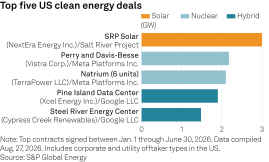
Most nuclear offtake agreements came at the beginning of the year, with two additional deals signed in the second quarter. Seven offtake agreements totaling about 7.5 GW were signed in the first half of 2026. In May, an undisclosed offtaker signed a 744-MW nuclear agreement with Constellation Energy Corp. In June, Walmart Inc. signed a 176-MW power purchase agreement for Constellation's Dresden Clean Energy Center. The deal was Walmart's first nuclear PPA.
"Working with Constellation allows us to support new operations in Illinois while advancing our strategy in a way that prioritizes affordable, reliable, and clean energy for our business and the communities we serve," Shayne Wahlmeier, senior vice president of energy at Walmart US, said in a statement.
The number of large nuclear deals signed by hyperscalers early in 2026, including deals for small modular reactors (SMRs), reflected companies' interest in round-the-clock firm power, Luke Edney, partner at Norton Rose Fulbright, told Platts, part of S&P Global. Despite the 10- to 15-year lead time, hyperscalers are well positioned to take a long-term view, accepting the extended lead time in exchange for securing future capacity at a given site. Edney's practice focuses on energy and infrastructure projects, including construction, project development and joint ventures.
Until multiple SMRs have been successfully deployed, it will take "those people [hyperscalers] that are willing to take the long-term risk on executing to demonstrate and prove the concept," Edney said.
Hyperscalers are largest offtakers
Hyperscalers Meta and Google were the largest offtakers in the first half of 2026, with 9,830 MW and 6,469 MW in total deal volume, respectively, representing over half of total offtake deal volume during that period.
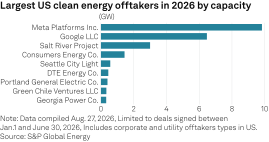
The volume highlights the need for hyperscalers to provide power to their AI-focused data centers. Their investor-grade creditworthiness makes them attractive partners for developers, Zach Banks, a partner at Vinson & Elkins, told Platts. Banks' practice includes representing private equity sponsors and lenders in financing transactions involving energy and infrastructure assets. While behind-the-meter natural gas projects are attractive because of their ability to bring enough baseload power, challenges remain, which is why they are also looking to sources like nuclear as a solution, Banks said.
"Even if you have natural gas in sufficient quantities, there's the element of routing that to a project," Banks said. "There's just a big gap to solve in terms of how all this stuff is ultimately going to be powered and making sure that there's enough of it. And the demand right now outweighs the supply significantly."
SRP's deal with NextEra Energy Inc.'s competitive generation subsidiary made SRP the top utility clean-energy offtaker in the first half of the year. Consumers Energy Co. had seven clean energy contracts in 2026, all solar, for a total of almost 1.5 GW. The power purchase agreements are aimed at helping the utility comply with a 2023 Michigan law that set renewable energy portfolio targets for state utilities.
