Refined Products, Crude Oil, Diesel-Gasoil, Fuel Oil
September 03, 2026
European diesel margins surge as US supply crunch supports rally
By Alexandra Vladimirova and David Neef
Editor:
HIGHLIGHTS
ARA diesel crack hits record $98/b
US East Coast inventories fall to all-time low
Falling Rhine water levels threaten supply chains
European diesel refining margins surged to record highs in the first days of September, with the rally driven as much by a supply crunch on America's East Coast as by geopolitics, analysts said.
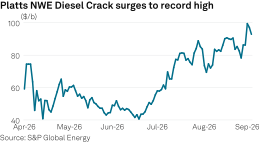
The physical Amsterdam-Rotterdam-Antwerp diesel crack hit a record $98/b on Sept. 1 before easing to $95.30/b on Sept. 2, well above the August average of $80.50/b, July's $71.71/b and June's $44.75/b, according to assessments from Platts, part of S&P Global Energy.
The ongoing Middle East conflict and Russia's extended diesel export ban remain significant contributors to the elevated crack, but both were largely priced in during late August, according to S&P Global analysts.
"I think the going assumption was that the [Russian diesel] ban would be extended, especially since refineries have continued to be hit," said William O'Neil, principal analyst at S&P Global Energy CERA.
A bigger driver was the latest EIA weekly report, which showed US East Coast diesel inventories at a record low, with New England stocks also hitting an all-time low of 2.3 million barrels.
"This comes despite the fact that US refineries are running at the highest sustained rates since 2018. At the same time, Irving Oil's Saint John refinery, which typically supplies nearly all of the East Coast's diesel imports, is shutting down this week for two months of maintenance," O'Neil said.
"This confluence of factors means the East Coast is likely going to struggle to build diesel stocks ahead of the heating oil season this winter, and all of this raises competition for Gulf Coast barrels," he added, noting the tight US market was feeding through to European cracks.
Europe, a net diesel importer, has leaned more heavily on US supply since the Middle East conflict curtailed exports from that region. Iran has escalated attacks on the oil supply chains of neighboring Persian Gulf states amid renewed tensions with the US, pushing up tanker rates and insurance costs.
Russia's diesel export ban has added to competition for US barrels, with former buyers of Russian supply, including Turkey, Brazil and several African nations, hunting alternative volumes. On Aug. 29, Russia's energy ministry extended its export ban on diesel, marine fuel and gasoil for producers through Sept. 30, from the previous Aug. 31 deadline. Non-producers remain barred from exporting diesel and gasoil through January 2027.
Platts assessed the flat price of ULSD 10ppm Northwest European Cargo at $1,456.50/mt on Sept. 2, with ULSD 10 ppm Mediterranean Cargo at $1,452.75/mt. The NWE cargo averaged $1,290.63/mt in August and $1,169.89/mt in July, while the Med cargo averaged $1,322.56/mt in August and $1,194.79/mt in July.
Rhine River constraints
The crack's rise comes as water levels on the Rhine, a vital European inland freight corridor, are forecast to fall below 25 cm early next week, threatening further disruption to fuel supply chains across the continent.
"Lower water levels will feed into product pricing, compounding the squeeze the region is facing from the Russian export ban and the lack of barrels coming in from east of Suez, which is limiting total availability. However, we are currently not seeing refinery cuts as a result of the low Rhine levels, indicating the region is proving more resilient than in previous crises," said Bethany Emerson, analyst at S&P Global Energy CERA.
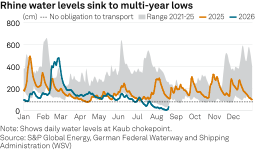
Water levels at Kaub, the shallowest stretch of the Middle Rhine, averaged 33 cm in August but dipped as low as 6 cm on Aug. 17, below the previous record low of 25 cm set in 2018. Levels then rebounded, holding above 77 cm between Aug. 29 and Sept. 1, but are now projected to drop below 25 cm during Sept. 8-13, according to German water authority WSV, making the middle Rhine increasingly unnavigable.
A European-based market source, who spoke on condition of anonymity as they were not authorized to speak publicly, said the recent uptick had done little to shift the market's cautious mood, warning that the situation was "about to enter tough times again." Barge transport to the Upper Rhine could face severe restrictions if levels keep falling, the source said. "No water [improvement] in sight as of today."
Views differed on whether the brief recovery had been put to use. The market source said there was scant evidence that traders had significantly capitalized on the reprieve to move extra volumes. Data provider Spotbarge took a different view, saying "market players definitely used the wave of water to move more product."
German weather service DWD forecasts mostly cloudy skies with little rainfall over the next four days across Rhineland-Palatinate, where Kaub sits.
Freight costs from the ARA hub to Basel, Switzerland, stood at €145/mt ($168.53/mt) on Sept. 2, up from €135/mt on Sept. 1 but below €276.67/mt on Aug. 14, Spotbarge data showed. Barges on the Lower Rhine can carry up to 1,000 mt for the coming week, but Upper Rhine loadables "from this point onwards are determined by company draft restriction, captain's experience and willingness of the barge company," Spotbarge said in a Sept. 2 note.
