Crude Oil, Refined Products, Maritime & Shipping, Diesel-Gasoil
August 21, 2026
Rhine water levels rebound, easing barge shipping strain
By Alexandra Vladimirova and David Neef
Editor:
HIGHLIGHTS
Rhine levels climb to 45 cm at Kaub point
Barge capacity can restore to 25% of normal loads
Freight costs edged down but stay almost four times July rates
Water levels on the Rhine, a critical European inland waterway for freight, rose above 40 centimeters late Aug. 20 and are forecast to climb above 70 cm by Aug. 24, offering some relief to fuel supply chains across the region.
Water levels at Kaub, the shallowest part of the Middle Rhine, stood at 45 cm as of early afternoon Aug. 21 and are expected to exceed 70 cm by Aug. 24, then hold around that level for the following two weeks, according to data from the German water authority WSV.
The recovery follows a drop below 10 cm at Kaub on Aug. 14 that persisted until Aug. 18, effectively splitting the river in two. Ships were still able to reach destinations on the Lower Rhine and around Cologne during that period, but faced severe restrictions further south.
German weather service DWD is forecasting showers and thunderstorms across Rhineland-Palatinate, where Kaub is located, on Aug. 21-22, followed by mostly dry conditions Aug. 23-24 — a wetter pattern than the region has seen in recent weeks. A summer drought slashed Rhine cargo capacity and pushed freight costs to record highs.
Market participants and analysts cautioned that a full resumption of normal barge operations will take time. "Historically, Rhine water levels lag rainfall recovery by several weeks as snowmelt, catchment saturation and upstream reservoirs gradually refill," S&P Global Energy CERA analysts said in a note.
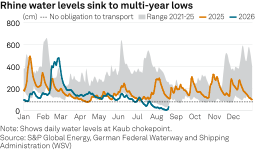
Traders said they were cautiously optimistic, citing uncertainty over how long the improvement will last and how far levels will rise. Forecast levels are expected to remain below the 80-cm threshold at which carriers have no legal obligation to transport cargo. Barge loads are generally halved when Kaub levels fall below 135 cm, and are limited to 25% of capacity below 75 cm.
"Barge types might differ, as some have lower drafts than others. If the rain indeed continues, regular barges are expected to pass Kaub again and take 700-800 mt as from Sept. 1," bunker data provider Spotbarge said in a note, adding that the forecast of 70 cm is still not guaranteed and "remains a significant operational risk."
The firm warned that if forecasts are revised downward after a barge has already loaded, "the vessel may no longer be able to pass Kaub and could be forced to return."
CERA analysts said that with no viable barge route and road freight costs near all-time highs, moving products from the coast or from refineries to inland consumers "is severely constrained and expensive," a dynamic likely to persist even as water levels recover in the coming weeks.
Despite the Rhine hitting record low levels earlier this month, neither the German nor the Swiss government released emergency fuel stocks. Crude supply via pipeline has kept Rhine-area refineries running without reported outages, CERA analysts said, with European refinery utilization projected at around 89% for August.
"Most of the logistical bottlenecks for refineries continue to be in the clearing of products, as most refineries lack a product pipeline and would otherwise rely on barge or rail to clear the barrels," analysts said.
Freight costs from Amsterdam-Rotterdam-Antwerp hub to Basel, Switzerland, were at €256/mt ($299.43/mt), down from €276.67/mt on Aug. 14, but up from €69.30 July 1, Spotbarge data showed.
The physical ARA diesel crack stood at $87.75/barrel on Aug. 20, up from an average of $71.71/b in July and $44.75/b in June, according to Platts assessments. Platts is part of S&P Global Energy.
