Crude Oil, Refined Products, Maritime & Shipping, Gasoline, Wet Freight, Fuel Oil
August 14, 2026
The Rhine drops below 10 cm at Kaub, disrupting European oil logistics
By Alexandra Vladimirova and David Neef
Editor:
HIGHLIGHTS
Water at Kaub falls to a record low of below 10 cm
ARA-Basel freight surges to €276.67/mt from €35/mt
Rhine crisis could cut 0.1-0.3 points from Germany's GDP: banks
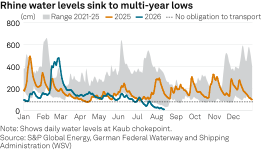
Water levels on the Rhine dipped below 10 centimeters Aug. 14, marking a record low at the Kaub chokepoint and threatening to disrupt fuel supply chains across Europe as the key trade artery becomes increasingly unnavigable.
The record-low readings at Kaub, the shallowest stretch of the Middle Rhine, are expected to persist through much of August, with levels forecast to hover at about 20 cm next week before a slight rebound above 30 cm on Aug. 23, according to German water authority WSV.
The previous record low of 25 cm was set in October 2018.
Market participants warned that a complete halt to navigation at affected stretches could occur as soon as next week, with one European-based source saying the Rhine was already effectively "split in half." Ships can still serve destinations in the Lower Rhine region and around Cologne, but face severe restrictions farther south, the source said.
While some cargoes continue to move using "modern lightweight barges," only a handful of ships can operate under current conditions, limiting the flow of refined products from southern Germany, according to a second source based in Europe. The source cautioned that rail alternatives would not be sufficient over an extended period if low water persists, warning of a potential "domino game" in the coming weeks, as inland supply chains come under mounting strain.
Freight costs
Freight costs from Amsterdam-Rotterdam-Antwerp (ARA) hub to Basel, Switzerland, surged to €276.67/mt ($320.36/mt) Aug. 14, up from €69.30 July 1 and €35 June 3, Spotbarge data showed.
Actual freight rates vary widely, depending on the barge and owner, Spotbarge told Platts, part of S&P Global Energy.
"The Rhine market remains very hampered due to the low water levels," said a market source familiar with the matter. "Only a handful of barges can pass. So, basically, barge owners can ask what they want."
Four regions in eastern France near the Rhine have reported motor fuel shortages in the past few days as ships struggle to reach the port of Strasbourg.
The logistics crisis has forced German states to suspend Sunday driving bans for lorries to accelerate truck deliveries, although road transport offers limited relief. Companies need about 52 truckloads to replace a standard 740-meter freight train, which is about one-fifth of a 500-TEU Rhine container ship, according to Deutsche Bahn estimates.
Rail options remain constrained by the closure of the right-bank Middle Rhine line, a key German freight route, July 10-Dec. 12 for major refurbishment. The timing of the closure has compounded the impact of the low water levels on inland transport capacity.
ING warned that record-low water levels could shave 0.3 percentage point off Germany's GDP growth this year, while Deutsche Bank Senior Economist Marc Schattenberg presented slightly more optimistic estimates.
"The low-water levels on the Rhine that have persisted since mid-July with no end yet in sight, mean estimates of a drag on GDP of 0.1-0.2 percentage point are becoming increasingly plausible," he said.
Weather forecasts offer limited hope for significant improvement. German weather service DWD expects no precipitation Aug. 14, with a possibility of showers, including heavy rain, Aug. 15. Aug. 16 will bring variable cloud cover, with intermittent showers and possible thunderstorms in the south, although conditions will become increasingly dry in the afternoon and evening. There may be some isolated showers Aug. 17, according to DWD.
The Netherlands' National Coordination Committee for Water Distribution said Aug. 11 that critically low Rhine water levels may continue into December even if wetter weather returns, suggesting disruptions to fuel supply chains could persist for months.
Schattenberg noted that the industrial landscape along the Rhine has changed since the 2018 drought, with significantly reduced industrial activity and some companies procuring specially designed ships.
"Some industries located along the river made changes after the 2018 drought. For example, specially designed tankers were procured that can still operate at comparatively low water levels," Schattenberg said.
To avoid future crises, companies will need a package of measures to strengthen the resilience of transport routes alongside the Rhine, Schattenberg said. Potential solutions include lowering the riverbed at the Kaub bottleneck, improving Deutsche Bahn's freight capacity, expanding storage capacity for critical transport goods, and upgrading road infrastructure, such as bridges.
