Electric Power, Coal, Energy Transition, Refined Products, Chemicals, Metals & Mining, Agriculture, Emissions, Grains, Vegetable Oils, Aromatics, Ferrous, Naphtha, Diesel-Gasoil
August 06, 2026
FACTBOX: European drought snarls inland commodity flows, cuts power supplies
HIGHLIGHTS
Rhine, Danube river levels hit record lows in key chokepoints
Inland markets face squeeze on fuel, chemicals, metals and grains
Power plants reduce output due to cooling water limitations
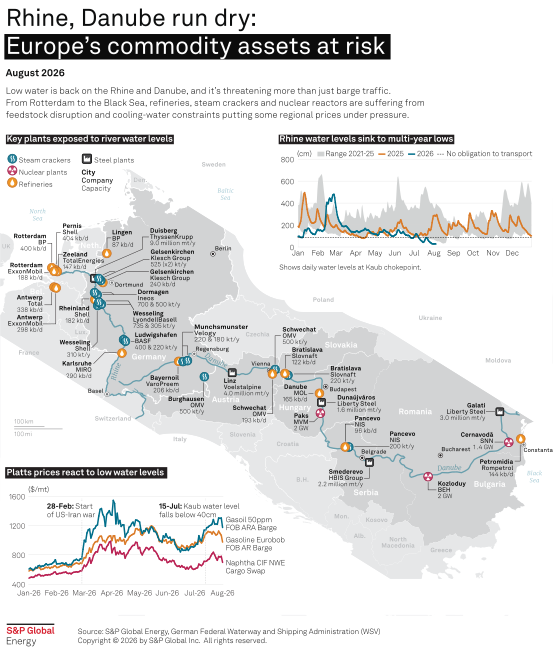
Record temperatures in Europe have left its two busiest waterways – the Rhine and the Danube – at critical lows, shutting down key trade arteries and power plants stymied by cooling water restrictions.
Rhine water levels hit an all-time low of under 20 cm at Germany's Kaub chokepoint, where barges make their way from the country's south into Switzerland, on Aug. 5. On the Danube, water levels in Budapest fell below 10 cm on Aug. 2, another record.
To keep traffic moving, shipowners are cutting loads to test the limits of navigable water limits with lower cargo volumes, but congestion is forcing up freight costs and forcing transport onto costlier road and rail routes.
In key pinch points, the disruption exceeds previous crises in 2018 and 2022, and comes ahead of what is typically the peak summer crunch point for regional water levels. As a result, inland markets are facing surging costs for energy, chemicals, metals and agricultural goods, compounding existing disruption from the Middle East and Russia-Ukraine conflicts.
Trade flows
- The Rhine typically ships around 300 million mt of goods per year, most of it oil products and chemicals, while ports along the Danube handled 62.7 million mt in 2025, according to the commissions for each waterway.
- Close to 1.1 million mt of oil products passed through the Upper Danube Hungary-Slovakia cross-border point in 2025, alongside 853,000 mt of ores and metal products and 370,000 mt of grain.
- Nuclear plants use the water for cooling, but are restricted from excessively raising river temperatures. A lack of a cool water supply to dilute wastewater can therefore force closures.
- At river levels below 150 cm, barges carrying more than 2,000 metric tons must reduce cargo loads to sail safely, prompting shipowners to impose surcharges to offset lost capacity.
- Below 80cm, vessels on the Rhine have no legal obligation to transport goods, and 40 cm is normally considered the cutoff to fully halt barge traffic. A small number of super lightweight, modern barges are still sailing shallower depths with little cargo, but few can navigate key pinch points.
- Navigation of the Danube has been suspended at two points near the border between Austria and Slovakia until Aug. 17, according to the Danube Commission's website.
- The Danube has provided an alternative exit route for Ukrainian grain and vegetable oil via the ports of Reni and Izmail since Russia began targeting its Black Sea trade.
- Along the Rhine, diverting to rail transport has been challenged by Deutsche Bahn construction work along the River's right bank, which is taking place from July 10 to Dec. 11.
- Steel producer ArcelorMittal has adjusted some production from its Duisburg facility, while Tata Steel Nederland is shifting some cargo to rail freight to minimize disruption.
- Serbia imported only 20% to 25% of planned petroleum product quantities at the end of July because of barges operating at 30-40% of normal capacity on the Danube, its energy minister said.
- German Chemicals producer BASF declared force majeure on deliveries of certain surfactant products from its European production assets.
- LyondellBasell declared force majeure on supply from its 170,000 mt/year butadiene extraction unit at Wesseling, Germany, effective July 16 according to a customer letter seen by Platts July 23.
- Balkans hydropower output hit a 10-month low in July, with signals of further drops to come.
Prices
- Oil product prices in the Amsterdam-Rotterdam-Antwerp barges have been depressed by Rhine congestion that has left product idle at the coastal port hub. Barge prices for FOB ARA ULSD were $1175.5/mt on Aug. 6, down 12% from July 31, according to Platts assessments.
- In petrochemicals, Platts assessed the European styrene monomer contract price for August settled at €1,841/mt (about $2,120.28/mt), up €149/mt from the July contract.
- The August contract for benzene, a key feedstock for styrene, was up by €184/mt, having settled at €1,277/mt on July 31 amid production disruptions, restricted Rhine barging activity and limited imports into the ARA hub.
- Grain and corn prices have been supported by Black Sea disruption, low river levels and a deteriorating EU crop outlook. Platts assessed Corn loaded in Constanta, Romania at $243/mt on Aug. 6, up from $228/mt June 30.
- Ex-Hungarian base day-ahead power prices were $182.42/MWh on Aug.6, up from $142.14/MWh July 30.
- The price of hot-rolled steel coil loaded in Germany's Ruhr region – the Northwest European benchmark- reached €715/mt on Aug. 6, up from €680/mt on June 30.
- Inventories are growing at the ARA hub. Naphtha stocks peaked at 618,000 mt in the week to July 30, their highest level since March 12, Insights Global data showed. Gasoil stocks built for the first time since May in the week to Aug. 6.
Infrastructure
- Power plants in Hungary, Romania, Slovenia, France, Italy and Poland have been forced to reduce or halt operations and turn to neighboring countries for imported supply.
- Hungary's 2-gigawatt Paks nuclear power plant, which typically supplies up to 40% of its electricity, depends on the Danube for cooling. It has been running at significantly reduced rates since late July and has only one 240-megawatt turbine still operating.
- Hungarian refiner MOL volunteered to reduce its electricity use by 40% in peak periods, which a spokesperson said would come mostly from its petrochemicals facilities.
- Romania blew up a rock formation in the Danube to redirect water toward its Cernavoda nuclear power plant and prevent it from shutting down. Authorities are working to sink four barges to further support water levels.
- In Serbia, the sole refinery in Pancevo is releasing oil reserves to compensate for shortages in August. The country's biggest hydropower plant, Djerdap 1, is running at a third of its capacity.
- In Romania, automakers Dacia and Ford have paused production until Aug. 19, in a move the prime minister says will cut electricity demand by 200MW.
- Austria's 192,000 b/d OMV Schwechat refinery has experienced some restrictions related to product distribution via the Danube, and has adjusted some supply patterns within its subsidiary network, it told Platts on July 23.
