Metals & Mining, Ferrous, Non-Ferrous
June 15, 2026
High-stakes USMCA trade review tests North American supply chains

By Kip Keen
Editor:
The United States-Mexico-Canada Agreement, ratified in 2020, faces a mandatory six-year review by July 1. Once expected to be a routine assessment, the review now has the potential to rewire North American supply chains. The first US-Mexico bilateral talks started earlier this year, while Canada-US negotiations remain on ice. If the three countries reach an agreement, USMCA extends until 2042.
The outcome of the review has major implications for the three countries' deeply integrated economies. In 2024, Canada supplied 70% of US primary aluminum imports, according to S&P Global Market Intelligence data, while Canada and Mexico combined accounted for 93% of US steel exports, according to the American Iron and Steel Institute.
President Donald Trump has warned he could withdraw the US from the trade pact. Alternatively, if the three countries do not reach a deal by July 1, the USMCA could shift to ongoing annual reviews until 2036, unless otherwise decided.
We answer five key questions on the USMCA talks and what they could mean for metals and mining.
1. Why is the 2026 review critical for metals markets?
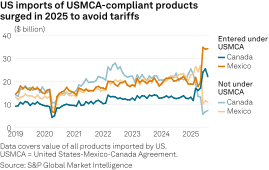
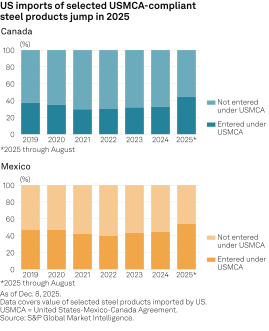
North American metals markets are intertwined, so any changes to rules of origin and duties will ripple through supply chains. Canada was the top source of US metals and minerals imports at $43.55 billion in 2024, or 17.7% of total imports in the category, according to the latest US International Trade Commission data. Mexico was third after China at $27.67 billion, or 11.2% of the total. USMCA-compliant trade — products that get preferential treatment under the trade agreement and avoid potentially higher global duties — surged in 2025, with 78.2% of Canadian and 75.8% of Mexican imports qualifying as compliant in the three months through Aug. 31, 2025, up from 36.8% and 47.9%, respectively, in the same prior-year period, according to Market Intelligence data.
Many aluminum, steel and copper products from Mexico and Canada face 50% Section 232 duties under the Trade Expansion Act of 1962, even with USMCA in effect. Canada and Mexico, along with some industry trade groups in the US, would like to see Section 232 tariff relief as part of negotiations. The two countries could agree to tougher rules of origin under a revised USMCA, if the US lightened Section 232 tariffs in concession, experts said.
2. How is a compliance surge reshaping trade?
The compliance surge that began with the 50% tariff announcements in June 2025 reflects exporters and importers seeking to avoid tariffs where possible and has created a two-tier market: products meeting rules of origin flow with minimal friction, while those that do not face potential duties.
This included tariffs under the International Emergency Economic Powers Act, until the US Supreme Court struck them down in February. The court's ruling frustrated Trump, who could become more determined than ever to demonstrate tariffs are effective policy, according to Robert Embree, vice president and senior economist at Rosenberg Research & Associates.
3. What are the key negotiating positions and where do they diverge?
Some US metals companies are pushing for stricter melt-and-pour requirements, and tighter rules of origin. The American Iron and Steel Institute and the Steel Manufacturers Association advocate for greater alignment between the three trade partners on these issues. Still, tighter rules of origin could become so complex as to amount to a trade barrier themselves, complicating tracing of intricate metals supply chains, according to John Boscariol, partner and co-head of the international trade and investment law practice at the Canada-based McCarthy Tétrault firm.
Mexico is prioritizing tariff relief. President Claudia Sheinbaum said May 14 that there is no rush ahead of the July deadline, while reiterating Mexico wants existing US tariffs reduced. Canada is focused on preserving its relative tariff advantage. Prime Minister Mark Carney has said that Canada will not let the US dictate terms of the review, while the Canadian leader has also ruled out using energy or critical minerals as leverage.
While the review system was designed primarily for small tweaks rather than fundamental change, the US appears to be taking a more ambitious and aggressive approach to the process, according to Diego Bitar, a fellow with the Americas Program at the Center for Strategic and International Studies in Washington, DC.
What's at stake in USMCA review
| Scenario | Pathway | Potential metals impact |
| Clean 16-year extension to 2042 | All three parties agree by July 1 to renew without major structural changes. | USMCA-compliant trade continues with less friction. Cross-border steel, aluminum and copper supply chains still face Section 232 duties. |
| Extension with modifications | Extension paired with new policies that could include tighter rules of origin, expanded melt-and-pour requirements and a supply-guarantee mechanism for critical minerals. | Higher regional content thresholds could reshape sourcing in metals-intensive sectors. Section 232 duties likely persist but with potential preferential USMCA rates possible for some products. |
| No consensus — annual reviews begin | Parties fail to agree by July 1. Pact shifts to annual reviews. Agreement does not terminate until 2036. | Concerns over changing rules discourages capex in some metals-heavy industries. USMCA compliance still delivers benefits, but annual reviews leave traders guessing. |
| More bilateralization | The trilateral agreement survives on paper but trade talks run on separate US-Mexico and US-Canada tracks. | The US approach to Canada and Mexico trade diverges, with trade in metals-heavy sectors like auto manufacturing, steel and other metals in the crosshairs. Common aspirations of a "Fortress North America" for industries like steel diminish. The US is already negotiating separately with Mexico and Canada. |
| US withdrawal | Trump triggers six-month withdrawal notice. Canada and Mexico lose USMCA-compliant status for a slew of products. | Disruption. Billions of dollars of metals that traded duty free under USMCA face more tariffs and lose preferential treatment over rules of origins. Previously USMCA-compliant metals products could reprice. Canada and Mexico increase trade with other markets, and their products become less competitive for US buyers. |
| As of May 27, 2026 Selected outcomes based on reporting by Platts, part of S&P Global Energy. Source: S&P Global Energy | ||
4. Could the US actually withdraw?
A US withdrawal is possible, Drew Fagan, professor at the University of Toronto's Munk School of Global Affairs and Public Policy, and other experts told Platts. Withdrawal would strip Canadian and Mexican exports of protections, exposing their goods to more duties and slashing preferential treatment. On June 10 Trump said he would not renew the agreement, saying the US does not need anything from Canada or Mexico.
A permanent shift in the US tariff baseline is likely regardless of the outcome, experts said. The 2.5%-3% most-favored-nation duty average is unlikely to return, and the new floor is probably around 10%, with USMCA among limited exceptions, said David Gantz, a fellow at Rice University's Baker Institute for Public Policy in Texas.
5. What could USMCA talks mean for critical minerals cooperation?
Critical minerals have emerged as one area where Canada, Mexico and the US could seek closer ties. All three USMCA nations have flagged mineral security as a national priority, and US and Mexican officials emphasized collaboration on critical minerals in February.
Meanwhile, the US could seek guaranteed, uninterrupted supply of metals from its neighbors in exchange for tariff relief, experts said. But it's unclear if Mexico or Canada would accept such terms given the issue of maintaining sovereignty over resources.
