Chemicals, Refined Products, Crude Oil, Energy Transition, Agriculture, Metals & Mining Theme, Aromatics, Emissions, Vegetable Oils, Non-Ferrous, Biofuel
December 23, 2025
COMMODITY TRACKER: 4 charts to watch this week

By Staff
As the year draws to a close, Russian crude discounts are widening due to ongoing sanctions, while tin prices rise amid supply constraints. Conversely, Asian MTBE prices have hit a four-year low, reflecting reduced blending demands.
1. Sanctions fuel discounts on Russian crude
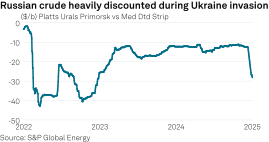
What's happening? Sanctions imposed on Russia in response to its invasion of Ukraine have led to Russian barrels trading at steep discounts. In recent months, the discount on Russia's flagship Urals crude grade has widened as buyers respond to the latest sanctions targeting its biggest oil producers, Rosneft and Lukoil. Platts, part of S&P Global Energy, assessed Russia's flagship Urals crude grade at $29.15/b below the Dated Brent benchmark on Dec. 19, marking three months of widening discounts and leaving the spread at its widest point since April 2023. Prior to the invasion, Urals was trading at a discount of less than $5/b to Dated Brent.
What's next? If a deal is reached in talks aimed at ending Russia's invasion of Ukraine, it could include some sanctions relief, potentially restoring some Russian oil exports and narrowing Urals discounts. An end to active fighting would ease supply security risks, which have risen alongside attacks on refining and supply infrastructure since the conflict began.
2. Tin market sees rising prices amid supply constraints
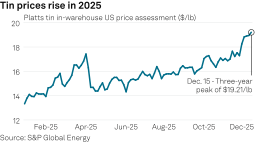
What's happening? Tin prices have increased due to a global supply squeeze, reaching a three-year high. The London Metal Exchange cash price for tin hit $42,257/metric ton on Dec. 17, marking a 46.5% increase since the beginning of 2025. Similarly, the Platts-assessed price for New York Grade A tin rose to $19.21/lb on Dec. 15. Supply challenges, such as mine disruptions in Indonesia and Myanmar, have contributed to this rally, along with increased recognition of tin's critical role in electronics and renewable technologies.
What's next? Market experts anticipate continued bullish sentiment for tin as supply constraints persist. Investor interest is strong, with record-long net fund positioning at the London Metal Exchange. Companies like Cornish Metals Inc. are capitalizing on high prices, planning to restart tin production in the UK by 2028, Fawzi Hanano, chief development officer at Cornish Metals, told Platts. The global tin market's concentrated nature suggests that even minor disruptions can exacerbate supply deficits, leading to further price volatility, industry experts say.
3. Indonesia's biodiesel ambitions keep palm oil markets on a boil
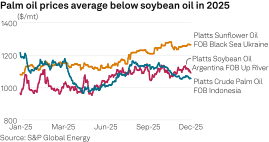
What's happening? Palm oil markets are expected to remain robust through 2026, driven by regional demand despite forecasts of higher production. Indonesia's upcoming B50 biodiesel mandate will absorb nearly half of its crude palm oil output, impacting exportable supplies. In 2025, largest exporter Indonesia's crude palm oil production is projected to rise to 56 million metric tons, while Malaysia's is expected to surpass 20 million metric tons. In physical markets at origins, the average price of crude palm oil FOB Indonesia was at $1,090/mt in 2025, according to data from Platts.
What's next? Indonesia's B50 biodiesel mandate, anticipated in the latter half of 2026, could significantly reduce palm oil exports and support prices. Export levies might rise by 5%-7.5% to fund the program. Global demand will also be influenced by US biofuel policies, keeping soybean oil prices high. India and China are forecast to increase imports, with India expected to import 8.7 million mt in 2025-26. The palm oil derivatives market will likely track crude palm oil price movements, with demand expected to rise in the summer months.
4. Asian MTBE prices hit a four-year low
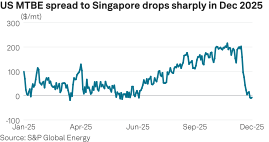
What's happening? Asian MTBE FOB Singapore prices closed at a four-year low of $608.05/mt on Dec. 17, driven by declining crude oil futures prices and reduced blending demand, reflected in weaker Platts Singapore 92 RON gasoline swaps. The MTBE price decline follows a $6.73/mt drop from the previous day, marking the lowest level since Feb. 4, 2021, when it was assessed at $595/mt. The front-month Singapore 92 RON gasoline swap also fell to $70.40/b Dec. 17, its lowest in over seven months, reflecting softened driving demand in the US, Platts data showed.
What's next? Looking ahead to 2026, the MTBE market presents mixed perspectives. Some market participants are optimistic about motor gasoline and blendstocks, while others foresee a bearish trend for the first quarter, expecting prices to remain soft until the Lunar New Year. Supply tightness in the gasoline complex may persist, but demand could pick up in one to two months.
Reporting and analysis by Rosemary Griffin, Karlitos Brian Decena, Aditya Kondalamahanty, Aditya Deval, Rachelle Teo, Ashley Peh

Editor: