Crude Oil, Refined Products, Maritime & Shipping, Diesel-Gasoil
December 16, 2025
FACTBOX: What a Russia-Ukraine peace deal could mean for oil markets
By Rosemary Griffin and Robert Perkins
HIGHLIGHTS
Discounts on Russian crude could narrow
Sanctions relief could reroute some Russian oil exports
Likely end to attacks on energy infrastructure
Brent crude futures fell below $60/b Dec. 16, trading close to levels last seen in early 2021, amid growing market expectations over a possible Russia-Ukraine peace agreement that could restore Russian oil production and exports if sanctions unwind.
Although yet to materialize, market watchers anticipate a peace deal leading to a significant oil market rebalancing, with a potential release of oil-on-water as shipping trade routes normalize, a rise in Russian supplies dependent on the speed of production recovery, and a narrowing the discount on Russian crude.
"Even if all Western sanctions on Russia were to be removed and drone attacks on Russia refineries were to stop, we would not expect an immediate rebound in Russia supply but rather a gradual recovery," according to the Goldman Sachs analysis dated Nov. 26. "Several key factors that weigh on Russia oil production are likely structural—technological and operational bottlenecks and a high tax wedge to ensure solid government oil revenue—and overcoming them could be a matter of years rather than months."
However, industry experts remain divided on the immediate global production impact.
Tatiana Mitrova, a fellow at Columbia University's Center on Global Energy Policy, agrees the near-term impact would be "minimal," noting that "even with a peace deal, sanctions are highly unlikely to be removed rapidly or unconditionally."
Ronald P. Smith of Emerging Markets Oil & Gas Consulting Partners said that OPEC+ decisions will be the primary factor determining output levels in 2026.
Trade flows
A peace agreement could trigger substantial shifts in global oil trade patterns as Russian exports normalize, though experts expect limited immediate production changes.
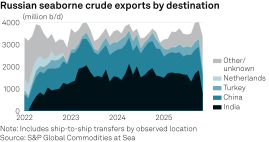
- Russian oil exports have fallen by about 900,000 b/d since the war began, primarily driven by reduced gasoil and diesel exports
- Russian crude oil-on-water has increased by about 80 million barrels since the start of the conflict due to longer voyage routes
- Since launching the invasion, Russia has rerouted significant volumes of oil and oil products away from traditional markets in Europe to non-sanctioning countries, primarily China and India.
- Under a slow recovery scenario, Russian production would stabilize at 10.1 million b/d through 2027: Goldman
- A fast recovery scenario envisions linear production growth to pre-war levels of 11.3 million b/d by the end-2027: Goldman
- Peace deals are unlikely to unlock new export markets immediately in the current oversupplied global environment
- Attacks on Russian refineries and import bans on refined products have accelerated the decline in diesel and gasoil export volumes
- Sanction pressures have forced Russian crude onto longer shipping routes, increasing oil inventory levels at sea
- Chinese independent refiners are seeking alternative heavy crude supplies as traditional Russian flows remain constrained
- China imported around 2 million b/d of Russian crude in the first 10 months of 2025
Prices
Oil price forecasts face significant downward pressure as markets price in potential Russian production recovery, though pricing benefits may emerge faster than volume increases.
- Supply concerns drove Platts Dated Brent from around $100/b on the eve of the invasion to $137.64/b March 8, 2022. Since then, attacks, sanctions and rounds of peace talks have continued to impact assessments.
- Brent crude prices could average $4-$5/b below base case forecasts in 2026-2027 under a slow Russian recovery scenario, according to Goldman Sachs. A fast recovery scenarios suggest Brent prices averaging $5-$9/b below base-case forecasts for 2026-2027, according to the bank.
- The average price received for Russian crude is expected to rise significantly following a peace agreement and sanctions relief
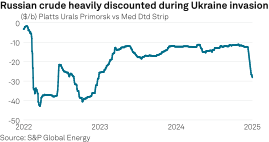
- Platts, part of S&P Global Energy, assessed Russia's flagship Urals crude grade $28.15/b below the Dated Brent benchmark on Dec. 15, marking three months of widening discounts and leaving the spread at its widest point since April 2023. Prior to the invasion, Urals was trading at a discount of less than $5/b to Dated Brent. This spiralled to a post-invasion maximum of $42.86/b on April 13, 2022.
- Europe gasoil and diesel margins are currently estimated to include a $7/b geopolitical risk premium versus Brent crude, according to Goldman Sachs
- Freight rates for refined oil products have increased approximately $3/b since the war began due to sanctions and route diversions
- Lower freight rates following a peace deal could reduce product margins as shipping costs normalize
Infrastructure
Russian energy infrastructure recovery and global refinery system normalization could reshape product supply dynamics, though capacity constraints may limit near-term gains.
- S&P Global Energy estimates that at end-November about 18% of Russian refinery capacity was offline due to attacks and maintenance issues.
- Tighter global refinery systems have made product markets more vulnerable to supply disruptions than crude markets
- Russian upgrader facilities for heavy crude processing are operating significantly below capacity due to maintenance delays
- Port infrastructure damage and operational constraints continue affecting Russian export terminal capabilities
- Storage facility utilization has increased globally as Russian crude seeks alternative discharge points
- Production capacity limitations may become a constraining factor for Russian output expansion by next year, according to Goldman
- European refinery configurations remain adapted to process alternative crude grades following Russian supply disruptions

Editor: