Metals & Mining Theme, Non-Ferrous
December 18, 2025
Tin soars to 3-year high as supply squeeze fuels critical metal rally

HIGHLIGHTS
Tin gains prominence as critical battery material
Supply issues expected to persist
A global supply squeeze has fueled a price rally in tin, attracting increased market interest in the relatively obscure critical material, according to industry experts.
The London Metal Exchange cash price for tin soared to a three-year high of $42,257.00/metric ton on Dec. 17, jumping 46.5% since the start of 2025. The LME tin cash price has hovered above $40,000/mt for most of December so far, marking the first time it has reached this level since early 2022, when the Russia-Ukraine war roiled markets.
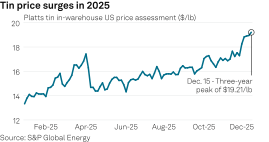
The Platts-assessed price of New York Grade A tin, in-warehouse duty paid, US, also hit a three-year peak in the latest session on Dec. 15 at $19.21/lb, rising 44.1% since the start of the year. The Platts price assessment from S&P Global Energy is published biweekly.
The price surge has been triggered by persistent supply-side issues in 2025, such as mine disruptions, as well as a growing market recognition of tin's value, industry experts say.
Tin serves as an anode material in lithium-ion batteries for electric vehicles and is also crucial in solders that connect components in electronic devices and solar panels. It has been included on the critical mineral lists of the US, Canada and the UK, while Australia classifies it as a strategic material.
Despite its versatility, tin has been largely overshadowed by other energy transition metals, such as lithium and copper.
"Tin is often overlooked because it is still widely perceived as being used primarily for tin cans, but [it] is now attracting far greater attention," said Tom Langston, a senior market analyst at the International Tin Association, an industry group.
Supply challenges
While global appetite for tin is growing, the market faces supply challenges. On Oct. 15, Indonesian President Prabowo Subianto said that the government had suspended 1,000 illegal tin mines in the Bangka Belitung Islands over the past year as part of a broader crackdown on illicit mining activities.
Indonesia accounted for 16.7% of global tin production in 2024, according to data from the US Geological Survey.
"We were losing 80% of our total tin production to these illegal miners and through smuggling," Prabowo said during a Forbes conference in October.
In November, the Malaysian government ordered Malaysia Smelting Corp. Bhd. subsidiary Rahman Hydraulic Tin Sdn. Bhd. to pause tin mining operations for three weeks over alleged river pollution. Rahman Hydraulic resumed activities on Dec. 4, Malaysia Smelting said.
Tin supply has also remained tight in Myanmar due to a delayed restart of shipments from the Man Maw mine in the state of Wa, according to Luke Adriaans, a senior analyst at London-based critical minerals consultancy Project Blue. Wa state authorities suspended tin mining operations in August 2023 to preserve mineral resources.
"Chinese smelters that depend on this feedstock are facing shortages," Adriaans told Platts. "Some have turned to lower-grade stockpiles, which has pushed treatment charges higher and reduced refined supply."
Unrest in eastern Democratic Republic of Congo, despite a US-brokered peace deal between Congo and Rwanda in early December, has also weighed on the tin market. Congo is home to Alphamin Resources Corp.'s Bisie tin mine.
Bullish sentiment
The elevated price environment has sparked positive investor sentiment for tin. Net fund positioning at the London Metal Exchange is currently at record-long levels as tin trades with a "supply-risk premium," Langston said.
Industry participants, such as Cornish Metals Inc., are also benefiting from high tin prices. The company aims to become a major tin supplier in Europe by restarting the past-producing South Crofty tin mine in the UK, targeting initial production in mid-2028.
"The strong tin price improves the project's economics and makes the case for restarting production even more compelling, as Cornish Metals continues to advance toward production," Fawzi Hanano, chief development officer at Cornish Metals, told Platts.
Industry experts expect bullish sentiment on tin to persist as supply constraints are anticipated to remain in place in the near term.
"The concentrated nature of the global tin market means that small disruptions can strengthen deficits and result in price volatility," Hanano said.

Editor: