Crude Oil, Maritime & Shipping, Refined Products, Chemicals, Natural Gas, Electric Power, Agriculture, Wet Freight, Fuel Oil, Naphtha, Olefins, Aromatics, Meat
September 15, 2026
COMMODITY TRACKER: 5 charts to watch this week

By Staff
Editor:
Tanker transit challenges in the Strait of Hormuz and China's rising EV adoption were among the topics discussed at APPEC 2026 in Singapore. Meanwhile, US power sector gas demand eyes a September record and Brazil's beef exporters are targeting expanded US quotas.
1. Oil tankers disable tracking systems in Strait of Hormuz
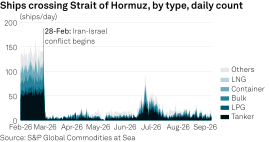
What's happening? Tankers transporting oil through the Strait of Hormuz are increasingly disabling automatic identification system signals and deploying anti-drone defenses, panelists said Sept. 10 at APPEC 2026, hosted by S&P Global Energy. The AIS blackout has turned the Strait of Hormuz into a "mysterious black box," said Max Tay, Repsol's head of heavy products in Asia. Estimates of oil volumes transiting the strait ranged from 6 million barrels/day to 10 million b/d. Emarat Maritime Managing Director Rishi Nyati described tankers as "completely dark," with some ships' names painted over.
What's next? Rahul Kapoor, vice president and global head of shipping and metals at S&P Global Energy, said tanker freight rates have risen predominantly due to restricted vessel availability. The resumption of normal transit through the Strait of Hormuz and the recovery of oil flows are expected to proceed gradually through the end of 2027, Kapoor said. The bunker market remains vulnerable to localized availability disruptions as blenders shift to just-in-time operations, potentially producing mini supply shocks, Tay said.
2. Sinopec sees China EV sales at record high
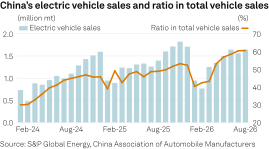
What's happening? China's electric vehicle penetration reached a record 60.6% of new vehicle sales in August and could rise to 75%-80% by 2030, said Fairy Wang, vice president of Sinopec's Economics & Development Research Institute, APPEC conference on Sept. 10. China has already exceeded the government's 2035 target of 50% EV penetration by about a decade. The country is on track to surpass targets outlined in its 15th Five-Year Plan (2026-30), released on Sept. 11, which aims for electric passenger and commercial vehicles to account for 70% and 40% of new vehicle sales, respectively, by 2030.
What's next? China's demand for refined products peaked in 2023, and total oil demand likely peaked in 2025, leaving the country's nearly 1 billion metric tons/year refining system with prolonged overcapacity, Wang said. Average refinery utilization currently stands at about 73%. Total refining capacity could decline to 900 million-930 million mt/year by 2030 as smaller, less efficient refineries close. Refiners are expected to shift from fuels to petrochemicals by increasing production of naphtha, olefins and aromatics. Wang said product demand continues to grow in Southeast Asia, Africa and Latin America, where refinery closures in Europe and Australia could leave supply gaps.
3. US power sector gas demand heads for September record
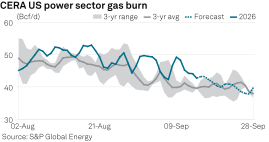
What's happening? US power sector gas demand is likely to set a record high in September as summer heat persists across much of the country. Demand from power stations averaged 46.2 billion cubic feet/day during Sept. 1-14, exceptionally high for this time of year. It was 6.8 Bcf/d higher year over year and 5.2 Bcf/d higher than the three-year average, according to S&P Global Energy CERA data. It follows the demand of 49.3 Bcf/d in August, which was a record high for any month. Cooling demand is driving the strong gas burn: US population-weighted average temperatures averaged more than 3 degrees F above normal Sept. 1-14.
What's next? Demand is expected to remain strong through the second half of the month, averaging more than 40 Bcf/d during Sept. 15-28, according to a CERA 14-day forecast. Temperatures are forecast to be about 3 F above normal for Sept. 16-29.
Even with the high demand, prices have been relatively subdued.4. Brazil beef exports pivot to US amid China, EU challenges
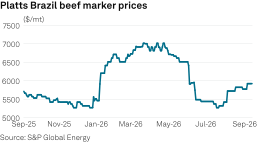
What's happening? Brazil's beef exporters may offset weaker shipments to China and the EU in marketing year 2026 by benefiting from a temporary expansion of the US tariff-free import quota, according to the market participants. The US increased its tariff-free quota for lean beef trimmings by 300,000 mt for September-November to ease domestic beef prices. Brazil exported 240,975 mt of beef to the US during January-August, up 37.2% year over year, according to Brazil's Secretariat of Foreign Trade. Platts assessed the Brazil beef marker at $5,920/mt Sept. 14, up 6.3% year over year.
What's next? CERA forecasts Brazil's beef exports to the US at 401,301 mt in 2026, with potential for 40%-50% growth by year-end. However, overall exports are projected at 3.86 million mt in MY 2026, down 11.9% year over year. Shipments to China face pressure from annual import quotas set at 1.1 million mt for 2026, while EU imports were suspended effective Sept. 3 over antimicrobial compliance concerns.
5. Aframax freight rates hit record high on tight tonnage
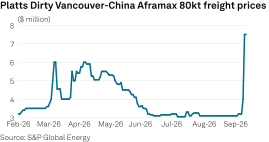
What's happening? Aframax freight rates reached an all-time high on Sept. 11, driven by tight vessel availability and strong global demand. The benchmark 80,000 metric ton Vancouver-China route reached $7.5 million, the highest since Platts began assessing it on Feb. 2, after ExxonMobil chartered a vessel from Centrofin for an end-September cargo. The rate had held steady at roughly $3.1 million through August and early September. Shipowners leveraged tight tonnage and strengthening markets in the Far East and Arab Gulf to command premium rates, the shipbroker said.
What's next? Shipowners are expected to demand premium rates as the position list remains tight, a shipbroker said. Market sources reported further fixing activity, with tankers heard to be placed on subjects at w475 and subsequently at w500. Global freight rates have increased following the latest escalation in the conflict between the US and Iran. "The sky is the limit [on rates] when freight forward agreements and owners [are] bulled up," a second shipbroker said.
Reporting and analysis by Mia Pei, Oceana Zhou, Killian Staines, Sampad Nandy and Lucas Casas.
