Crude Oil, Maritime & Shipping, Refined Products, Wet Freight, Fuel Oil
September 10, 2026
APPEC: Tankers transit Hormuz in the dark as oil flows persist

By Mia Pei
Editor:
HIGHLIGHTS
Hormuz oil flows at 6 mil-10 mil b/d or higher
Vessel scarcity drives freight rates higher
Blenders cut inventories amid backwardation
Tankers transporting oil through the Strait of Hormuz are increasingly disabling automatic identification system signals, masking vessel identities and deploying anti-drone defenses, with flows through the waterway estimated across a wide range, panelists said Sept. 10 at APPEC 2026.
Max Tay, Repsol's head of heavy products in Asia, said the AIS blackout had turned Hormuz into a "mysterious black box," preventing traders and analysts from accurately tracking vessel movements.
Estimates of oil volumes transiting the strait ranged from 6 million barrels/day to 10 million b/d, potentially producing significantly different market and price expectations, Tay said Sept. 10 during a panel discussion at the conference, hosted by S&P Global Energy, in Singapore.
Emarat Maritime Managing Director Rishi Nyati described tankers operating through the southern Omani corridor as "completely dark," with some ships' names painted over.
Nyati estimated that about 10 million b/d of oil, or possibly more, was passing through the Strait of Hormuz, alongside additional volumes transported via regional pipelines.
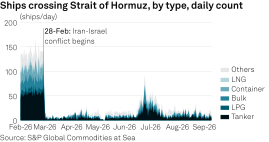
An S&P Global Commodities at Sea report showed that Strait of Hormuz traffic remained steady at 17 ships on Sept. 9, while the tanker New Andros, carrying Iraqi fuel oil, remained outside Hormuz following an attack in the Gulf.
Some tankers operating through Hormuz have introduced enhanced security measures, including drone cages around vessel bridges, electronic jamming equipment, and procedures to move crews into safe rooms on the side of the vessel considered less exposed to attack, depending on the direction of travel, according to Nyati.
"I have been doing this for 30 years. I have never seen anything like this before," Nyati said.
Emarat had taken one vessel out of the region and was not currently sending ships through the Strait of Hormuz because of heightened security risks, he said.
Despite the disruption, shipping continued to transport oil from producing to consuming markets without causing severe shortages, a recessionary shock, or oil prices of $200-$300/b that some market participants had initially predicted, Nyati said.
Freight rates rise
Tanker freight rates have risen predominantly due to restricted vessel availability rather than an increase in underlying cargo demand, Rahul Kapoor, vice president and global head of shipping and metals at S&P Global Energy, said.
"What you are seeing is primarily because of vessel supply, not cargo demand as such," Kapoor said, adding that S&P Global Energy expected the resumption of normal transit through the Strait of Hormuz and the associated recovery in oil flows to proceed gradually through the end of 2027.
Restricted vessel availability and limited visibility over Hormuz movements were also disrupting product arbitrage economics, according to Tay.
The east-west fuel oil arbitrage widened from about $70/mt three weeks earlier to $90/mt within a week, Tay said. He noted that indicative freight for a Suezmax voyage from Rotterdam to Singapore was initially around $9.5 million in August, before vessel offers rose to $10.5 million-$11 million.
Bunker supply uncertainty
The bunker market was not facing an outright fuel oil shortage, but suppliers remained vulnerable to localized or short-lived availability disruptions, Tay said.
Strong backwardation was discouraging blenders from holding inventory and prompting them to prepare fuel closer to delivery dates, according to Tay. A late-arriving or off-specification component could therefore prevent a supplier from delivering an on-specification bunker stem as scheduled.
"Blenders are now taking less storage; they are blending just in time," Tay said, warning that the practice could produce "mini supply shocks."
Bunkering activity in Fujairah had recovered to about 40% of prewar levels, while Singapore remained comparatively steady, Tay said.
China had also proven resilient with domestic fuel oil production, while "pockets of bunkering demand" were emerging along the African coast as shipping routes adjusted, Tay said.
