Electric Power, Natural Gas, Coal
September 14, 2026 · Updated September 15, 2026
September heat drives record US power sector gas burn; prices remain subdued

Editor:
HIGHLIGHTS
Gas climbs despite higher renewables, coal
Strong production outlook limits price upside
US power sector gas demand is likely to set a record high in September as summer heat persists across much of the country.
Demand from power stations averaged 46.2 billion cubic feet/day during Sept.1-14, exceptionally high for this time of year. It was 6.8 Bcf/d higher year over year and 5.2 Bcf/d higher than the three-year average, according to data from S&P Global Energy CERA.
Demand is expected to remain strong through the second half of the month, averaging more than 40 Bcf/d during Sept. 15-28, according to a CERA 14-day forecast. That would put power sector gas burn on pace to shatter the previous September record of 40.7 Bcf/d in 2024.
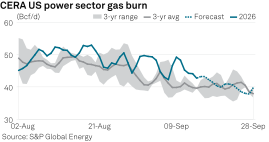
It follows a record-setting August when power burn averaged 49.3 Bcf/d, the highest for any month, surpassing the previous high of 49.2 Bcf/d in July 2024, CERA data showed.
Hot weather is driving the strong demand. US population-weighted average temperatures averaged more than 3 degrees F above normal Sept. 1-14, and are forecast about 2 F above normal for Sept. 15-28, according to CERA data.
The high-power sector gas burn comes even as competing technologies record significant growth. Combined wind and solar output were about 360 gigawatt-hours/day higher year over year during Sept. 1-13, while coal-fired generation rose by 650 GWh/d, according to the Energy Information Administration's hourly electric grid monitor. Stronger overall power demand meant gas-fired generation grew by about 680 GWh/d.
Prices
The warm weather outlook supported futures prices Sept. 14, although they remain relatively subdued. The NYMEX front month rose to $2.88/MMBtu, up 5 cents from its prior settlement, according to data from exchange CME Group.
"NYMEX winter contracts slipping to fresh lows last week may continue to throttle the extent of upside potential at the front of the NYMEX curve," Eli Rubin, senior energy analyst with EBW Analytics, wrote in a Sept. 14 market note to subscribers. "The continued gathering of production tailwinds is a bearish headwind for NYMEX gas futures into 2027."
US production was about 4 Bcf/d higher in the first eight months of 2026 compared with 2025, with the Permian Basin making up 1.7 Bcf/d of that growth, according to CERA data. The Permian now has a clear runway for growth, with several new egress projects entering service this year.
Henry Hub spot prices have also been relatively subdued, averaging $2.85/MMBtu for Sept. 1-14 delivery, according to data from Platts, part of S&P Global Energy.
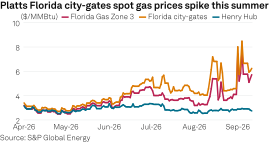
But the record power-sector gas burn has led to higher prices in the Southeast. Cash prices at Florida Gas Zone 3 averaged $5.78/MMBtu during Sept 1-14, while Florida Gas city-gates averaged $6.48/MMBtu.
Temperatures in the Southeast were 3.5 F above normal during Sept 1-14, lifting power sector gas burn to 11.8 Bcf/d, about 1.3 Bcf/d higher than the three-year average.
