Refined Products, Chemicals, Crude Oil, Diesel-Gasoil, Naphtha, Olefins, Aromatics, Gasoline
September 10, 2026
APPEC: China's EV push to reach 75% by 2030, reshape refining sector

Editor:
HIGHLIGHTS
EV adoption displaces 56 mil mt oil in 2026
Refining capacity drops to 900 mil mt by 2030
Asian markets accelerate vehicle electrification
China's electric vehicle penetration could reach 75%-80% by 2030, up from more than 60% currently, accelerating transport fuel displacement and forcing refiners to increasingly rely on capacity rationalization, petrochemical integration and exports, Fairy Wang, vice president of Sinopec's Economics & Development Research Institute, said at APPEC on Sept. 10.
Wang said China has already surpassed the government's 2035 target of 50% EV penetration, reaching the milestone about a decade early.
China's EV penetration rate reached a record high in August, with EVs accounting for 60.6% of new vehicle sales.
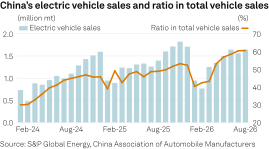
EVs are expected to displace about 56 million metric tons of oil demand in China this year, equivalent to roughly 1.2 million barrels/day, with about two-thirds of the reduction coming from gasoline and one-third from diesel, she said.
China's EV fleet has grown to about 50 million vehicles, or roughly 30% of the total vehicle parc. However, EVs have a disproportionately large impact on fuel demand because they are used more intensively than conventional vehicles, particularly in public transportation fleets and ride-hailing services.
"One EV replaces 1.7 to two gasoline cars," Wang said.
She attributed the rapid adoption to years of subsidies, a nationwide charging network with more than 23 million charging points, and improving battery technology that now enables many models to travel about 500 km on a single charge.
Despite slower growth expected as adoption spreads to rural areas and colder northern provinces, Wang said EV penetration is likely to continue rising through the decade.
"We believe that by the end of 2030, China's EV penetration will reach 75% or even 80%," she said.
Asia likely to accelerate electrification
Wang said that recent Middle East supply disruptions and elevated fuel costs are prompting many Asian countries to reassess energy security and accelerate EV adoption.
She identified Australia, Singapore and Vietnam as leading markets, supported by favorable economics, infrastructure investment and policy incentives.
India, South Korea, Indonesia, and Malaysia form a second tier of emerging EV markets, with penetration between 10% and 30%, while adoption remains below 10% in countries such as Japan, Bangladesh, and Sri Lanka.
"Most countries will reconsider their energy security issues, and most countries will promote EV industry development, but the pace will be different," Wang said.
Refiners face structural adjustment
The acceleration of vehicle electrification is expected to intensify pressure on China's refining sector.
Wang said China's demand for refined products peaked in 2023, and total oil demand likely peaked in 2025, leaving the country's nearly 1 billion mt/year refining system with prolonged overcapacity. Average refinery utilization is currently about 73%, she said.
To adapt, China is expected to continue closing smaller, less efficient refineries, particularly those with capacity below 2 million mt/year. Total refining capacity could decline to 900 million-930 million mt/year by 2030, according to Wang.
Refiners are also expected to accelerate the shift from fuels to petrochemicals by increasing production of naphtha, olefins, and aromatics to meet demand growth in the chemicals sector.
A third avenue is exports.
While Chinese transport fuel demand has peaked, Wang said product demand continues to grow in parts of Southeast Asia, Africa, and Latin America. Refinery closures in Europe and Australia, along with limited capacity additions elsewhere, could leave supply gaps.
"We think there will be some shortage of products in other regions, especially in Latin America and Africa," Wang said.
However, China's ability to capitalize on those opportunities will largely depend on the government's fuel export quota policy, she added.
