Crude Oil, Maritime & Shipping, NGLs, Agriculture, Energy Transition, Metals & Mining Theme, Dry Freight, Oilseeds, Grains, Carbon, Ferrous, Non-Ferrous, Vegetable Oils
March 17, 2026
COMMODITY TRACKER: 5 charts to watch this week

By Staff
Middle East conflict creates the largest oil supply disruption in history and food inflation concerns rise globally. European carbon prices hit ten-month lows ahead of the EU summit, while China's metals trade shows mixed trends.
1. Global oil market faces supply disruption
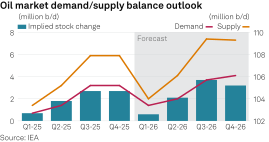
What's happening? The International Energy Agency reports the largest supply disruption in history as the Middle East conflict drives global oil production to four-year lows. According to the IEA's March 12 monthly oil market report, Persian Gulf suppliers have cut crude production by at least 8 million b/d and shut in an additional 2 million b/d of condensates and natural gas liquids. S&P Global Energy CERA analysts project Dated Brent crude could recede to $80/b in April if Strait of Hormuz flows recover.
What's next? The IEA revised its 2026 outlook, reducing the global oil supply growth forecast to 1.1 million b/d from 2.4 million b/d previously. Market surplus is rapidly declining, expected to shrink from 3.8 million b/d to just 600,000 b/d in Q1 2026. IEA member states have released 400 million barrels from stockpiles, but warn this is only a temporary measure. The agency projects continued uncertainty with no immediate signs of conflict de-escalation.
2. Middle East conflict sparks global food inflation concerns
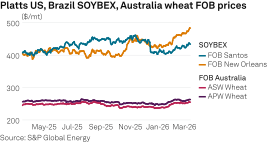
What's happening? The ongoing Middle East conflict is escalating food inflation risks by disrupting energy and fertilizer trade flows. The UN Food and Agriculture Organization's Food Price Index increased 0.9% month over month to 125.3 points, marking its first rise in five months. The increase was driven by firmer prices in cereal, meat, and vegetable oil markets, signaling potential widespread challenges across the agricultural supply chain.
What's next? Market analysts anticipate rising input costs could push grain and oilseed prices higher, particularly for wheat, corn and soybeans. The UN World Food Programme warns that escalating fuel and food costs linked to the conflict may intensify food insecurity across the Middle East and other regions. Import-dependent economies in the Persian Gulf and parts of Asia are especially vulnerable to potential supply disruptions.
3. European carbon prices fall on policy uncertainty
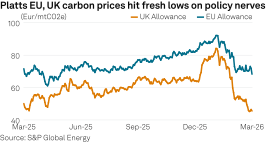
What's happening? EU Allowances fell to Eur68.43/mtCO2e, a ten-month low over the week ending March 13, according to Intercontinental Exchange data. Policy risk is back in focus ahead of the March 19 EU Council summit. A review of the EU's carbon market is scheduled for the third quarter and is expected to cover market mechanisms and sectoral expansion. Market participants are paying particular attention to potential changes to the Market Stability Reserve, the supply-management tool for allowances, because it could be amended without reopening the core ETS Directive, potentially bringing changes sooner than broader reforms.
What's next? Danylo Babkov, carbon analyst, S&P Global Energy Horizons, said the power sector's potential coal pivot could add approximately 32 million mt of carbon emissions, potentially increasing allowance demand. However, weaker activity in petrochemicals and refining might offset around 16 million mt. ICE data shows investment funds reduced long positions to 52.4 million allowances, the shortest net length since August 2025.
4. China metals trade sees divergent trends in 2026
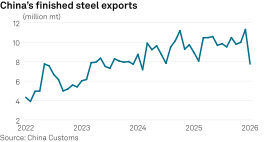
What's happening? China's metals trade displayed mixed patterns in the first two months of 2026. Finished steel exports fell 8% year over year to 15.591 million metric ton, with daily volumes reaching their lowest since July 2024, China Customs data showed on March 10. Meanwhile, unwrought aluminum and aluminum product exports increased 12.8% to 971,000 mt, according to the data released by the General Administration of Customs March 10. Copper imports weakened, dropping 16.1% to 700,000 mt, with Platts, part of S&P Global Energy, assessing the premium at $45/mt CIF China on March 16. Market participants noted limited direct aluminum trade exposure to the Middle East.
What's next? Steel exports are expected to soften further in March and April, as shipping disruptions through the Strait of Hormuz and rising antidumping cases against Chinese steel products weigh on trade flows, according to the trading sources. The aluminum market is likely to see China remain a net primary ingot importer, with the SHFE/LME ratio around 1.07. The global copper concentrates market is expected to see a deficit of 542,000 mt in 2026, expanding from 205,000 mt in 2025, indicating potential supply tightness, according to a February S&P Global Energy CERA report.
5. Palm oil mill effluent market rises amid geopolitical tensions
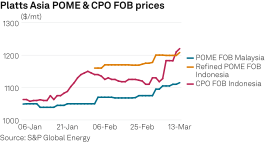
What's happening? The Asian palm oil mill effluent market has experienced a significant rise, triggered by escalating geopolitical tensions in the Middle East. Crude oil price increases have boosted the energy sector, subsequently pushing up palm oil prices. Market sources from Singapore indicate rising inquiries and increased willingness to pay higher prices for POME, with traders cautiously monitoring market volatility. Platts assessed POME FOB Malaysia at $1,115/mt on March 16.
What's next? Market participants remain cautious about rapid price fluctuations. A Singapore-based trader noted that buyers prefer faster shipments to minimize risks associated with energy market fluctuations. The market continues to be influenced by palm oil price trends, with an inherent delay in price adjustments due to the physical collection process.
Reporting and analysis by Kelly Norways, Sampad Nandy, Irina Breilean, Eklavya Gupte, Shivam Prakash, Jing Zhang, Lucy Tang, and CK Quick.

Editor: