Fertilizers, Chemicals, Energy Transition, Maritime & Shipping, Agriculture, Renewables, Dry Freight, Food
March 13, 2026
Middle East war impacts global food security over fertilizer, fuel and freight issues

HIGHLIGHTS
Conflict drives fuel, fertilizer costs up
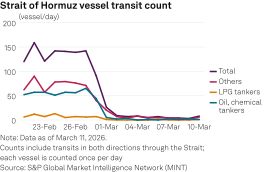
Shipping drops 75% through Strait of Hormuz
Food inflation had just begun to abate
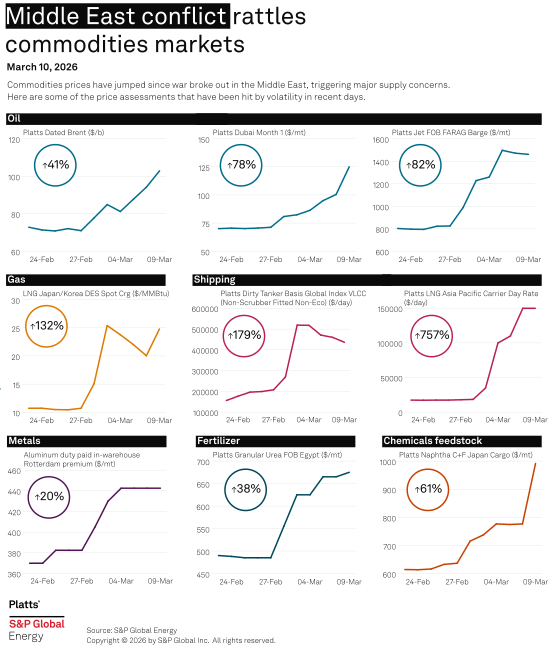
The escalating conflict in the Middle East is raising renewed concerns about global food inflation, as disruptions to energy, fertilizer and shipping markets threaten to push farm-to-fork costs higher across agricultural supply chains.
Warnings from the UN World Food Programme, researchers at the International Food Policy Research Institute (IFPRI), and market data compiled by S&P Global Energy show that the conflict's impact is spreading beyond the region through rising fuel prices, disrupted maritime routes and tightening fertilizer supplies — all key inputs to global food production.
The pressure is emerging just as global food prices had begun to stabilize following several years of volatility due to supply chain disruptions in the Black Sea stemming from the Russia-Ukraine war.
The UN Food and Agriculture Organization's Food Price Index rose for the first time in five months, averaging 125.3 points, up 0.9% month over month, driven by firmer cereal, meat and vegetable oil prices.
While the index remains below year-earlier levels, the new geopolitical situation could quickly reverse that trend.
Energy and fertilizer shocks
Shipping disruptions around the Strait of Hormuz, a critical chokepoint for global energy and fertilizer trade, are at the center of the emerging inflation risk.
According to an IFPRI publication on March 6, roughly 27% of global oil exports, about 20% of LNG trade and up to 30% of global fertilizer exports move through the waterway linking the Persian Gulf to global markets.
Since the start of hostilities in late February, shipping traffic through the strait has dropped sharply amid drone and rocket attacks on tankers and surging maritime insurance costs.
Energy markets reacted quickly, with crude oil futures for May delivery rising more than $10/b, roughly 15%, in the first days of the conflict and European natural gas prices jumping more than 50%, according to IFPRI.
Higher energy prices quickly feed into agricultural input markets.
Nitrogen fertilizers rely heavily on natural gas as a feedstock, and fertilizer exports from Gulf producers such as Qatar, Saudi Arabia and Oman have already slowed.
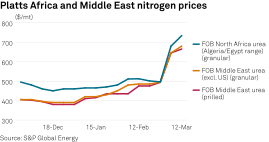
Predictably, prices for key fertilizers surged.
The cost of producing ammonia in Europe has soared since the outbreak of the war in the Middle East due to natural gas costs.
Platts, part of S&P Global Energy, calculated the estimated production cost at $652/mt, including carbon costs March 12, when the Dutch TTF front-month contract settled at Eur50.78/MWh.
This is up around 65% from $396/mt on Jan. 5, when the TTF was Eur27.41/MWh.
Fertilizer prices
IFPRI estimates that as much as one-third of global fertilizer trade could be affected if the disruption persists.
Higher fertilizer costs could then squeeze farm margins and influence planting decisions in the coming seasons, potentially reducing fertilizer application rates or shifting acreage toward less input-intensive crops.
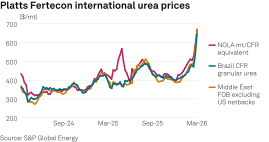
The plunge in shipping activity through the Strait of Hormuz has also pushed global fertilizer prices higher.
Falling shipments of natural gas—an important feedstock for nitrogenous-based fertilizers—have driven up prices, while fertilizer exports from the Persian Gulf have dropped precipitously. Qatar, Saudi Arabia, Bahrain, and Oman are large fertilizer exporters, particularly of urea, diammonium phosphate (DAP), and anhydrous ammonia.
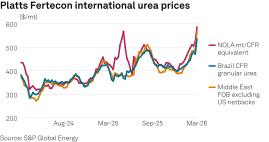
Middle East urea prices closed over $590/mt on March 5, up over $90/mt compared to a week earlier, a 19% increase, while US Gulf DAP prices hit $655/mt, up over $30/mt, a 5% increase, IFPRI said.
As much as one-third of global fertilizer trade could be affected, said the IFPRI report.
Food diversification threat
The increased costs come at a time when farmers around the world are already facing lower prices for grains, oilseeds, and other field crops. Higher fertilizer prices mean lower profitability margins for producers and could lead some to plant less input-intensive crops like rice, wheat, or maize in favor of oilseeds, or apply less fertilizer on their crops.
S&P Global CERA projects Italian corn area to drop to about 480,000 hectares in marketing year 2026-27 (July-June) from 541,000 hectares in MY 2025-26. Poland, France and Spain are expected to see declines of 9%, 3% and 11%, respectively, over the same period.
The immediate impact may be relatively small, since many farmers would have already made input purchases for spring planting in the Northern Hemisphere.
However, a prolonged conflict could affect planting decisions and yields in the Southern Hemisphere, as well as fertilizer applications for rice in South and Southeast Asia.
Freight disruptions ripples
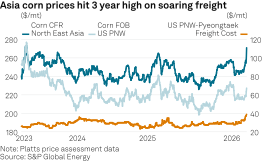
Shipping disruptions are also raising global freight costs and extending delivery times for agricultural commodities.
War-risk insurance premiums for vessels transiting the Persian Gulf have increased by about 50%, while shipping traffic through the Strait of Hormuz has fallen by roughly 75% in recent days, according to S&P Global shipping data.
Platts Container Rate 33, for the West Coast India-Middle East route, was assessed at $3,400/forty-foot equivalent unit (FEU) on March 11, up 1,136% from March 2, according to S&P Global Energy data. Meanwhile, freight for the same route per twenty-foot equivalent unit stood at $2,200/TEU on March 11, having risen 1,000% from March 2, Platts data shows.
According to ING Global Markets Research, the conflict has effectively embedded a "geopolitical risk premium" across energy, freight and agricultural markets.
Food security risks mount
The UN World Food Programme on March 8 said rising fuel and food costs linked to the conflict risk pushing more households toward food insecurity in the Middle East and beyond.
Supply chain disruptions and longer shipping routes are already delaying humanitarian deliveries and raising operational costs for aid agencies.
"People already on the edge could be pushed further toward severe food insecurity," the WFP said in an assessment of the crisis.
The agency is adapting supply routes and scaling up emergency operations in several countries while monitoring potential refugee movements across the region.
WFP officials warned that global supply chains face a rare "dual chokepoint" disruption, with shipping already strained by Red Sea attacks and now facing additional risks around the Strait of Hormuz.
Import-dependent regions exposed
Countries in the Persian Gulf and parts of Asia with import-dependent economies are particularly vulnerable to supply disruptions.
IFPRI notes that Gulf states depend heavily on imported wheat, vegetable oils and sugar, with per-capita wheat consumption often exceeding 100 kg per year.
If the Strait of Hormuz remains restricted, importers may be forced to rely on alternative land routes or longer maritime corridors, which would further raise costs. For example, Saudi Arabia could redirect some imports through Red Sea ports, though shipping volumes in that corridor have already declined significantly since late 2023 due to Houthi attacks, IFPRI said.
The Philippine Department of Agriculture said it is monitoring the conflict's impact on food prices, warning that higher fuel, fertilizer and shipping costs could quickly raise the landed cost of wheat and animal feed.
