Crude Oil, Refined Products, Maritime & Shipping
Updated March 09, 2026; First published March 06, 2026
FACTBOX: Oil futures cross $110/b as Middle East conflict hits production
HIGHLIGHTS
Brent futures trade at $114.28/b; NYMEX at $114.15/b in Asia
Middle East producers cut output as infrastructure attacked
Crude oil futures extended gains in midmorning trading in Asia on March 9, driven by mounting supply risks as key producers cut output amid the Middle East conflict.
At 11:23 am Singapore time (0323 GMT), the ICE May Brent crude futures contract rose $21.59/b (23.29%) from the previous close to $114.28/b, while the NYMEX April light sweet crude contract rose $23.25/b (25.58%) to $114.15/b over the same period.
Mojtaba Khamenei, the son of the late Iranian supreme leader Ayatollah Ali Khamenei, has been appointed by Iran's Assembly of Experts to succeed his father as the new supreme leader of the country, various media outlets reported March 9.
Producers in Iraq's southern fields have seen output plunge to 1.3 million b/d, directed to local refineries and power stations, Kazem Karim, Basrah Oil Co.'s deputy director for field and license affairs, told Iraqi state media March 8.
Saudi Arabia's 1 million b/d Shaybah oil field saw more rounds of drone strikes over March 7-8, but all were intercepted and destroyed, with no reports of damage, according to social media posts by the country's Ministry of Defense.
The oil field, located in the Empty Quarter, was the target of one intercepted drone strike on March 8, the ministry said on X, marking the seventh round of early-morning attacks on the facility amid the Middle East conflict.
The following are key facts on the impact of the Middle East conflict on oil, oil products and shipping:
Trade flows
Asian refiners are beginning to pivot to alternative suppliers amid unprecedented disruption to Middle Eastern supply chains.
- An Iran-linked VLCC crossed the Strait of Hormuz in the early hours of March 7 and is heading for China carrying 2 million barrels of heavy sour crude, suggesting Chinese refiners could continue to receive Iranian barrels even with the critical waterway effectively shut.
- The US Department of the Treasury issued a 30-day waiver on March 5, allowing delivery of sanctioned Russian oil to India to prevent a near-term supply disruption.
- Singapore's weekly base oil exports dropped 39.8% week over week to 41,258 metric tons on March 4, Enterprise Singapore data showed, amid supply fears.
- India is seeking alternative bitumen sources amid the conflict, Platts, part of S&P Global Energy, reported earlier, with 90% of its imports typically coming from the Middle East.
- Traders and oil importers have deferred chartering for several Persian Gulf tankers, releasing previously hired ships. At least six LR tankers were released over March 4-5 after being chartered for Persian Gulf spot voyages.
- South Korea's Korea National Oil Corp. received a 2-million-barrel cargo of Kuwaiti crude on March 6 for strategic storage amid concerns about supply disruptions.
- Oman crude loadings at Mina al Fahal port continue uninterrupted.
- Analysts have said the Trump administration's proposal to provide insurance for ships in the Strait of Hormuz is unlikely to resolve the backlog in the short term.
Prices
Energy prices have surged across oil and shipping markets amid fears of supply disruptions from the conflict.
- At 11:23 am Singapore time (0323 GMT), the ICE May Brent crude futures contract rose $21.59/b (23.29%) from the previous close to $114.28/b, while the NYMEX April light sweet crude contract rose $23.25/b (25.58%) to $114.15/b over the same period.
- Dated Brent was assessed at $94.195/b on March 6, 7.4% higher day over day and up from $70.94/b prior to the war.
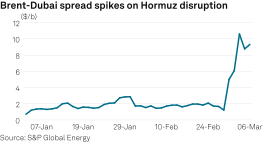
- The Brent-Dubai spread widened 6% to $9.31/b on March 6, up from $1.67/b on Feb. 26 to its widest since mid-2022.
- The May Dubai swap was pegged at $97.53/b at 10 am Singapore time (0200 GMT), up $20.89/b (27.26%) from the previous Asian market close.
- NYMEX front-month ULSD rose 57 cents/gal to $4.1919/gal, while front-month RBOB rose 38.8 cents/gal to $3.1342/gal.
- The VLCC index for non-scrubber-fitted non-eco ships ended at $460,152/day on March 6, down 2.3% day over day but up 121.23% from $208,000/day pre-war.
Infrastructure
Direct attacks on energy facilities continue as the US-Israel bombing campaign against Iran continues.
- Floating storage of crude and condensate in Southeast Asian waters has fallen sharply from the record high reached at the end of 2025, largely driven by a draw-down of Iranian barrels, according to S&P Global Commodities at Sea data.
- Iraq's oil production from its southern fields has plunged to 1.3 million b/d, directed to local refineries and power stations, Kazem Karim, Basrah Oil Co.'s deputy director for field and license affairs, told Iraqi state media March 8.
- Several oil depots in Iran's Tehran and Alborz provinces were hit on March 7 by missiles, state-owned National Iranian Oil Products Refining & Distribution Co. said.
- Kuwait has trimmed its crude production and refining throughput on a "precautionary" basis following Iranian attacks on energy infrastructure and oil tankers in the Gulf, its state oil firm said March 7.
- Saad al-Kaabi, Qatar's energy minister, told the Financial Times that Gulf energy producers could shut production within days.
- The Fujairah Industrial Zone, home to a refinery and one of the UAE's main crude and bunkering terminals, came under further attack on March 6, with authorities extinguishing a fire.
- An anchored VLCC owned by Mitsui O.S.K. Lines, one of the world's largest shippers, was hit by a falling object in the Gulf of Oman on March 4, the company said March 6.
- HKN Energy halted operations at the Sarsang block in Iraqi Kurdistan following a field explosion, impacting 30,000 b/d of production.
- DNO evacuated some personnel from Kurdish oil fields amid regional security concerns and attacks, potentially further denting Iraqi output.
- Qatar's energy minister said LNG deliveries would take "weeks to months" to return to normal after halting operations this week.
- Oman Oil Marketing Co. confirmed that normal operations have resumed at Duqm port fuel storage following a tank incident.
