
Resilience as a framework for sustainability
Resilience isn’t just a buzzword: It’s the driving force behind Sustainable1 from S&P Global Energy Horizons.
21 September 2026
Around the world, one word is appearing with increasing frequency in business circles: Resilience.
Resilience can mean different things to different people, much like the word “sustainability.” At S&P Global Sustainable1, we view resilience as a simple concept at its core: It means creating a strategy that can withstand disruptions, allowing an entity to thrive in the long term.
Sustainability in 2026 is a story of resilience — how stakeholders balance urgent and sometimes competing priorities in the face of uncertainty and rapid change. The term has become a mainstay in corporate leadership communication as companies respond to the current environment of disruption and fragmentation by seeking stability in the face of change.
Analysis of earnings call transcripts shows that mentions of the terms "ESG," "sustainability" and "resilience" have evolved over time. Among US-listed companies, we see that mentions of “ESG” drop after peaking in early 2021. Mentions of the word “sustainability” peaked at the start of 2022 and have tapered but remain high. The word “resilience” is on the rise, creeping back toward its peak during the COVID-19 pandemic — another period of massive disruption.

What does resilience mean in practice? How can we distinguish companies investing in their ability to withstand periods of disruption, or even thrive during them?
Sustainable1 from S&P Global Energy Horizons has developed a framework for evaluating resilience and revealing decision-useful signals to drive value creation. This framework comprises four steps or layers.
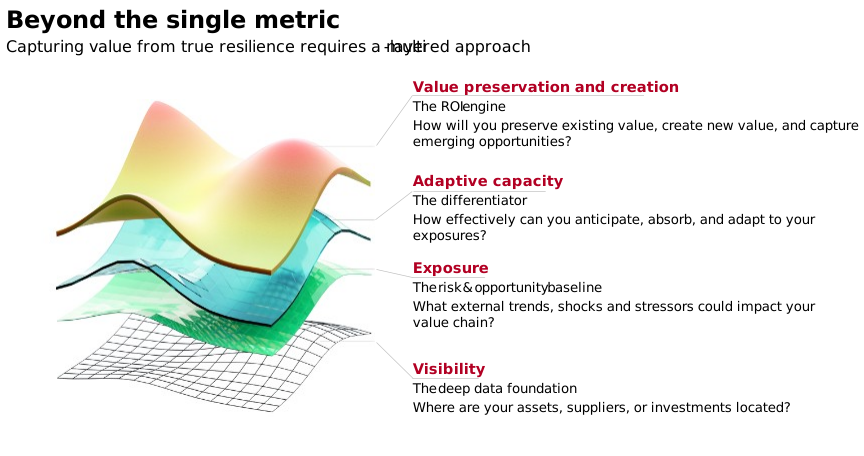
This framework can be applied to a broad range of environmental, societal, economic and technological change drivers, from the rise of AI tools, to exposure to climate physical and transition risks, to dependence on nature and biodiversity or on human capital.
This layered framework allows us to understand resilience through multiple lenses. Here, we lay out how this approach can be used to assess the resilience of a model portfolio to physical climate risk.
Visibility
S&P Global's deep baseline of data creates a foundation for understanding climate risk exposure and resilience, grounded in three key datasets:
- Climate hazard data: We combine industry-standard CMIP6 data with proprietary S&P Global models developed by our Climate Center of Excellence to map 10 core climate hazards across four climate change scenarios and eight time periods for the entire world.
- Corporate hierarchy and entity relationships: S&P Global Market Intelligence data offers comprehensive mapping of corporate hierarchies, inter-company relationships and business relationships via the Cross Reference Service.
- High-resolution asset-level location coverage: Sustainable1 has complete coverage of more than 9 million asset locations. Our approach includes analyst-validated coverage of material asset locations for more than 850,000 companies. This produces an accurate view of risk exposure, particularly in emerging markets.
- Green capex & opex: This base layer also includes comprehensive as-reported data on opex and capex directed to adaptation activities via S&P Global's partnership with Arctal.
Our visibility layer also includes datasets showing where companies stand on sustainability. This view includes:
- The S&P Global Corporate Sustainability Assessment (CSA), an annual evaluation of the sustainability practices of more than 13,000 companies globally. It captures more than 3,500 data points across nearly three dozen environmental, social, governance and economic topics.
- S&P Global ESG Scores measure a company’s performance on and management of material environmental, social and governance risks, opportunities and impacts informed by the CSA process.
Taken together, these datasets create a baseline view of the links between physical hazards and the specific assets and operations that could be exposed — improving decision-usefulness for risk management, investment research and disclosure.
Exposure
To understand climate resilience, we start by assessing exposure to climate physical hazards. Corporate losses due to climate physical hazard exposures are projected to reach a cumulative $28 trillion, absent adaptation, by 2050 for the world’s largest companies that make up the S&P Global 1200, according to projections using the Sustainable1 Physical Risk dataset. This projection uses the SSP2-4.5 climate change scenario, which assumes strong greenhouse gas emissions reductions.
This projected financial impact is not uniform across companies and sectors. The chart below presents cumulative financial losses driven by evolving climate hazards to 2050 compared with total revenue in 2025 for a model portfolio based on companies in the S&P Global 1200. This view can enable investors to better understand where climate physical risk is concentrated within a portfolio and identify holdings where risk is disproportionately high or low relative to the size and financial resources of the company. For example:
- Companies in the top-left quadrant are projected to face high climate hazard financial impacts per $1 million of revenue. The communication services, utilities, energy and information technology sectors are overrepresented in this quadrant. These companies represent possible targets for engagement or divestment to reduce portfolio exposure to future climate hazard-related losses.
- Companies in the bottom right quadrant face lower projected climate hazard financial impacts per $1 million of revenue and could represent the core of a climate risk-resilient portfolio.
- Companies in the bottom left quadrant face lower climate hazard financial impacts, broadly in proportion with revenue, representing possible targets for monitoring and engagement to build capacity.
- Companies in the top right quadrant face higher climate hazard financial impacts broadly in proportion with revenue and could present an opportunity to engage to drive adaptation and resilience (A&R) capital expenditure (capex).

Adaptive capacity
Next, we assess the capacity of portfolio companies to adapt and respond to the climate physical risks they face. There is now growing acknowledgment that the world will fall short of the Paris Agreement’s goal of limiting global warming to 1.5 degrees C above preindustrial levels, and limiting the overshoot past this threshold is becoming a priority. This is leading to more pragmatic discussions that recognize that the world’s response to climate change needs to include significant investment in A&R to prepare for the reality of the warming world.
Below, we plot cumulative costs due to climate physical hazards per $1 million of revenue against the performance of companies on the Physical Climate Risk Adaptation criteria in the S&P Global Corporate Sustainability Assessment. This view reveals a concentration of companies with high projected future climate damages and limited evidence of effort to manage these impacts. In our model portfolio of S&P Global 1200 constituents, there are 127 companies exposed to high climate hazard damages ($100,000 or more per $1 million in revenue) but have low maturity in physical climate risk adaptation practice and strategy.
These companies could be prime targets for engagement to drive the adoption of best practices, increase board and management attention to climate hazards and increase investment in climate-related A&R.
In contrast, companies at the highest level of adaptation readiness face a wide range of climate hazard exposure and could form the core of a portfolio that is more resilient to climate physical risk.

Value preservation and creation
Finally, we turn our attention to opportunities to take action to protect portfolio value and identify new investment opportunities. Rising climate physical hazard exposure creates not only risk for investors but also opportunities to finance the A&R investments that will strengthen companies in the medium term.
While the implementation of A&R initiatives is naturally highly site- and context-specific and dependent on detailed engineering assessments, it is useful to consider the magnitude of the losses that could be avoided through common adaptation solutions as a “benchmark” for potential positive-ROI A&R capex. We estimate that potential avoided climate hazard damages for the S&P Global 1200 over the next 25 years could justify total investment in A&R capex of at least $1.2 trillion. This total annualizes to $91 billion over the next 25 years, an investment target we call the Economic A&R Capex Benchmark.
We reach $1.2 trillion in cumulative A&R investment opportunity by starting with our projection of $28 trillion in climate hazard damages by 2050 for S&P Global 1200 constituents. We apply a 6% annual discount rate to arrive at a cumulative present value of $3.1 trillion in costs in 2026 prices. We then adjust for ongoing operation and maintenance expenses and a margin for project delivery risk, to estimate the total A&R capex spend that is expected to deliver a positive return on investment. The cumulative $1.2 trillion to 2050, or $91 billion annually, represents investments in A&R solutions where the present value of avoided future losses is greater than the lifetime capex and opex cost plus a 10% investment hurdle rate.
Data gathered by Sustainable1 in partnership with Arctal on corporate green capex commitments suggests that disclosed investment in A&R capex in 2025 fell well short of this benchmark across almost all sectors of the S&P Global 1200.
In total, disclosed A&R capex in 2025 represented just over 21% of our Economic A&R Capex Benchmark, with only the utilities sector exceeding its sector-level target, while both the materials and industrials sectors performed well relative to the overall index. These are highly capital-intensive industries with strong capex programs and significant revenue at risk if operations are disrupted by a climate hazard event.

Below, we also show that disclosed A&R-related capex represents less than 10% of overall green capex reported by S&P Global 1200 companies in 2025. While this may in part reflect investor preferences for deploying capital toward decarbonization and resource efficiency, it may also reveal an underappreciation of the magnitude of future corporate losses driven by climate physical hazards and the opportunity for resilient companies that effectively manage these risks to out-compete their peers in the future.

The limited scope of corporate A&R investment presents opportunities for investors and banks to finance the deployment of value-creating technologies and capital works that strengthen corporate resilience in the long term.
A framework for resilience
There are many other lenses through which companies can apply these layers to measure resilience, including but not limited to energy transition resilience, nature resilience, supply chain resilience, and even resilience in the context of national security or defense.

We explore these topics and more in the latest S&P Global Sustainability Quarterly, The Resilience Imperative.

Further listening:
What to expect from Climate Week NYC: Why resilience is high on the agenda | S&P Global
How sustainability is evolving into a broader conversation about resilience | S&P Global
How one of the world's largest insurers is building climate resilience | S&P Global
How food and beverage giant PepsiCo uses AI for its 'era of resilience' | S&P Global