
S&P Global Energy
COP31: Energy security, war and the climate imperative
COP31 priorities
The UN Climate Change Conference, convening in Antalya, Turkey, in November, comes as climate diplomacy shifts from pledge-making to proof of delivery. The war in the Middle East and rising trade tensions have made geopolitics inseparable from the climate agenda.
Where earlier summits chased new commitments, COP31 will be judged on delivery. That framing emerged at the UN climate meetings in Bonn, Germany, in June 2026, where delegates signaled that the next phase of the Paris Agreement will be measured less by ambition than by implementation. Tight budgets and energy-security anxieties only complicate that test.
The war in the Middle East has sharpened the calculus further, pushing electrification and energy security back to the top of the agenda. Governments are weighing the strategic cost of fossil-fuel dependence alongside its climate toll.
In the run-up to the summit, co-hosts Turkey and Australia have laid out a package of measurable global targets spanning clean energy, methane abatement and industrial decarbonization, intended to give shape and discipline to the negotiations.
Electrification looms largest among them, emerging as the connective tissue between decarbonization, energy security and industrial competitiveness. This is embodied in the COP31 presidency's flagship push to lift electricity's share of global final energy demand from roughly one-fifth today toward more than a third within a decade.
COP31's key themes are presented here, each assessed for its prospects of meaningful progress in Antalya.
Road to COP31
Despite momentum from the UN climate meetings in Bonn, persistent challenges remain ahead of COP31, including stalled climate finance commitments and uneven political engagement that constrain implementation in developing nations.
A series of regional meetings, including the pre-COP in Fiji and Tuvalu, will look to rebuild trust and narrow long-standing differences over finance and adaptation.
Ultimately, COP31's success will hinge not on new announcements but on whether parties can bridge entrenched divides and operationalize commitments already on the table.
Challenges to net zero
In 2026, S&P Global Energy CERA developed four scenarios to explore how the world could evolve under different assumptions about the future.
Under the Base Case scenario, global greenhouse gas emissions are expected to decline gradually from a peak of 50 billion metric tons of CO2 equivalent in the early 2020s to about 46 billion mtCO2e by 2050.
But under the Adaptation scenario, which balances fossil fuel-powered economic growth against heightened global warming, emissions rise to 53 billion mtCO2e by 2060. Decarbonization ambition weakens, but it does not disappear.
Under the Fracture scenario, technological progress accelerates against a backdrop of weak policy and governance. In the Renaissance scenario, emerging markets play a key role in driving a late-but-accelerated energy transition in an increasingly multipolar world.
The near-term picture for global emissions has grown more complicated. A higher-for-longer trajectory in fossil fuel demand has pushed up expectations for near-term greenhouse gas emissions, even as the long-term case for decline remains intact.
The tension between a stickier present and a still-plausible lower-carbon future is likely to run through much of the debate in Antalya.
That future will be shaped less by supply-side pledges than by the pace of electrification and the broader march of clean technology, both of which are steadily redrawing the map of global energy trade.
Per-capita electricity demand is rising across every region and under every outlook, including in mature markets that spent decades on a plateau or in decline.
Electricity is on track to become the dominant form of end-use energy — a shift only the "Adaptation" scenario fails to capture, underscoring how central electrification has become to nearly every credible pathway forward.
Decarbonization will remain uneven but directionally consistent. China and the EU are expected to continue leading the long-term shift away from fossil fuels, even as other regions move at a different pace.
How quickly electrification advances in each market — and how unevenly it does so — will determine not just the shape of the energy transition but the future contours of international trade in oil, gas and power. That granularity, as much as the headline trajectory, will matter most to how COP31's implementation agenda is judged.
The age of electrification
If COP31 has a single organizing idea, it is electrification. The COP31 presidency has proposed lifting electricity's share of global final energy consumption from around 23% today to 35% by 2035, a target billed as ambitious, yet intended to bind together clean power deployment, grid modernization and end-use electrification across transport, buildings and industry.
The rationale is as much about security as it is about emissions. Turkey's COP31 president-designate, Murat Kurum, has argued that electrifying daily life shields households and businesses from volatile fossil fuel markets, framing the target as a hedge against geopolitical shocks as much as a climate measure.
Electricity's share of global final energy consumption from around 23% today to 35% by 2035

Projected average growth in global electricity demand through 2030
3.6%
per year
The scale of the challenge is considerable. Global electricity demand is projected to grow by an average of 3.6% annually through 2030, even as 666 million people remain without access to electricity and nearly 2 billion still lack clean cooking fuels. Europe's own experience offers a cautionary tale: electrification there has stalled around 23% for a decade, well short of an indicative 32% target for 2030, prompting Brussels to prepare a fresh Electrification Action Plan.
For commodity markets, faster electrification points to an accelerating substitution of oil and gas in end-use sectors, alongside sustained demand growth for renewables capacity, grid infrastructure and critical minerals.
The International Energy Agency says electrification could cost-effectively reach 33% of global final energy consumption by 2035 using available technologies, putting a proposed 35% international target within "striking distance." However, analysts at CERA describe the target as ambitious, noting that across its four main long-term energy scenarios, the 35% threshold is not reached until well after 2035.
Complementary targets on waste, methane and circular material use round out a 10-theme action agenda at COP31 designed to give the electrification push institutional weight.
Importance of Turkey in energy, climate and geopolitics
Straddling Europe and Asia, and sitting at the crossroads of the Black Sea, the Mediterranean and the Caucasus, Turkey has long served as an energy bridge between major producing regions and consuming markets. That geography, paired with its NATO membership and deepening ties to both European and Gulf energy systems, gives Ankara a geopolitical weight in climate diplomacy that extends well beyond its own emissions footprint.
The country submitted an updated NDC in late 2025, introducing a 2035 target of a 42% emissions cut from business-as-usual, capping emissions at 643 million mtCO2e, while reaffirming its 2053 net-zero goal. Renewable ambitions are steep. Ankara aims to quadruple wind and solar capacity to 120 GW by 2035, alongside plans to scale electrolyzer capacity to 70 GW by 2053.
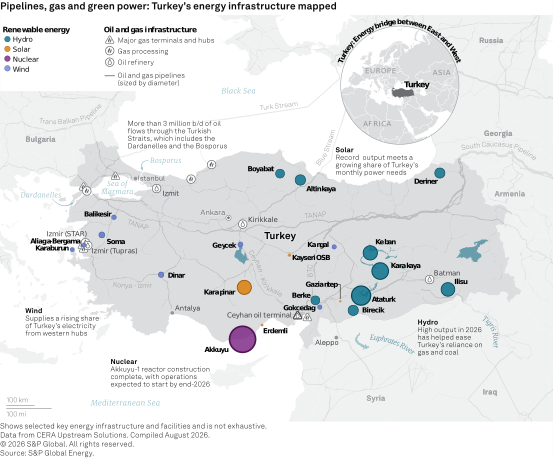
A consequential domestic move came in July 2025, when Turkey adopted its first Climate Law, establishing the legal groundwork for a national emissions trading system and stronger monitoring and verification requirements. The legislation marks a pivot from target-setting to enforcement, echoing elements of the EU's climate framework and adding sector-specific rules for aviation, shipping and industrial emissions. These measures carry particular weight for export-heavy industries like iron and steel, now facing mounting pressure from the EU's carbon border adjustment mechanism.
Yet gaps remain. Turkey has not set a formal timeline for phasing out coal or other fossil fuels, exposing the friction between its climate goals and near-term energy security and economic priorities. That balancing act mirrors the message Ankara has carried into the COP31 presidency: support for accelerated global action away from fossil fuels, tempered by recognition of differentiated national circumstances and development needs.
Environmental markets
The climate crisis has created a new universe of environmental markets.
Among them is the voluntary carbon market, which trades credits from projects that avoid or remove GHG emissions. Since 2023, the voluntary carbon market has faced pressure and criticism over the efficacy of certain carbon offsets and projects, leading to a steep drop in both liquidity and prices. Despite these challenges, there are signs of market resurgence, with the number of credit issuances and retirements beginning to rise. This has led to a gradual rebound in prices for some categories and projects. The increase suggests that stakeholders are actively working to address concerns around quality and transparency, potentially indicating a turning point for the carbon market as it strives to regain credibility and foster renewed investor confidence.
Key aspects of Article 6 of the Paris Agreement were finalized at COP29 in Baku, Azerbaijan. This has led to a notable boost in Article 6.2 activity, with nearly 112 bilateral deals signed under this mechanism, which sets out a system of national accounting for GHG emissions and allows the cross-border exchange of carbon credits.
After several nations agreed on a landmark decision to adopt the guidelines for a new carbon market under Article 6.4 in Baku, the focus has moved to implementation.
The Article 6.4 Supervisory Body continues to hold technical discussions focused on governance, regulatory and procedural issues.
These negotiations ahead of COP31 will be central to the credibility of international carbon markets and their contribution to climate ambition.
Many countries see Article 6 as a key tool for stimulating decarbonization and private investment to reduce GHG emissions.
Climate diplomacy under strain
Success in Antalya will ultimately hinge on whether governments, financial institutions and industry can align around credible delivery mechanisms, even as fiscal constraints, energy security concerns and uneven access to finance continue to pull national priorities in competing directions.
For markets, the implications are tangible. An accelerating electrification agenda points toward a longer-term reshaping of demand for oil, gas and power infrastructure alike, even as the pace and credibility of that shift remain contingent on the political and economic realities each country brings to Antalya.
Climate diplomacy has entered a period of strain, tested by war, trade tensions and a widening gap between long-term ambition and near-term political reality. Whether that strain breaks the process or forges a sturdier one may prove the defining question of this COP cycle.
Click here to track further news and analysis on COP31.
Published on: October 01, 2026
Contributors: Eklavya Gupte
Editor: Ashanti Rojano
Design: Energy Content Design