
S&P Global Energy
The Strait of Hormuz: Defining 'open' in a complex market landscape
Platts, part of S&P Global Energy, explores the conditions needed to consider the Strait of Hormuz "reopened," based on conversations with the market.
Introduction
The Strait of Hormuz is today the world’s most critical energy chokepoint. Prior to the start of the US and Israel war with Iran on Feb. 28, 2026, more than 100 vessels and around 20 million barrels of crude oil and refined products transited the Strait daily, equivalent to nearly 20% of global oil supply, according to S&P Global Energy CERA and Commodities at Sea. In addition, around 30% of global LPG, 20% of LNG, 16% of alumina, and 14% of global fertilizers transited the Strait of Hormuz prior to the onset of the war, according to CERA.
Since the war began, vessel traffic through the Strait of Hormuz has severely contracted due to physical security risks and the exorbitant cost of obtaining adequate shipping insurance, rendering commercial operations unfeasible. Despite ongoing political and military initiatives, market confidence in the prospects for reliable and safe passage has not been restored.
This paper outlines the conditions that Platts, part of S&P Global Energy, is observing as key factors in determining what a commercial “reopening” of the Strait would entail.
How has transit through the Strait of Hormuz changed since the onset of the war?
Traffic through the Strait of Hormuz has moved through three distinct phases since the conflict began, according to S&P Global Commodities at Sea (CAS) and MINT data. In February, roughly 135 vessels transited the Strait per day, including around 54 oil, chemical and LPG tankers and around six LNG carriers per day. That baseline figure underscores the scale of the subsequent disruption: by late May, total traffic had collapsed to an average of 11 vessels and less than two tankers per day, leaving throughput more than 90% below pre-conflict norms.
Vessel traffic fell further to just seven vessels per day in March. A fragile and volatile recovery followed in April, with total traffic rising to 14 vessels per day, including a daily average of four tankers, but confidence remained low due to ongoing attacks and shifting political announcements. Commercial operators largely withdrew, leaving largely higher-risk or localized trades; US-sanctioned vessels accounted for 45% of transits in March and 29% in April. Against this backdrop, industry participants continue to highlight the importance of country affiliations and navigational behavior when assessing a meaningful commercial reopening of the Strait.
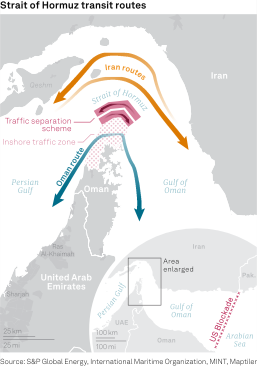
Mid-April saw the introduction of a US blockade in the Gulf of Oman, targeting Iranian-linked vessels and further restricting passage through the Strait. In the first month of the blockade, 30-40 vessels crossed the blockade line daily, but only a small fraction of them successfully transited the Strait; CAS data recorded 14 vessels turned back, while others called at ports outside the Strait but inside the blockade line. While the blockade has been partially effective, 10% of vessels crossing were identified as US-sanctioned or Iran-linked, many of which are tankers. Although some unauthorized movements continue—further complicated by tankers disabling AIS transmissions—no Iranian crude tankers have been confirmed to have passed through both the Strait and the blockade line since mid-April.
Inbound traffic remains even more restricted. CAS data shows many non-Iranian tankers have been observed waiting in the Gulf of Oman, but only a few have been permitted entry. Early inbound movements were dominated by Iranian-linked tankers in ballast, again highlighting the significance of vessel affiliation. Notable exceptions, such as the Suezmax tanker POLA, the VLCC AGIOS FANOURIOS I, and the Vietnamese-owned VLGC NV SUNSHINE, entered following diplomatic negotiations. These rare inbound transits by non-Iranian vessels are closely watched as signs of improving sentiment, but they remain isolated events and have not established a consistent trend.
In contrast to oil tankers, “other” vessel types such as landing craft, tugs, cargo ships, and aggregate carriers now dominate movements through the Strait. These vessels accounted for over half of the traffic in May, underscoring a significant shift in the types of vessels permitted or able to transit. Most vessels have now abandoned the traditional Traffic Separation Scheme historically used to navigate the Strait, opting instead for the non-standard route that passes directly through Iranian territorial waters and has been prescribed by Iran to avoid possible collisions with naval mines. Only two vessels sailed via the Oman route in the first half of May.
How have freight markets reacted?
Vessel re-routing and surging costs have defined the freight market since the onset of the conflict.
The closure of the Strait has shifted crude and refined product loadings in the Middle East to ports outside the Strait, such as Fujairah, Sohar, Mina Al Fahal, and Duqm in the Gulf of Oman, as well as Yanbu, Rabigh, and Jazan on the Red Sea. The combination of trapped vessels within the Strait, widespread route diversions, and reduced cargo volumes from the region has compelled many tankers to ballast to the Atlantic Basin in search of new employment opportunities.
In addition to US and Iranian controls on vessel movements, market participants have identified insurance as a key barrier to commercial transit through the Strait. Following the outbreak of the war, war risk premiums for routes transiting the Strait surged by over 1,000%. Prior to the war, market participants reported premiums ranging from 0.1% to 0.3% of hull value. This doubled in the immediate onset, rising to 2.5% to 5% following vessel attacks. For a typical VLCC valued at $100 million-$150 million, this equates to $2.5 million-$7.5 million per voyage. For Medium Range tankers, Additional War Risk Premiums (AWRP) have reached $80,000-$120,000 for a seven-day period. By late March, premiums eased to between 0.8% and 1.5% as limited transits resumed, though they remain significantly higher than prewar levels.
As a result of surging costs, some shipowners have been forced to either idle their vessels or demand substantial rate increases. At the beginning of the conflict, this led to VLCC spot earnings spiking above $300,000 per day, with other segments—such as Suezmax, Aframax, and product tankers—also reaching record highs as exports from Saudi Arabia, the UAE, and Iraq came to a halt. The surge in rates for Middle East Gulf routes and the presence of trapped tonnage within the Gulf had an immediate ripple effect on Atlantic Basin routes, including US Gulf–China VLCC voyages. However, by mid-April, these rates had eased back to pre-crisis levels of around $99,000 per day.
Partial ceasefires allowing limited transits helped cool rates in late March and early April, but given the outlined limitations, more than 800 vessels remain stranded in the Middle East Gulf according to CAS data.
CAS clearance scenario modeling offers approximate number of days required for the roughly 800 laden vessels to exit the Strait. At a 50% traffic rate, or 68 daily vessel exits, the Middle East Gulf would be clear of laden tankers in roughly two weeks. A 10% clearance rate, or 14 vessels per day, eight-to-nine weeks would be required for full clearance. These assumptions are built around de-mining of shipping lanes, resurgence of shipper and insurer confidence, and cooperation between the US and Iran to adhere to safe, undisrupted flows through the Strait.
Confidence in the sustained reopening of the Strait has been severely undermined by a “stop-start” pattern of events. Multiple short-lived “open” windows—such as a sub-24-hour post-ceasefire period and a roughly 48-hour US-protected corridor—have been immediately followed by renewed attacks, creating a credibility gap. Even if a formal peace framework were to emerge, a “behavioral drag” from key maritime stakeholders would be expected to delay any return to normalcy. Shipowners, charterers and insurers are likely to adopt a cautious, wait-and-see approach. This means that vessel capacity utilization will likely remain capped as the industry hesitates to fully re-engage with the route until long-term stability is proven.
Defining "open"
Through detailed consultation across crude oil, refined products, and shipping markets since the war’s onset, Platts has gathered extensive feedback outlining key factors for considering whether the Strait can be considered commercially reopened.
According to market feedback, in addition to a demonstrable sustained ceasefire, a reopening of the Strait of Hormuz should be defined by a series of factors, at a minimum: the restoration of functional, insurable, and sustained commercial maritime traffic under stable and commercially acceptable risk conditions.
1. Vessel traffic recovery
Market participants would need to converge around a minimum threshold of pre-war vessel traffic—reflecting both owned and chartered ships operated by a diverse set of international market participants, including oil majors, trading houses, and National Oil Companies—passing continually through the Strait for a sustained period. In the feedback received by Platts, market participants specified thresholds ranging from 50% to 90% of pre-war traffic, sustained for one week to up to one month. Meaningful recovery toward pre-war throughput is a critical indicator that confidence has returned across the supply chain, including charterers, shipowners, and cargo interests.
2. Observation period following ceasefire
Expectations shared indicate a minimum observation period following a declared ceasefire is required to verify that hostilities have genuinely ceased, that no intermittent disruptions persist, and that maritime traffic can return to normal without incident. In the feedback provided to Platts, indications for an observation period ranged from 30 to 45 days. During this period, stranded vessels should be able to exit safely, while vessels waiting outside should begin re-entering in a consistent and orderly manner.
3. Marine insurance availability
Marine insurance availability is considered a central determinant of normalcy. Feedback indicated that a broad pool of underwriters should be willing to provide war risk cover, not just a limited or highly selective group. Premiums may remain elevated relative to pre-conflict levels, but coverage should be accessible at commercially viable terms. A market with prohibitively expensive or limited coverage would not constitute normalization.
4. Physical security conditions
Physical security conditions should be demonstrably improved, including confirmation that naval mines or other navigational hazards have been cleared and that maritime security frameworks—such as naval patrols and convoy mechanisms, if applicable—function effectively to ensure safe passage, according to market feedback.
5. Fleet deployment patterns
Visible return of VLCCs and other large crude carriers into the Middle East Gulf, along with regular port calls and loading programs, would signal restored confidence among shipowners and charterers. The scale and frequency of such deployments should align with pre-conflict norms or show a clear trajectory toward them, market participants have told Platts.
From this extensive market feedback, a complex picture emerges regarding the conditions that should be met for the market at large to consider the Strait of Hormuz “open” for sustainable, consistent traffic. Conditions include sustained traffic flow, adequate insurance coverage, restored throughput levels, confirmed navigational safety, and normalized vessel deployment. Complex conditions will need to apply for one of the most important waterways to be fully operational again under stable and commercially acceptable conditions.
Contributors: Staff
Design: Energy Content Design
Published: May 2026