Refined Products, Maritime & Shipping, LNG, Energy Transition, Crude Oil, Chemicals, Agriculture, Fuel Oil, Emissions, Biofuels
September 29, 2026
PATH TO NET ZERO: Shipping companies face slow low-carbon bunker transition

By Max Lin
Editor:
HIGHLIGHTS
Intensity reduced, not total emissions
Cost of green fuel much higher
Cargo owners less willing to pay premiums
This is the sixth in a multi-part series on net-zero efforts across industries. The previous article can be found here.
Major shipping companies have made progress in reducing the greenhouse gas emissions intensity of their operations but are struggling to achieve emission cuts in absolute terms.
In their latest annual reports, the world's top 10 maritime companies by market capitalization — all of which have some degree of net-zero targets by 2050 or earlier — reported long-term declines in GHGs per transport work but rising emissions overall in 2025.
The development came as many ships were forced to take longer routes amid geopolitical conflicts and consumed more fuel, even as vessel operators were willing to invest in energy-efficiency measures that could yield healthy financial returns in a bullish oil market.
"With longer distances, the emissions per ton-mile goes down, but the total emissions of course go up," Tore Longva, decarbonization director of classification society and maritime advisory DNV, told Platts, part of S&P Global Energy. "A lot of the low-hanging energy efficiency measures are implemented ... but a 25% further energy efficiency improvement is [still] possible towards 2050. Ultimately, however, low-GHG fuels will be needed to reach net-zero."
Longva and all other industry experts interviewed for this article responded by email.
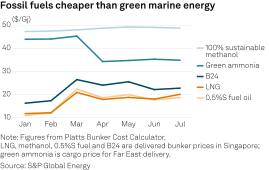
Green marine energy remains much more costly than conventional, oil-based fuels due to its limited availability. July's average delivered bunker price for 0.5%-sulfur fuel oil — the most popular marine fuel — was $18.66 per gigajoule in Singapore, compared with $20.05/GJ for LNG, $22.72/GJ for B24 bioblend, and $48.69/GJ for 100% sustainable methanol, according to the Platts Global Bunker Cost Calculator.
Regulatory drivers
To reduce the price gap, the European Union has, since 2024, extended its emissions trading system to cover shipping and introduced the FuelEU Maritime rules in 2025 to cap GHG bunker fuel intensity.
The International Maritime Organization earlier approved the Net-Zero Framework, designed to place a cost on GHGs from ship operations globally from 2028. But its implementation is facing delays as fierce US opposition has prompted many of the UN agency's member states to discuss revisions.
"IMO's [Net-Zero Framework] is critical for what happens next," said Tristan Smith, a professor at UCL Energy Institute in London. "Regional policy lacks the stringency to make a significant impact on shipping's energy transition. ... It is hard to see how it will enable any mass market participation in energy transition for the foreseeable future."
Some in the shipping industry have echoed Smith's view.
Wolfram Guntermann, director for regulatory affairs at German container line Hapag-Lloyd AG, one of the world's largest listed shipping firms, said the IMO framework is highly important because shipping is a cross-border industry that requires globally aligned regulations.
"A common international fuel standard and emissions-pricing mechanism would provide greater investment certainty, support the scaling of low- and zero-emission fuels and reduce regulatory fragmentation," Guntermann said.
Simon Bergulf, vice president for environment and climate at World Shipping Council, said the liner industry — represented by his organization — has invested $180 billion in ships capable of running on sustainable fuels such as bio-LNG and low-carbon methanol.
"[But] global regulations for a global industry are necessary to make it possible for carriers to operate on green fuels at scale, and to incentivize fuel and energy providers to invest in new production capacity," Bergulf said.
Voluntary demand
Without sufficient global regulatory drivers, shipping companies have been seeking to provide sustainable freight services at higher prices in their pursuit of a financially viable energy transition. But demand on that front, often arising from cargo owners' voluntary decarbonization efforts, has been falling.
A.P. Møller-Mærsk A/S reported that its biofuel and green methanol use nearly halved to 1,524 GWh in 2025, from 3,034 GWh in 2024, reversing an upward trend in recent years. The world's largest listed shipping company cited lower voluntary demand as one of the reasons for the decline.
In the latest annual Shipping Decarbonization Survey by Boston Consulting Group, the organization found that cargo owners, on average, were willing to pay a 3% premium to transport goods on ships running on green fuels in 2025, down from 4.5% in 2024 and the lowest since 2022.
The share of cargo owners unwilling to pay any premiums increased by 4 percentage points in 2025, while those inclined to pay premiums of over 20% fell to zero from 3% in the prior year, according to the survey of 125 logistics executives.
"Cost management has moved to the top of the agenda, while other priorities include energy security and resilience," Boston Consulting Group said. "Low-carbon shipping is increasingly deprioritized."
Outlook for shipping sector
Although long-term deep decarbonization requires large amounts of green fuels at affordable prices, major Japanese shipping firms Nippon Yusen Kabushiki Kaisha and Mitsui O.S.K. Lines Ltd. said they could achieve substantial GHG cuts through improved energy efficiency and use of currently available alternative fuels — such as LNG and biofuels — for the interim period.
"We believe meaningful emissions reductions remain achievable through measures within our direct control, including energy-efficiency improvements, fleet modernization, retrofits and operational optimization," NYK told Platts in an email.
MOL said the company's goal is to reduce emissions without relying "excessively" on uncertain regulatory developments or technological breakthroughs.
"We are currently advancing decarbonization primarily through the use of LNG, while working toward a future transition to zero-emission fuels such as ammonia," the company said.
Fotios Katsoulas, research director for alternative fuels at S&P Global Energy Horizons, said shipping companies are likely to focus more on decarbonization means at hand if regulators continue to have difficulties implementing GHG rules.
"Some moderation in the pace of transition is possible," Katsoulas said. "The most likely outcome is not a reversal of decarbonization targets but rather a slower transition pathway."
Susan Dlin contributed to this article.
