Energy Transition, Refined Products, Agriculture, LNG, Crude Oil, Natural Gas, Carbon, Renewables, Hydrogen, Biofuels, Emissions
September 28, 2026
PATH TO NET ZERO: US oil majors cast doubt on feasibility of net zero by 2050
By Jeremy Beaman and Corey Paul
Editor:
HIGHLIGHTS
Companies cite tech gaps, policy uncertainty
Profits surge on higher oil, products prices
This is the fifth in a multi-part series on net-zero efforts across industries. The previous article can be found here.
Some of the largest US oil and gas companies appear to be growing increasingly doubtful that a net-zero future is attainable by the middle of the century.
Among the top 30 US companies in the sector, some reported declining corporate emissions intensities for 2025. Although a handful said they have already achieved net-zero emissions for at least a segment of their businesses, most have no firm goal, and integrated oil majors are casting doubt on the feasibility of their long-term targets.
Amy Myers Jaffe, director of New York University's Energy, Climate Justice and Sustainability Lab, said that growing geopolitical uncertainty may make companies less willing to commit to emissions trajectories decades into the future, citing the sustained loss of energy supplies from the Persian Gulf amid the Middle East war.
"The war has created a tremendous amount of uncertainty about what the trend line is," Jaffe said.
Jaffe pointed to research conducted with Kalme Moncavo, an NYU graduate student, comparing sustainability reports published in 2021 and 2025 across 100 companies in multiple sectors, including oil and gas. The analysis found that references to 2030 targets increased by about 15%, while references to 2050 targets declined by about 45%, suggesting companies may be more comfortable discussing nearer-term goals than long-range commitments.
Jaffe said companies have also become more cautious about discussing Scope 3 emissions because of inconsistent reporting standards and growing litigation related to climate impacts.
Dropping 2050
As recently as 2025, Chevron Corp. upheld a target set years earlier to achieve net-zero Scope 1 and 2 emissions for its upstream production by 2050. In the company's latest disclosures, Chevron backed off the fixed 2050 date, saying neither technology nor public policy has advanced sufficiently to make the 2050 target achievable.
Although Chevron said it no longer uses 2050 as a timeline, spokesperson Bill Turenne said the company continues to aspire to achieve net-zero Scope 1 and 2 upstream emissions on an equity basis.
"We aim to grow our oil and gas business, lower the carbon intensity of our operations and grow new businesses in renewable fuels, carbon capture and offsets, hydrogen, power generation for data centers, and emerging technologies," Turenne said.
ConocoPhillips, which introduced a net-zero target in 2020, is on track to reduce its emissions intensity by 50%-60% by 2030, the company said in its latest annual corporate sustainability report.
However, slow development of low-carbon technologies and climate policy are among factors that "have led us to remove the 2050 date from our ambition," the company said in the report.
"This adjustment reflects current societal, technological and economic realities, as well as evolving stakeholder expectations," ConocoPhillips said.
ExxonMobil Corp., the US' largest integrated oil company, similarly cast doubt on the feasibility of net zero, although it has yet to explicitly remove the target.
"ExxonMobil is continuing to pursue the net-zero ambition, but we recognize the external challenges of technology and policy play a role in our ability to achieve net-zero," an ExxonMobil spokesperson said.
Competing for capital
The retrenchment, which began to take shape among some others in the sector in 2025, comes into focus at a time of surging profits for companies with exposure to crude oil and refined products, driven by disruptions from the US-Israel war with Iran.
Among the 10 largest US oil producers and refiners, second-quarter 2026 net income came in about 3.5 times higher year over year for the group on average. Profits were much higher on a quarter-over-quarter basis for much of the group.
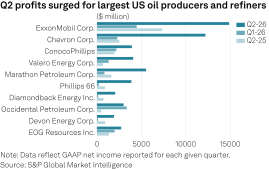
Even before the latest run-up in prices triggered by the war, some large oil companies were chasing production growth and engineering exits from low-carbon investments that, in some cases, had been initiated only years earlier. That trend has continued into 2026.
BP PLC reported after-tax impairments of about $4 billion for 2025, which the company largely attributed to its biogas and renewable energy businesses. The company went on to announce plans to sell Archaea Energy Inc., the US renewable gas business it acquired in 2022.
Other energy companies headquartered outside the US, including Shell PLC, TotalEnergies SE and Woodside Energy Group Ltd., have cast doubt upon certain decarbonization targets of late or otherwise trimmed low-carbon spending.
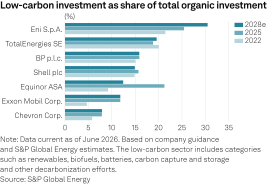
Of TotalEnergies' roughly $16 billion in 2026 capital expenditures, low-carbon spending is estimated to account for about 20%, which is on the higher end of the company's peer group but represents a decline from 25% in its previous plan, according to S&P Global Energy CERA director of integrated oil equity research Sam Hanna.
The decision to cut back is justified by lower return expectations relative to traditional oil and gas businesses, Hanna wrote in a Sept. 8 report.
"In addition, it was a challenge for TotalEnergies to balance the capital needed for its ambitious low-carbon targets with the continued need to invest in upstream and LNG assets that provide a significant portion of current cash flow, especially when taking into account that about 40% of cash flow is being distributed to shareholders in the form of dividends and share buybacks," Hanna wrote.
Volatile markets, shifting policy
The evolution of decarbonization strategies is a response to concerns among some companies that they overshot on low-carbon investments, said Andrejka Bernatova, managing partner of energy sector investor Dynamix Capital Partners.
"We definitely have seen over the past couple of years a pretty significant scale down in terms of clean energy interest and investments from companies in the traditional natural resources space," Bernatova said.
For investments in the US, a change in sentiment and policy between the Biden and Trump administrations also partly explains decisions to scale back, Bernatova said.
For the second time, in January 2025, President Donald Trump withdrew the US from the Paris Agreement. Trump has repeatedly beckoned oil producers to increase production to lower prices and has revoked Biden administration climate policies, such as stricter vehicle tailpipe rules, designed to reduce carbon emissions.
Most oil and gas companies have been decreasing low-carbon investment, said Simon Wong, a portfolio manager with Gabelli Funds.
"The only areas that are still seeing some investments are biofuels and carbon capture," Wong said. "With the Middle East conflict, the conversation has shifted from climate/net-zero initiatives to energy security."
Another factor influencing how companies discuss net zero may be the growing controversy surrounding carbon offsets and voluntary carbon markets since 2023, NYU's Jaffe said. Many net-zero strategies relied on offsets to address residual emissions that could not be eliminated directly.
"The collapse of the voluntary offsets market and the collapse in volume of the voluntary offsets market was really probably more material to companies changing how they spoke about net-zero than changes in political or economic views of climate change," Jaffe said.
Companies investing in the US will always have to consider the prospect that evolving federal policies will affect investments across energy resources, according to Bernatova.
"Sometimes investing in the US is a little bit more risky than investing in emerging markets because obviously, the tide shifting, right, every four years or every eight years pretty significantly," Bernatova said.
The role of buyers
While the US government has pulled back decarbonization rules and policies of the Biden administration, companies with international operations still need to understand how foreign governments and customers view climate risks and decarbonization, Jaffe said.
"The fact that one of those governments, or two of those governments, might have turned on a coal plant in the middle of a national emergency doesn't mean that you're capturing what the long-term concern is for that country," Jaffe said.
Absent regulatory pressures from the current administration, reducing emissions is still critical for US energy exporters, especially LNG companies that sell exclusively into foreign markets, said Eric Smith, a business professor at Tulane University and associate director of the Tulane Energy Institute.
Emissions reporting requirements under the EU's methane rules for energy imports grow increasingly strict over the next several years, and by August 2030, the bloc will require buyers that import fossil energy under new or renewed contracts to demonstrate that their imports have an associated methane intensity below a specified threshold.
"The big international companies and virtually anybody that sells LNG is in the position of having to abide by its customers' rules, not by its country of origin rules," Smith said.
Susan Dlin contributed to this article.
