Refined Products, Agriculture, Energy Transition, Fuel Oil, Biofuel, Renewables
December 15, 2025
COMMODITIES 2026: EU biofuels sector eyes momentum from Germany’s push to cut emissions
By Thomas Washington and Olly Wroe
HIGHLIGHTS
Europe’s renewable energy directive rollout gathers pace
Germany policy key as largest EU renewable diesel market
Feedstock price volatility major uncertainty for producers
European biodiesel producers have welcomed a German push for steeper emissions reductions under the EU's Renewable Energy Directive as a potential boost for demand, but market volatility and uneven regional implementation remain concerns over future uptake.
The German Cabinet on Dec. 10 approved a draft law to reform the country's Greenhouse Gas Reduction Quota (THG-Quote), setting an ambitious long-term target to reduce fuel emissions by 59% by 2040. The regulation includes binding sustainable aviation fuel mandates, and introduces stringent new fraud prevention measures that could reshape European biofuel trade flows.
The EU's RED III Directive entered into force in 2023 and gave member states 18 months to implement its renewables targets as national laws.
"Few countries actually transposed the directive (RED III) by May 2025, however, we expect most major countries to have transposed the directive into national law by the end of 2026," Seb Lewis, associate director consulting at S&P Global Energy, said.
RED III implementation across Europe is gaining momentum, with the Netherlands, Italy and France already moving forward with their programs. Germany is the largest European market for renewable diesel, making its regulatory decision critical for producers who have invested heavily in production capacity.
Neste, the world's leading producer of renewable diesel, was among the companies keeping a close watch on the German decision. "The [German] numbers in terms of incremental demand have ranged anywhere from 1 million to 2 million tons," CEO Heikki Malinen said during the company's third-quarter earnings call on Oct. 29, ahead of the cabinet decision. "Whether it's on the low end or on the high end... it's still positive, and hopefully, the other European countries will then follow up." Germany is the biggest market, he added.
HVO to gain
Analysts expect that it is renewable diesel, also known as hydrotreated vegetable oil (HVO) that stands to gain from the moves in regulation, rather than sustainable aviation fuel. "European SAF mandates are still relatively modest compared to the RED II / RED III trajectories for renewable fuels and we expect European demand for HVO to be higher than SAF in 2026," Lewis said.
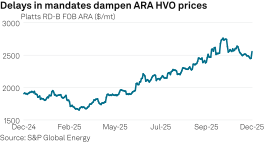
Accordingly, the progress of legislation has had a direct impact on renewable diesel prices. They had risen in recent months but retreated in December as for much of the month the news flow focused on delays to mandates.
Politicians hoped that antidumping duties on China would support the domestic sector when they were imposed earlier this year, but high import volumes appear to have kept pressure on local prices.
"Delays in the RED reform at the member state level are a factor of uncertainty and anecdotal evidence points to imports from China under the [anti-dumping] duty," analysts at S&P Global Energy CERA said in a December market outlook.
Platts, part of S&P Global Energy, assessed renewable diesel that complies with the EU's annex IX B on a FOB basis at Amsterdam-Rotterdam-Antwerp at an average of $2,496.50/metric ton in Dec.1-12. This was down from a November average of $2,566/mt.
European demand should grow in 2025 by 7% and is set to reach more than 20 million mt in 2027 on the back of higher mandates in various countries, efforts to cut the use of surplus tickets, and the implementation of RED III and Fuel EU Maritime, analysts at CERA said.
In 2025-27, these dynamics should roll back the 2024 decreases in demand, when consumption fell by 10% to 17 million mt, analysts at CERA said.
Laggards cause uncertainty
The potential for different implementation timelines across key member states has prompted competitiveness concerns for players in the Dutch bunker market, where the RED III legislation is widely expected to take effect from Jan. 1, analysts at CERA said Dec. 11.
Accordingly, the Netherlands will temporarily ease fuel transition obligations for the maritime and inland shipping sectors in 2026, as part of its implementation of the EU's Renewable Energy Directive III, the Ministry of Infrastructure and Water Management announced in a newsletter Dec. 10.
Neste identified several key European markets beyond Germany as critical for growth, including Italy, the Netherlands, and Nordic countries Finland and Sweden. The company expects gradual increases in mandate percentages heading toward 2027-28 and beyond to 2030, though implementation may be blunted by inflation concerns, Malinen said.
Volatile feedstocks
Feedstock price volatility remains a key uncertainty for the 2026 outlook, with trade policy changes creating unpredictable market conditions. Recent regulatory decisions have impacted buyer behaviour, particularly affecting procurement patterns from Europe and Asia, Neste management said.
"RED III has a more ambitious transport target and advanced biofuels target than RED II, which should mean even more demand in Europe for limited waste and residue feedstocks like UCO," Lewis said.
While animal fat prices have decreased due to reduced US buying activity, used cooking oil (UCO) prices have held relatively stable as Chinese buyers have increased purchases, Neste said.
German legislation will further heighten the importance that "the feedstock needs to be the right kind and from a reliable source," Malinen said.

Editor: