Crude Oil, Refined Products, Maritime & Shipping
December 12, 2025
COMMODITIES 2026: New product shipping patterns likely, rates set to rise on key routes
By Thomas Washington and Marina Ledakis
HIGHLIGHTS
Longer voyages, higher freight rates for Europe expected
Opportunities arise for US, Middle East exporters
The EU's upcoming embargo on petroleum products refined from Russian crude means European refiners will start to seek alternative supplies, prompting new trade patterns and potential rate premiums for some delivery routes, according to shipping and oil industry experts.
The EU's ban takes effect in January and puts refiners in Turkey and India that have been sending products made from Russian crude to Europe into the spotlight, Francisco Blanch, head of global commodities and derivatives at Bank of America Global Research, told journalists Dec. 9.
In response to the changes, the US will likely begin to service Europe more regularly, while flows from India and Turkey could be redirected to South America, where the US has a more dominant position, Blanch said.
"Ultimately, longer voyages and more expensive prices for European consumers, that's an inevitable consequence of trying to apply pressure on Russia," Blanch said.
Against this backdrop, India has a choice, according to Kevin Zhao, a shipping analyst at S&P Global Energy CERA.
"Either cease processing Russian crude for its EU-bound exports to maintain market share, or find new buyers for these Russian-origin products," Zhao said.
The regulatory shift implies significant upward pressure on freight rates for routes from the Persian Gulf, as LR2 and MR tankers are diverted to serve European demand, he added.
The extent of the potential impact is debated, however.
While market watchers expect some remoulding of trade flows, the exact shape of this is not yet wholly clear and the impact on freight rates could be neutral to slightly positive, according to Jacob Meldgaard, CEO and executive director of Torm, presenting his company's results Nov. 6
"The EU import ban... is not expected to significantly affect product tanker ton-miles as alternative sources are available at similar distances or could slightly increase demand if imports are sourced from further away," he said.
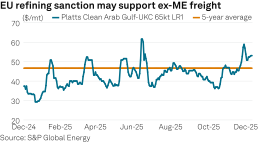
Platts, part of S&P Global Energy, assessed the rate to carry a 65,000 metric ton cargo of clean products from the Persian Gulf to the UK/Continent at an average of $52.58/mt in the Dec. 1-12 period. This is up from $36.15/mt in mid-October and above the five-year average of $46.65/mt.
Malleable routes
The supply disruption is creating opportunities for US exporters, already benefiting from reduced Russian competition, according to Adam Lanning, senior tanker analyst at shipbroker SSY.
"The USG MR market has already been gaining from the drop in overall Russian CPP exports as it has been able to re-capture trade opportunities into South America, specifically Brazil," Lanning told Platts.
Long-haul routes into Europe, such as the Persian Gulf to UK/Continent and transatlantic MR routes, are expected to command significant premiums, creating a more volatile freight environment, CERA's Zhao said. The key indicator to monitor will be the EU diesel crack spread, as its widening provides the primary incentive for these long-haul arbitrage movements, he added.
The Mediterranean region faces particular complications, as it has historically benefited from petroleum products coming directly from Turkey, BofA's Blanch said.
European refining capacity under pressure
The embargo's impact will be compounded by European refinery closures that are reducing the continent's ability to produce its own petroleum products, Torm's Meldgaard said.
At present, global diesel is well-supplied and Russian gasoil exports have also rebounded, although these cargoes no longer head to Europe, CERA oil analyst Rebeka Foley said, adding that the situation does loosen global balances. Given that weather is mild in Europe and the US is already exporting more diesel to the region, CERA analysts expect that sanctions will see distillate trade being reshuffled, albeit not accompanied by a spike in prices. Europe will keep pulling more from the US and also the Middle East, while sanctioned barrels will head to other markets, Foley said.
One thing to watch is Amsterdam-Rotterdam-Antwerp stocks, Foley said. These are easing and now below the five-year average, she added. Lower stocks will keep a floor under prices, but only until the colder weather starts to fade early in the first quarter, at which point there will be a slump in diesel cracks, she said.
"One thing we've been reminded of in recent years is that the world is round and markets always find a way," Foley said.

Editor: