Crude Oil
November 11, 2025
Russia's Far East ports ship record crude volumes amid Ukrainian attacks
By Kelly Norways and Jan Kedzior
HIGHLIGHTS
Russia exports record volumes from Far East ports
Ukrainian drones hit Tuapse terminal, Yaroslavl pipelines
Sanctions shifts more crude exports to Asian buyers
Russia exported record volumes of crude oil from its Far Eastern ports in the week to Nov. 9 as a spate of Ukrainian drone strikes have put pressure on the country's refinery runs and Western oil logistics.
According to S&P Global Commodities at Sea data, Russia shipped 12.4 million barrels of crude from its far east in the seven days to Nov. 9, mostly from the port of Kozmino southeast of Vladivostok.
The export volumes represent a 40% weekly increase in shipments from Russia's Eastern region and mark the highest ever volume recorded by CAS. According to historic CAS data, which dates back to 2016, Russia's Far East ports have only ever shipped more than 10 million barrels of crude in a week on seven previous occasions, all occurring within the last three years.
Russia's ESPO Blend crude accounted for 60% of the weekly export volumes from the Far East coast, followed by Urals crude with a 20% share, CAS data showed.
The spike followed a week of heavy Ukrainian drone attacks on Russian oil logistics. On Nov. 1, drones struck the country's Tuapse oil terminal on the Black Sea, while days later, pipeline infrastructure in Central Russia was targeted by attacks.
On Nov. 4, Russian authorities reported "minor" damage to two oil pumping stations in the country's Yaroslavl region, without providing specifics on the affected infrastructure. The area is home to several pipelines running from Russia's Far East to major export terminals on the Baltic Sea, including a Transneft crude connection. Transneft was not available for comment.
Rising crude exports from Russia's Far East also coincide with a wider increase in Russian crude availability in recent weeks, as Ukrainian drones have continued to target the country's refining sector and hit capacity to process crude at home.
According to CAS data, Russia shipped a record 4.1 million b/d of crude oil in October, although volumes dropped dramatically in the final week of the month. In the seven days to Nov. 9, the country's total crude exports recovered 3.6 million b/d, of which approximately 1.4 million b/d was shipped to India and China, respectively.
Long-term shift
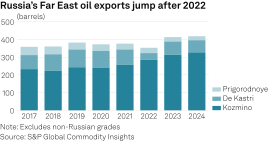
Record crude exports from Russia's Far East coincide with a subtle shift in the country's oil logistics since its invasion of Ukraine in 2022. The country's Baltic seaports still handle the majority of its crude, however, successive Western sanctions have seen its Far East ports handle growing volumes as the Kremlin has swapped its former European buyers for new trade partners in Asia.
Between 2017-2022, Russia shipped an average of 1 million b/d from its far eastern ports, CAS data shows. By 2023-24, volumes had climbed to 1.1 million b/d in 2023-2024, while levels have averaged 1.2 million b/d in 2025 to date. In 2025, Far East crude exports have accounted for roughly a third of the national total, up from 18% in 2021.
New US and EU sanctions have sought to add additional pressure to Russia's energy logistics, while the newly reopened ITP pipeline has offered Turkey, the Kremlin's number-three oil buyer, a competitive alternative to Russian oil.
In the seven days to Nov. 9, Russia exported a single 1 million-barrel crude cargo to Turkey, its the lowest weekly volume in eight months, CAS data showed. However, falling shipments follow a recent influx of Russian oil into Turkish ports. According to CAS data, Turkey's Aliaga terminal imported 6.6 million barrels of Russian oil in the final week of October, a weekly record, while the country's official statistics show a 13% hike in the its Russian crude imports between August and September.
Increasingly, refineries specifically sanctioned by various Western authorities, such as India's Vadinar and China's state-owned Yulong Petrochemical, have accounted for a growing share of Russian exports, Platts has reported previously.
In October, Yulong was in the top two importers of Russian crude, CAS data showed, together with India's Jamnagar refinery in Gujarat, which is not subject to sanctions. In the week to Nov. 9, no known export terminals received delivery of Russian oil, with all supplies still in transit.
Jamnagar refinery owner, Reliance, was not available for comment, but has vowed to comply with all applicable sanctions.

Editor: