Refined Products, Crude Oil, Diesel-Gasoil, Gasoline
September 25, 2026
Europe urges US to avoid 'concerning' diesel export ban
By Kelly Norways and Sophia Aung
Editor:
HIGHLIGHTS
EU warns US diesel ban puts both economies at risk
US ships 360,000 b/d of diesel to Europe in Q3
Bloc in 'high-level' discussions with White House
The EU has urged the US to abstain from the "very bad idea" of a diesel export ban, citing mutual disadvantages to the move informally endorsed by US President Donald Trump earlier this week.
US officials have spent the week qualifying comments from Trump appearing to back a ban, with Energy Secretary Chris Wright saying the policy would prove a "blunt hammer" and White House representatives denying plans for a 90-day shut in.
Nevertheless, Wright described the possibility of a voluntary plan for US refiners to keep diesel in the domestic market, and rumors have continued to swirl over tougher export controls.
"Any disruption would risk negatively impacting both sides," said European Commission Spokesperson, Olof Gill, at a press briefing in Brussels Sept. 24, sharing that the bloc "views with concern," reports of a potential ban and is closely monitoring its fuel stocks.
The EU is in high-level discussions with the US, and would expect to be consulted on potential measures affecting shared markets, he said, noting significant internal dissent that could potentially stop plans from moving ahead.
Gill added that when it comes to this discussion in the US, there are also strong voices "that believe any proposed ban of this nature would be a very bad idea indeed."
Diesel makes up for roughly 50% of Europe's oil product consumption, and has become a key strategic dependence since more of the region's own refineries have shuttered.
After sanctioning Russian diesel in 2023, as well as fuel made from Russian crude earlier this year, Europe has increasingly relied on the Middle East, and latterly the US, as a source of reliable supply.
European dependence
Before the US-Iran conflict erupted, Europe was importing 200,000 barrels/day – 300,000 b/d of diesel from countries inside the Persian Gulf, accounting for roughly 10% of total imports.
Since those supplies have evaporated, US arrivals have helped fill the vacuum. In the third quarter of 2026, the country is on track to ship 360,000 b/d of diesel to Europe, up from 250,000 b/d pre-war, according to S&P Global Commodities at Sea data.
For countries like the UK and the Netherlands, US diesel imports have played an outsized role, accounting for a massive 62-72% of all diesel imports in August, CAS data shows.
As the single largest exporter of diesel globally, few countries can rival the capacity of the US. With fewer Russian and Middle Eastern barrels making their way to the market.
India is on track to become the world's number-two supplier in Q3 2026, but volumes remain less than half the 1.6 million b/d shipped by US refiners last month, and sanctions on Russian crude derivatives could limit flows to Europe.
Record diesel exports from the US have offered one lifelines to the global market through the Middle East conflict, with its refiners running at close to full capacity and straining to capitalize on significant margins. In the event of an export ban, however, US refiners could be left with a significant excess of diesel, potentially forcing run cuts of roughly 2 million b/d, according to analysts at S&P Global Energy CERA.
Contrary to the intentions of the Trump administration, an indefinite ban could have the perverse effect of incentivizing refiners to address maintenance needs after months of running above nameplate capacity, said Jonathan Lamb, a senior oil and gas analyst at European investment bank Wood & Co. A short-term ban, on the other hand, could see refiners shift product into inventory, hoping for higher prices on the global market once constraints are lifted, he said.
Market jitters
In Europe, traders have balked at the prospect of US shut-ins, but remain cautiously optimistic that a ban may never materialize.
"The market is not taking it seriously," said one Mediterranean gasoil trader, noting the US's own dependence on European gasoline. The US once banned crude exports in the aftermath of the 1973 oil crisis, HSBC economists Paul Bloxham and Jamie Culling said in a Sept 25 note, while the Biden administration considered a ban in 2022 but never moved ahead with it.
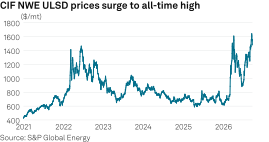
ICE Low sulfur gasoil futures slumped Sept 25, with the front-month contract settling 4% lower day-over-day at 1630 London time, down from a midweek high of $1,519/mt Sept 24.
In the physical market, prices remain close to the record highs of earlier this month, while retail prices climbed to fresh record highs as stocks have continued to languish at four-year lows.
Responding to renewed supply concerns, France is pushing for measures such as relaxing fuel quality restrictions to address the situation, while Italy has called an emergency meeting of its refiners and Slovakia has demanded a special meeting of EU leaders to address the energy challenge. In the event of a US embargo, however, countries could have no choice but to resort to fuel rationing, analysts have warned.
With no sign of imminent relief from a Middle East peace deal, officials have expressed hope that Europe will avoid another energy supply shock from its closest trade partner. "The energy relationship we currently enjoy with the US is strong and stable," said Gill.
"Needless to say, we are monitoring the market and security of supply very, very closely," he said.
