Refined Products, Agriculture, Crude Oil, Diesel-Gasoil, Gasoline
September 22, 2026
Trump to consider diesel export restrictions amid political pressure

Editor:
HIGHLIGHTS
Trump tells advisors to examine diesel ban options
Republicans push restrictions citing prices
Ban could cut refinery runs 2 million b/d: report
US President Donald Trump and US Secretary of the Treasury Scott Bessent said the administration was considering restricting diesel exports amid surging pump prices, following days of increasing political pressure from fellow Republicans.
At an appearance alongside Ukrainian President Volodymyr Zelensky at the United Nations on Sept. 22, Trump responded to a reporter's question about Republicans' recent calls for the move, saying he has "called for that too."
"I've said let's not send out the diesel," Trump said. "We make a lot of diesel. It could have a little bit of an effect on regular automobile gasoline because when you do that, you know, it's a sort of a flow. It's a balance. But no, I've called for it. I've called for it within my people. I've been talking about it."
Trump then directed the question to Bessent, who said the administration was considering a range of options.
"Yeah, we're examining that, whether it's feasible in terms of the overall refining capacity and whether a full or a partial ban would work," Bessent said.
Asked for a timeline on the decision, Trump responded: "fast — one way or the other."
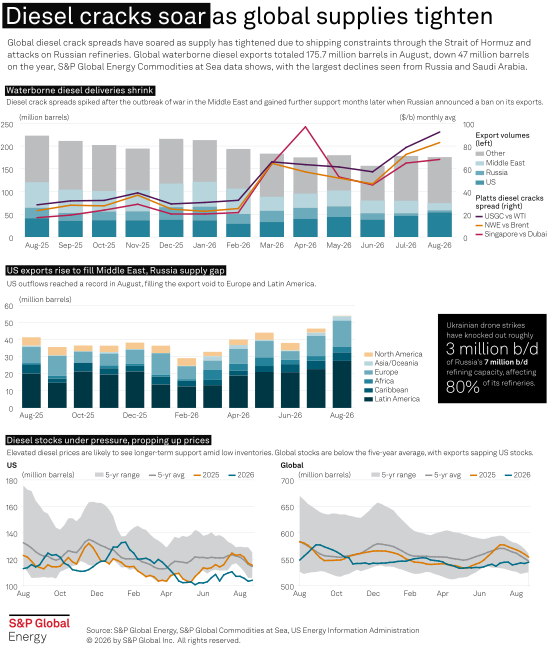
Global supply disruptions have propelled US diesel prices higher, prompting refiners to increase output and boost exports.
US exports of diesel reached a record high of 1.6 million barrels/day in August, with the bulk of those barrels headed to Latin America and Europe, S&P Global Commodities at Sea data shows.
US Gulf Coast ULSD export prices were last assessed by Platts, part of S&P Global Energy, at $4.4536/gal on Sept. 21, down from a record high $4.7833/gal on Sept. 16.
Political pressure
The acknowledgment followed nearly a week of calls for restrictions by members of Trump's own party. On Sept. 17, Tennessee Republican Congressman Tim Burchett filed two bills — H.R. 10423, which would impose an outright ban on diesel exports until January 2027, and H.R. 10422, which would trigger export controls if the national average diesel price hits $5 per gallon — arguing that redirecting domestically refined barrels away from export markets would ease prices at home.
Iowa Republican Senator Chuck Grassley amplified the push on Sept. 19, writing on the social platform X, that President Trump should "put an embargo on diesel exports like presidents in the 70s put embargoes on agriculture products," saying high diesel prices, "ARE KILLING FARMERS INCOME."
On Sept. 22, Michigan Republican Mike Rogers, a candidate in that state's 2026 Senate race, said in a social media video the US's war with Iran needed to "end quickly" and that Trump should restrict diesel exports in the meantime. "American energy should provide relief to American families first," Rogers said.
Other members of Trump's administration -- including US Energy Secretary Chris Wright and US Interior Secretary Doug Burgum -- have argued against banning diesel exports throughout 2026. On Sept. 19, Burgum told reporters at a G20 energy summit in Houston the administration "would consider an export ban if we thought that actually might lower prices, but that's not the case."
Industry impact
A proposal to ban US diesel exports — floated by senior US senators in recent days — could force American refiners to slash crude runs by nearly 2 million barrels/day and ultimately drive up gasoline prices, according to new analysis from S&P Global Energy CERA published on Sept. 22.
The analysis, authored by CERA analysts William O'Neil, Brian Stetter and Debnil Chowdhury, concluded that a complete export ban would be "highly disruptive" to fuel markets across the Atlantic Basin, triggering a domestic diesel glut that would push US refining margins down to levels last seen during the early stages of the COVID-19 pandemic — while simultaneously causing global diesel prices to spike.
The US is the world's largest diesel exporter, running a surplus of roughly 1.4 million b/d, the analysts said. Exports have surged to 1.5 million b/d year to date in 2026, up 275,000 b/d from the same period in 2025, partly backfilling lost supply from the Middle East and Russia. US diesel exports generated roughly $25 billion in revenue over the 90-day period from June 13 to Sept. 11, according to the analysts.
Under a complete ban modeled for October to December 2026, the analysts estimate that US refiners would need to absorb or eliminate forecast exports of 1.48 million b/d.
With commercially usable storage capacity likely to become rapidly constrained — particularly on the Gulf Coast where export-oriented refining is concentrated — the report concludes that refiners would be more likely to resort to crude run cuts than prolonged stock building.
Eliminating the remaining surplus would require run reductions of approximately 1.9 million b/d, or about 12% of total US refinery throughput — a scale not seen since the COVID-19 pandemic, when runs collapsed from 16.4 million b/d in the first quarter of 2020 to 13.7 million b/d in the second quarter.
"Such a rapid and prolonged reduction to refinery runs has only happened once in the modern era," the analysts said.
A run cut of that magnitude would have significant knock-on effects for other fuels, the analysis found. US gasoline production could fall by as much as 750,000 b/d, flipping the US from a net exporter to a net importer of gasoline in the fourth quarter of 2026. The international consequences of a full ban would also be severe, the analysts said, sharply raising prices in Europe and Latin America.
"Absent the return of refining capacity in the Persian Gulf or Russia, the consequences for the global diesel market would be severe," the analysts said.
The American Fuel & Petrochemical Manufacturers, the US's largest trade group representing refiners, pushed back sharply against the export ban proposals in a Sept. 21 blog post, arguing the intervention would reduce domestic fuel production rather than increase supply available to US consumers.
"Export bans do not create more fuel for Americans," AFPM said. "They reduce US fuel production, put upward pressure on prices, weaken energy security and hand market share to foreign competitors."
