Agriculture, Refined Products, Crude Oil, Energy Transition, Biofuels, Diesel-Gasoil, Fuel Oil, Vegetable Oils, Gasoline, Carbon
September 21, 2026
Global diesel disruptions ripple through US refining, biofuel markets
By Ana Hernandez and Carlos Castillo
Editor:
HIGHLIGHTS
US refiners maximize diesel production output
BO-HO spread plunges to seven-year low level
D4 RIN credits fall 16% amid price pressure
Global supply disruptions have propelled US diesel prices higher, prompting refiners to increase output while reshaping the economics of biodiesel, renewable diesel and D4 RIN credits.
Since the US-Iran conflict began in late February, reduced global oil supplies have driven the benchmark US Gulf Coast ultra-low sulfur diesel price up by more than $2.10/gal, or 77%. The benchmark set four record highs in September alone, including an all-time high of $5.18/gal on Sept. 15. Platts, part of S&P Global Energy, most recently assessed US Gulf Coast ULSD at $4.912/gal on Sept. 18.
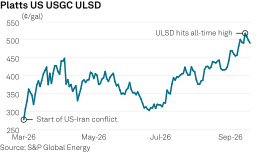
The latest price surge followed Russia's decision to extend restrictions on diesel exports through the end of October after Ukrainian strikes disrupted the country's refineries. The measures intend to stabilize Russia's domestic fuel market by restricting diesel, marine fuel and gasoil.
Those disruptions have increased demand for US barrels and created profitable export arbitrage opportunities. At the same time, low domestic inventories have added upward pressure to prices. Energy Information Administration data released Sept. 16 showed US ULSD inventories at 97 million barrels, well below the five-year average of 113 million barrels.
US refiners have responded by maximizing diesel output. Domestic production rose to 5.036 million b/d, compared with a five-year average of 4.615 million b/d for the same period, EIA data showed.
Much of that additional supply is being pulled into the export market. S&P Global Commodities at Sea data showed September US ULSD exports have averaged 1.635 million b/d, putting exports on course to surpass August's record.
The combination of strong overseas demand and constrained supplies has made diesel the most profitable major refined product for US refiners. Platts assessed the US Gulf Coast ULSD crack spread against West Texas Intermediate crude at $103.19/b on Sept. 18, up 224% from a year earlier.
Lower BO-HO pressures D4 RINs
The surge in petroleum diesel prices has also reshaped the economics of producing and blending biodiesel and renewable diesel. That shift is reflected in the BO-HO spread between CBOT soybean oil and NYMEX ULSD, which has fallen to its lowest level in seven years.
The BO-HO is used by the biodiesel industry to gauge production costs and margins. A lower BO-HO spread encourages biodiesel producers to maximize production. Conversely, as the BO-HO increases, the cost to produce biodiesel rises, leading to a decline in overall blending economics and unfavorable margins.
The BO-HO spread has plunged by more than 72 cents/gal, or 110%, since the start of September. Platts assessed the spread at minus 6.83 cents/gal on Sept. 18, its lowest level since May 2019.
The decline primarily reflected the sharp increase in diesel values. Over the same period, US Gulf Coast ULSD rose by more than 21 cents/gal, or 4.56%, after reaching an all-time high of $5.18/gal on Sept. 15.
The industry entered September with biomass-based diesel production already elevated. The latest EIA data showed biodiesel production had increased 42% since the start of the year to 129 million gallons in May. Renewable diesel production rose by more than 62% over the same period to 318 million gallons.
Both fuels generate D4 Renewable Identification Number credits under the Environmental Protection Agency's Renewable Fuel Standard. Obligated parties, including gasoline and diesel producers and importers, use RINs to demonstrate compliance with renewable fuel blending requirements.
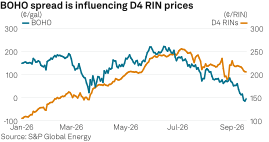
As the lower BO-HO spread strengthened incentives to produce biomass-based diesel and generate associated credits, D4 RIN prices came under pressure. D4 RINs fell 36.75 cents, or 16%, between Sept. 1 and Sept. 18, when Platts assessed them at $1.9275/RIN, down 13 cents from the previous day.
EPA data released on Sept. 17 showed a drop in August RIN generation, with D4 RIN output falling to a five-month low. Despite this, D4 RIN prices did not move higher, as market participants attributed the lack of upside to the low BO-HO spread, which continues to incentivize current RIN production, keeping prices low.
